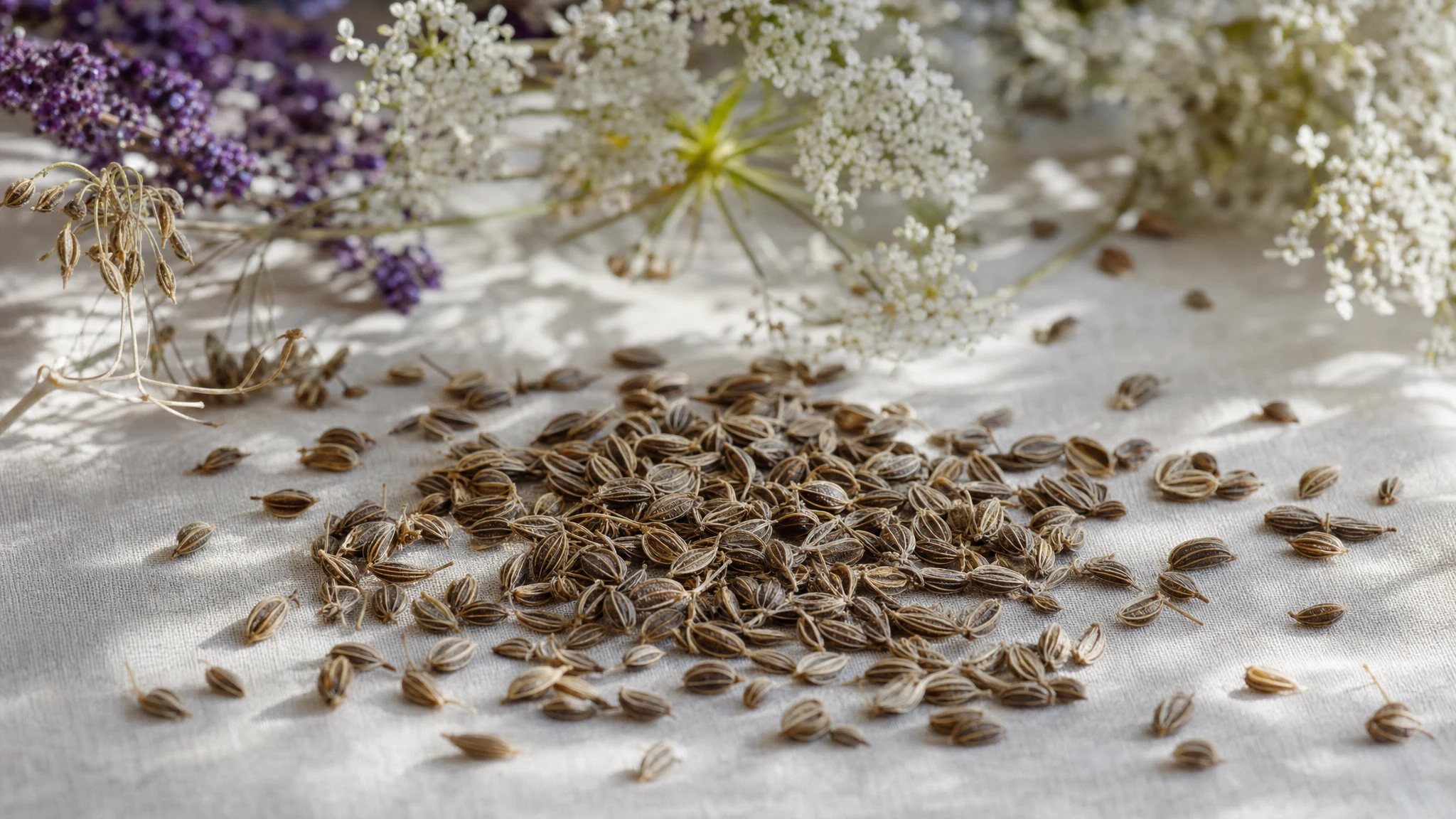
Anise and Menstrual Cramps: What the Studies Show
The published research on anise and period cramps is small. We found two randomized trials, both in Iranian university students, and both tested a swallowed capsule that combined anise with saffron and celery seed extracts, not anise alone and not essential oil aromatherapy. Neither study tells you what anise oil does on skin or in the air.
Anise Essential Oil
Our own Anise Essential Oil, in sizes from 0.5 oz to bulk.
From $7.99
Shop Now →This page reports what those studies did, what they could not show, and who to talk to. It is not advice to use anything for menstrual pain. For the plant itself, see our overview of what the research on anise does and does not show, and for skin-contact rules see our safety basics page.
First, What Kind of Pain Are We Talking About?
Clinicians separate period pain into two groups. Primary dysmenorrhea is cramping with no underlying pelvic disease, usually starting in the teens or early twenties. Secondary dysmenorrhea is pain caused by a condition such as endometriosis or uterine fibroids. The trials below enrolled students described as having primary dysmenorrhea, a label that depends on the study team having screened out other causes.
That distinction matters for how you read any herbal study. A product that shifts a pain score in healthy students with primary dysmenorrhea says nothing about pain that has a structural cause. The U.S. Office on Women's Health advises talking to a doctor or nurse if over-the-counter pain medicine such as ibuprofen or naproxen does not help, or if the pain interferes with daily activities like work or school (Office on Women's Health, Period problems).
The Trials We Could Verify
We searched for randomized trials of anise preparations in dysmenorrhea and opened each paper or its indexed record before describing it. Two trials met that bar. Both used a combination product, so the effect of anise cannot be separated from the saffron and celery seed in the same capsule.
| Feature | Isfahan trial (2009) | Menstrugole trial (2018) |
|---|---|---|
| Citation | Nahid K, Fariborz M, Ataolah G, Solokian S. J Midwifery Womens Health 2009;54(5):401-404 | Shobeiri F, Nazari S, Nazari S, Jenabi E, Shayan A. Obstet Gynecol Sci 2018 |
| Design | Randomized, double-blind, placebo-controlled pilot trial with three arms: herbal capsule, mefenamic acid, placebo | Randomized, placebo-controlled trial, two arms, block randomization |
| Participants | 180 female students aged 18 to 27, one university dormitory | 79 analyzed (39 herbal, 40 placebo), female students, one university in western Iran |
| Preparation | 500 mg of purified saffron, celery seed and anise extracts per dose | Capsules of dried celery, anise and saffron extracts versus a starch placebo |
| Dosing | Three times a day for three days from the start of bleeding or pain | Three times daily on days one to three of menstruation, for two cycles |
| Outcome | Pain severity and pain duration on a visual analog scale, at 2 and 3 months | Pain severity on a 0 to 10 visual analog scale |
| Reported result | Pain scores and duration fell more in the herbal group than in the mefenamic acid or placebo groups | Mean score in the herbal group fell from 7.28 to 1.92 (cycle 1) and 1.22 (cycle 2); placebo group stayed near 7.5 |
| Authors' own caution | "More clinical trials are needed to establish the efficacy of this herbal drug" | Small sample, narrow student group, only two cycles |
Sources: the Isfahan trial record on PubMed and the full text of the Menstrugole trial on PubMed Central.
Reading These Numbers Carefully
Three details should slow down anyone tempted to treat these results as settled.
The capsule is a mixture
Each product contained saffron and celery seed extracts alongside anise. If a capsule works, nobody can say which ingredient, or which combination, is responsible. A review of Iranian herbal trials describes the saffron, celery and anise product (sold under the name Menstrugol) as covered by two trials in its evidence base, and it does not study the three ingredients separately (Mirabi et al., Iran J Pharm Res 2014).
The paper itself contains inconsistencies
In the 2018 trial text we opened, the Introduction gives the extract amount as about 80 mg per capsule while the Methods state 500 mg, and the abstract gives P < 0.001 for the second cycle where the results table gives P = 0.001. These are small editorial slips, but they are the kind of detail that makes a careful reader want an independent replication before leaning on a result.
The groups were narrow and the follow-up short
Both samples were young women at a single institution, and the longer trial followed participants for two cycles. Neither tells us about women over thirty, women with irregular cycles, or what happens across a year of use. The authors of the 2018 trial list the small sample, the student-only population and the two-cycle length as limitations.
The Broader Review Literature
A 2014 systematic review in the Iranian Journal of Pharmaceutical Research pooled 25 randomized trials of herbal products for primary dysmenorrhea. Its authors described the herbal results as promising but also reported that most trials did not describe randomization, blinding or follow-up adequately, that none of the included studies reported negative results (a sign of possible publication bias), and that evidence for any single herb is preliminary. They called for more rigorous placebo-controlled trials (Mirabi et al. 2014).
We did not find a completed systematic review that isolates anise for dysmenorrhea. Searches turned up a 2024 review protocol covering several plants in the carrot family, which is a plan for future work rather than a result, and we did not open it, so we do not summarize it.
Our evidence-strength statement, plainly: low. Two small trials of one mixed product, from one country, with acknowledged methodological limits, cannot support the claim that anise reduces menstrual pain.
These Were Swallowed Extracts, Not Aromatherapy
Every preparation above was an oral capsule of plant extract, taken on a dosing schedule under study supervision. Anise essential oil is a different material: a steam-distilled concentrate that is roughly 80 to 90 percent trans-anethole, as we explain in our chemistry guide. Nothing in these trials tests that concentrate, whether on skin, in a diffuser, or by mouth.
That gap is the reason we will not suggest an essential oil as a substitute for what the studies examined. Swallowing an essential oil is outside the scope of this shop's cosmetic and aromatic use, and a capsule of standardized extract is not interchangeable with it.
Why Hormone-Sensitive Readers Should Pause
Anise-containing products have been studied for conditions tied to the menstrual cycle and menopause. One example is a 72-woman randomized trial of anise capsules for menopausal hot flashes (Zare et al., Shiraz E-Medical Journal, 2022), which reported fewer hot flashes in the anise group over 8 weeks, with symptoms rising again after the capsules stopped (trial record). We read that as a reason for caution, not reassurance. The sources we opened do not establish a mechanism, but a plant that appears in research on both menstrual pain and menopausal symptoms is one that anyone with a hormone-sensitive condition, or anyone taking hormonal medication, should ask a clinician about first.
Our page on anise oil, hormones and medications covers who should check before using anise in any form. Pregnant or breastfeeding readers should read our pregnancy and breastfeeding page, because menstrual-cycle research is not a guide to safety in pregnancy.
See an OB-GYN: When Period Pain Is Not a DIY Question
Make an appointment with an OB-GYN, or a primary care clinician who can refer you, if any of these apply:
- Over-the-counter pain medicine is not helping, or the pain keeps you from work or school.
- The pain began recently after years of easier periods, or it is getting steadily worse.
- You have pain outside your period, pain during sex, or bleeding between periods.
- Bleeding is heavy enough that you soak through a pad or tampon every hour.
- You have fever, fainting or sudden severe pelvic pain. Seek urgent care for that.
- You might be pregnant, or you take hormonal birth control or any prescription medicine.
Pain that is new, severe or changing can have causes, such as endometriosis or fibroids, that need a clinician's evaluation and cannot be sorted out by trying a plant product. The Office on Women's Health page cited above names pain at times other than just before or during your period as one reason to see a doctor.
What We Recommend Instead of Guessing
If you are curious about herbal products and period pain, take the specific product label, the capsule strength and a list of your medicines to a pharmacist or clinician and ask three questions: what is in it, does it interact with anything I take, and does my pain pattern call for an exam first. A pharmacist can check interactions in minutes. For our own part, the only anise product we sell is an aromatic oil, and we are not offering it for any health purpose. If you want to browse it for scenting projects, it is in the shop, and the safety basics page sets out dilution and patch-testing rules for skin contact.
Frequently Asked Questions
Has anise alone been tested for period cramps?
We could not verify a randomized trial of anise alone for dysmenorrhea. The two trials we opened used a three-extract capsule.
Does the research apply to anise essential oil?
No. The studies used swallowed plant-extract capsules. Essential oil is a concentrated distillate with different chemistry and different safety limits, and no study we found tested it for menstrual pain.
Who should I talk to before trying any herbal product for cramps?
Start with a pharmacist for interactions and with an OB-GYN or primary care clinician for pain that is severe, new or worsening. Pregnant women, people on hormonal medication, and anyone with a hormone-sensitive condition should ask before using anise in any form.
Is it safe to rely on a small study?
A small study can point to a question worth testing, but it cannot establish safety or benefit. The 2009 trial's authors, the 2018 trial's authors and the 2014 review all call for larger, better-controlled trials.
What is the difference between primary and secondary dysmenorrhea?
Primary means cramping without an identified pelvic disease. Secondary means pain from a cause such as endometriosis or fibroids. Telling them apart takes a clinician's history and sometimes an exam or ultrasound.
Where can I read the trials myself?
Both are linked above: the 2009 Isfahan trial on PubMed and the 2018 Menstrugole trial on PubMed Central. Reading the methods section is the fastest way to see what was actually tested.
Anise Essential Oil
Anise Essential Oil from our own shop, in sizes from 0.5 oz to bulk.
From $7.99
Shop Now →Sources & Further Reading
- Nahid K, Fariborz M, Ataolah G, Solokian S. The effect of an Iranian herbal drug on primary dysmenorrhea: a clinical controlled trial. J Midwifery Womens Health. 2009;54(5):401-404 (PubMed record)
- Shobeiri F, Nazari S, Nazari S, Jenabi E, Shayan A. Effect of Menstrugole on primary dysmenorrhea: a randomized clinical trial. Obstet Gynecol Sci. 2018 (PubMed Central)
- Mirabi P, Alamolhoda SH, Esmaeilzadeh S, Mojab F. Effect of herbs on primary dysmenorrhoea: a systematic review (title abridged). Iran J Pharm Res. 2014;13(3):757-767
- Zare E, Nahidi F, Mojab F, Alavi Majd H. The effect of Pimpinella anisum on menopausal hot flashes and their recurrence: a randomized, double-blind, multicenter clinical trial (title abridged). Shiraz E-Med J. 2022 (Brieflands record)
- Office on Women's Health: Period problems
- Anise oil safety basics: dilution, patch testing and pets