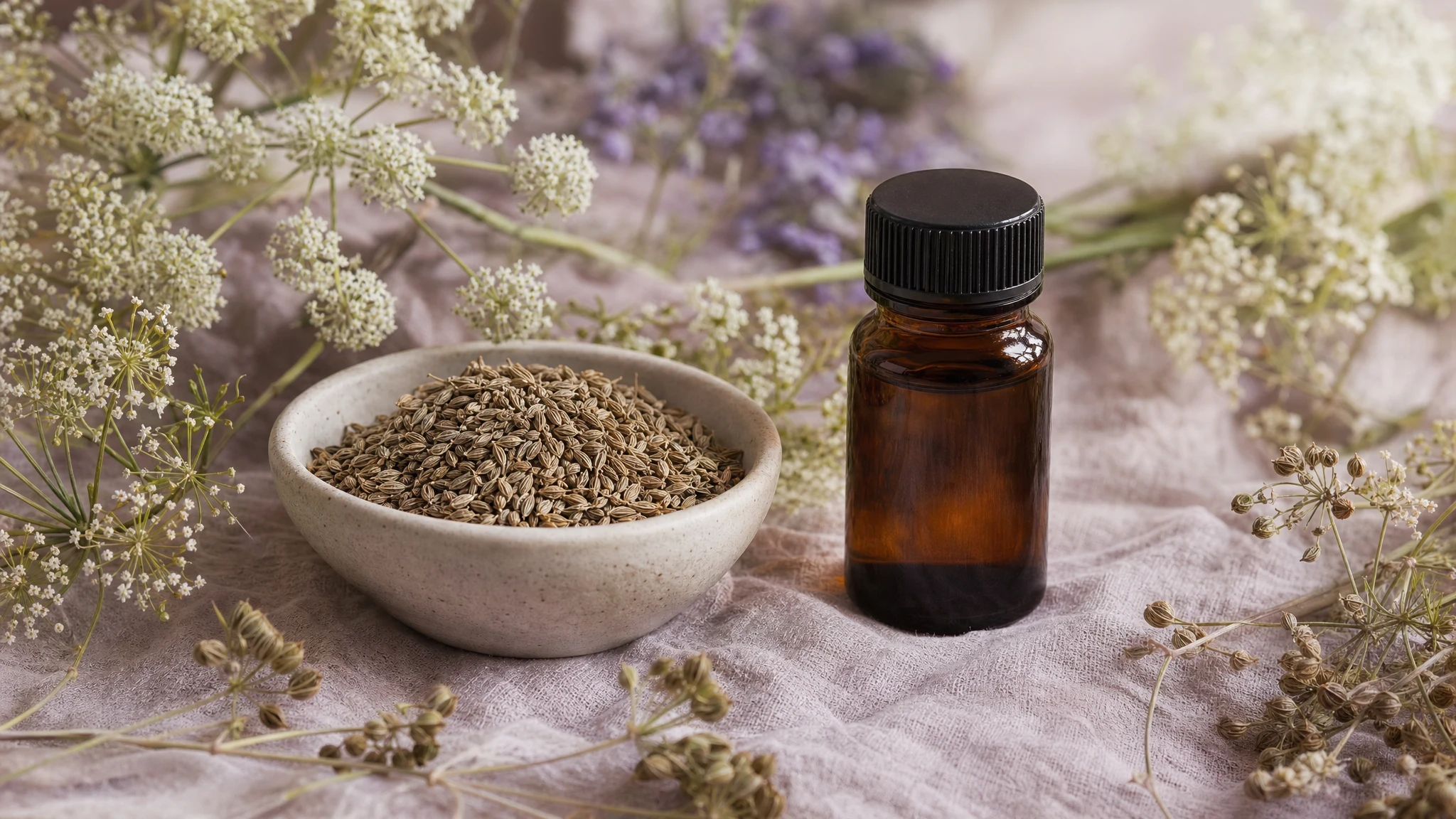
Anise Oil During Pregnancy and Breastfeeding: What to Know
Avoid anise essential oil while pregnant or breastfeeding unless your OB-GYN, midwife or pharmacist has specifically cleared it for you. Concentrated oil is a different exposure from anise as a seasoning, and the human safety data for the oil are thin. European regulators and this shop both advise against it.
Anise Essential Oil
Our own Anise Essential Oil, in sizes from 0.5 oz to bulk.
From $7.99
Shop Now →Why "the spice is fine" does not carry over to the oil
The most common reasoning goes like this: anise is in licorice candy, biscotti and after-dinner liqueurs, so a few drops of the oil must be harmless. That argument skips a step. Steam distillation concentrates the seed's volatile fraction. The European Medicines Agency (EMA) describes anise oil as containing mainly trans-anethole, at 80 to 95 percent, with smaller amounts of estragole, cis-anethole and p-anisaldehyde (EMA/HMPC/321181/2012, 2013). The oil is the plant's most potent fraction, and the safety questions that regulators raise are about those specific compounds, not about aniseed as a food.
Our position is simple. In pregnancy and while breastfeeding, the cautious default for the concentrated oil is avoidance unless a clinician who knows your history says otherwise. That is also what our How We Test page says: avoid it in pregnancy and while breastfeeding. This article lays out the evidence behind that default, including the places where the evidence is weak, so that you can have a better conversation with your provider. It is not medical advice, and it cannot replace that conversation. For the broader handling rules, see our anise oil safety basics.
What the regulators actually wrote
The EMA's herbal committee (HMPC) assessed aniseed and anise oil in 2013 as traditional herbal products for adults. Its conclusions on pregnancy and lactation are unusually direct, and they are worth reading in the original wording rather than through a summary.
| Source | What it says | What it does not tell you |
|---|---|---|
| EMA assessment report, 2013 | "There are no clinical studies available." Because of estrogenic, antifertility and fetal cell toxicity effects shown for trans-anethole in rats, "as a precautionary measure, anise oil and aniseed extracts should not be used during pregnancy and lactation." | Whether any human has been harmed. The report relies on animal and laboratory data. |
| EMA oil monograph, 2013 | "Safety during pregnancy and lactation has not been established. In the absence of sufficient data, the use during pregnancy and lactation is not recommended." It adds that no fertility data are available (monograph EMA/HMPC/321185/2012). | A measured risk. "Not established" means unstudied, which is different from "shown to be harmful." |
| EMA public statement on estragole (draft revision, 2014) | Exposure to estragole for "sensitive groups such as young children, pregnant and breastfeeding women should be minimised." It also notes that data on absorption of estragole through the skin are missing (EMA/HMPC/137212/2005 Rev 1). | How much estragole reaches the body from diffusing or skin contact. That is the missing piece. |
The same statement concludes that short-term adult use of herbal products at the recommended dose "does not pose a significant cancer risk." The committee's pregnancy caution is therefore a precaution aimed at groups it could not study, not an alarm about adults in general.
The animal data, and why they cannot be converted into advice
The EMA report summarizes a rat study of trans-anethole (Dhar, 1995, as reported by EMA). Given by mouth to adult female rats on days 1 to 10 of pregnancy, trans-anethole at 50, 70 and 80 mg per kg of body weight inhibited implantation by 33, 66 and 100 percent respectively. At 80 mg per kg, rats dosed on days 6 to 10 had three of five fail to deliver at term, which the report interpreted as a sign of early abortifacient activity. No gross malformations were seen in the offspring.
Two things are true at once. First, these findings are the reason the precaution exists. Second, the same EMA report states that animal and in vitro data on estrogenic and antifertility activity "at high concentrations" are not considered relevant to human exposure at the recommended dose for short-term adult use. Both statements come from the same document, and neither should be quoted without the other. Rats given a measured oral dose tell us little about a person smelling a diffuser or wearing a diluted blend. They also do not tell us it is safe.
The related estrogen question, covering what anethole does in laboratory assays, has its own article: Anise Oil, Hormones and Medications.
Breastfeeding: what the lactation database says
The U.S. National Library of Medicine maintains LactMed, a database of drugs and substances and their effects on nursing infants. It has an entry for anise (Pimpinella anisum), revised in 2026 (LactMed: Anise, PMID 30000835). Its main points, as written there:
- Anise is a "purported galactogogue," meaning something promoted to increase milk supply, and appears in some proprietary mixtures, but "few scientifically valid clinical trials support this use." A meta-analysis it cites found a small increase in milk volume on day 1 postpartum compared with no intervention, and low-certainty evidence for anise tea on day 7. This article reports those findings and does not recommend using anise for that purpose.
- Maternal anise intake "reportedly imparts an odor to breastmilk," possibly because anethole is excreted into breastmilk. (The EMA's 2013 report said it was unknown whether the constituents pass into milk, so the two sources differ in date and in how much they could say.)
- Anise is classed by the U.S. FDA as "generally recognized as safe" as a flavoring. That is a status for food flavoring amounts, not for concentrated oil used on or near an infant.
- Two cases are noted: elevated liver enzymes in a woman taking a product called Mother's Milk Tea, which contains anise, and toxicity in two breastfed newborns after "excessive maternal use" of an herbal tea containing anise and other herbs, "consistent with toxicity caused by anethole."
Those cases involved teas with several ingredients, so they cannot isolate anise, and they do not involve diffused or topical essential oil. They do show that anethole is a substance a nursing infant can be exposed to through the mother, and that "natural" and "traditional" did not prevent harm in the reported cases. LactMed also stresses that galactogogues should never replace evaluation of the modifiable factors that affect milk production, which is a lactation consultant's field.
Seasoning, tea and concentrated oil are not the same exposure
People ask whether the cookie, the tea and the oil blur together. They do not, though the evidence for each is different in kind. This table sorts what is known by exposure type.
| Exposure | What the sources address | Where the gap is |
|---|---|---|
| Aniseed or anise flavoring in food | FDA status as a flavoring (LactMed). No pregnancy-specific trial found in the sources reviewed. | Amount per serving varies; no study ties culinary amounts to pregnancy outcomes. |
| Anise tea or herbal products with anise | EMA advises against aniseed preparations in pregnancy and lactation. LactMed records case reports with multi-herb teas. | Products vary and may be mixtures; labeled and actual contents can differ, as LactMed warns. |
| Concentrated essential oil, swallowed | EMA reports that 1 to 5 ml of anise oil was linked to nausea, vomiting, seizures and pulmonary edema. | No pregnancy data. Not a consumer-use scenario. |
| Diffused oil, inhaled | None of the sources reviewed here includes a study of diffused anise oil in pregnancy or lactation. | Exposure level is unknown. Absence of studies is not evidence of safety. |
| Diluted oil on skin | EMA notes that skin absorption data for estragole are missing. | Unknown absorption, unknown effect during pregnancy. |
The honest reading is that the further you move toward concentration and toward less-studied routes, the less anyone can say. That is why the shop's advice is avoidance rather than a dilution number. If you are curious what can safely be said about eating the oil itself, see Can You Eat Anise Essential Oil?
Decision box: talk to your provider
Before using anise oil in any form while pregnant, trying to conceive, or nursing, ask a professional who knows your history.
- OB-GYN or midwife: for anything touching pregnancy, labor or fertility, including a question about "just diffusing it."
- Pharmacist: for how an aromatic product fits with prescriptions, supplements or teas you already take.
- Lactation consultant (IBCLC) or pediatrician: for questions about a nursing infant, including milk odor or feeding changes.
- Poison Control, 1-800-222-1222: free, confidential, 24 hours, if anyone swallowed oil or a product containing it (poison.org).
Bring the product name, the species on the label, and how you were using it.
If you already used it
A brief aromatic exposure does not, on the evidence above, show harm. It also does not show safety, and nobody can promise either. A reasonable step is to stop using it and mention it at your next appointment, or call earlier if you have symptoms or used a lot. If oil was swallowed or splashed into eyes, call Poison Control straight away rather than waiting for symptoms.
What is not known
- No controlled human study of anise essential oil in pregnancy appears in the EMA assessment, which states that "there are no clinical studies available."
- How much anethole or estragole a person absorbs from diffusing or skin use is not established.
- Whether the rat findings on implantation have any counterpart at human exposures is unknown. EMA itself judged them not relevant at recommended adult doses, while still advising against use in pregnancy.
- Whether the oil's constituents reach breast milk in meaningful amounts is described differently in the EMA report (2013) and in LactMed (2026), and LactMed says "possibly."
Where the evidence is this sparse, we think a clear "avoid unless cleared" is more honest than a precise-sounding limit that nobody has measured. If you are not pregnant or nursing and want product details such as size options, they are on our shop page.
Common questions
Is anise safe while pregnant?
No safety has been established for the concentrated oil, and the EMA recommends against anise oil and aniseed preparations during pregnancy. Whether ordinary food amounts of anise are fine for you is a question for your OB-GYN or midwife, since no study of culinary amounts was found.
Does anise oil breastfeeding use affect milk?
LactMed says anise intake reportedly gives breastmilk an odor and that anethole may pass into milk. It found few valid trials on milk supply and reported toxicity in two newborns after heavy maternal use of an anise-containing herbal tea.
Is it safe to diffuse anise around a pregnant person?
No study in the sources reviewed answers this either way. Our advice is to avoid it in pregnancy and ask your provider first, because inhaled exposure has not been measured.
Can anise oil be used around a nursing baby?
We advise against it. The EMA contraindicates anise oil for anyone under 18 and reports a case of a 12-day-old infant with seizures after receiving multiple doses of undiluted oil. See our guide to children and anise oil.
Is licorice candy the same thing?
No. Anise and licorice root come from different plants, a difference our myths article explains. For any specific candy or tea, check the label and ask your provider, since products vary.
Anise Essential Oil
Anise Essential Oil from our own shop, in sizes from 0.5 oz to bulk.
From $7.99
Shop Now →Sources & Further Reading
- Drugs and Lactation Database (LactMed): Anise. National Library of Medicine, revised 2026
- EMA/HMPC. Assessment report on Pimpinella anisum L., fructus and aetheroleum (EMA/HMPC/321181/2012), 12 November 2013
- EMA/HMPC. Community herbal monograph on Pimpinella anisum L., aetheroleum (EMA/HMPC/321185/2012)
- EMA/HMPC. Public statement on herbal products containing estragole (EMA/HMPC/137212/2005 Rev 1, draft, 2014)
- Albert-Puleo M. Fennel and anise as estrogenic agents. J Ethnopharmacol 1980;2(4):337-44
- Poison Control (poison.org): essential oils