
Is Anise Oil Safe Around Children? A Storage and Use Guide
We advise against using anise oil on children, and our How We Test page says so directly. European regulators contraindicate the oil for anyone under 18, and a 12-day-old infant had seizures after multiple doses of undiluted oil. In a home, the practical risks are swallowing, skin or eye contact, and easy access. Poison Control: 1-800-222-1222.
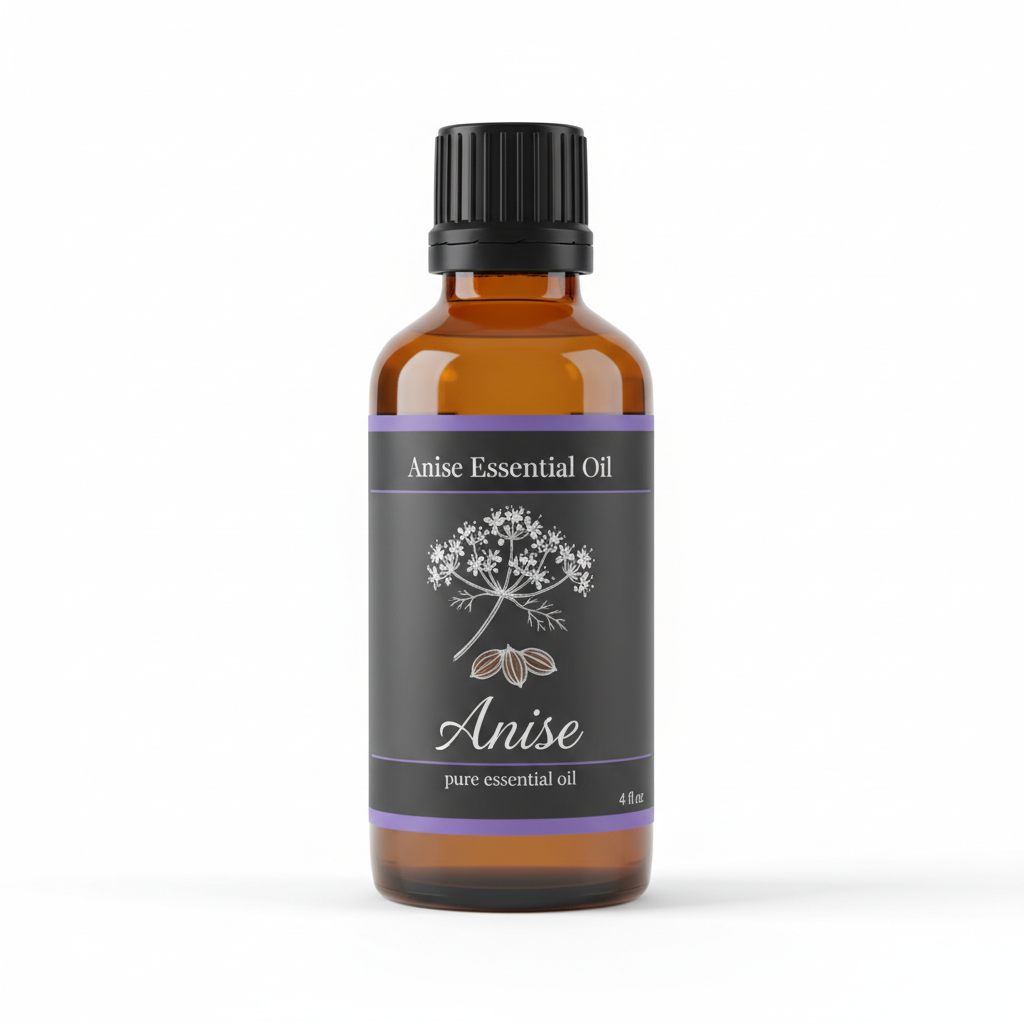
Anise Essential Oil
Our own Anise Essential Oil, in sizes from 0.5 oz to bulk.
From $7.99
Shop Now →The short answer, and what it rests on
There is no age at which we publish a "child dose" for anise oil, and this guide will not give one. Our safety basics page covers dilution for adult skin, and our How We Test page states the shop's position in one line: do not use it on children. That is a policy, and it is a deliberately conservative one. Here is the evidence it leans on.
The European Medicines Agency's herbal committee (HMPC) reviewed anise oil in 2013. Its monograph lists "children and adolescents under 18 years of age" under contraindications, "because of the lack of data and the presence of estragole" (EMA/HMPC/321185/2012). The assessment report adds that "no metabolic data for anethole in children is reported, posing toxicological concern" (EMA/HMPC/321181/2012). For whole aniseed, the same committee advised against use under 12.
Read that carefully. The regulator is not saying it has measured harm at some dose in children. It is saying nobody has the data, and the main constituents are ones it wants minimized in young children. When the people who evaluate a plant for a living decline to set any pediatric use, a seller has no business inventing one.
What has gone wrong, as documented
The EMA report records two items worth knowing. The first, citing a standard reference (Newall et al., 1996), is that "ingestion of 1 to 5 ml of anise oil was associated with nausea, vomiting, seizures and pulmonary oedema." The report does not give the age of those patients, so it should not be read as a child threshold. The second is a case report (Tuckler et al., 2002, as cited by EMA): a 12-day-old infant "who had unintentionally received multiple doses of undiluted anise oil" arrived at a pediatric emergency department with generalized tonic-clonic seizures. Blood counts, electrolytes, spinal fluid analysis, brain CT and EEG were normal, no further seizures occurred after admission, and the infant recovered with no reported sequelae.
That case matters for two reasons. It was a caregiver error with a product, not a deliberate poisoning. And it shows how small the margin can be for the youngest children, even when the outcome in that report was good.
Poison Control adds a general point about essential oils: children have "thin skin and immature livers," which may make them more vulnerable than adults to toxic effects (poison.org). Anise is also in the carrot family, and EMA lists sensitivity to Apiaceae plants such as fennel, caraway, celery, coriander and dill, or to anethole, as a reason to avoid the oil. Rare contact dermatitis from anethole-containing preparations has been reported. These are reasons to keep a child away from it, not a way to predict who will react.
Why this oil is easy for a child to mistake for something else
This part is our reasoning, not a study. Anise oil smells like licorice candy. Anise oil is also used as a baking flavoring, so a bottle can end up in a kitchen near vanilla and almond extracts. A small child cannot tell a baking flavor from candy and does not need to. The practical response is to store the oil where flavorings are not stored, and to keep it in the original labeled bottle. We discuss the culinary side separately in Can You Eat Anise Essential Oil?.
About child-resistant caps: do not assume
People often assume an essential oil bottle must have a child-resistant closure. The federal rules are narrower than that. The Consumer Product Safety Commission's special-packaging list at 16 CFR 1700.14 names specific substances, among them methyl salicylate above 5 percent by weight, aspirin, and, in two entries, nonemulsion liquids containing 10 percent or more hydrocarbons by weight with a viscosity under 100 SUS at 100 F (eCFR). The list does not name essential oils as a class, and it has no entry for anise or anethole. Whether a given oil falls under a general entry depends on its composition and properties, and that is a determination for the packager, not something a shopper can read off a label.
So the sound rule is the one that does not depend on the cap: handle every essential oil bottle in your home as if it could be opened by a child. Check the closure on the bottle in your hand rather than assuming. Even a closure that is hard for a young child to open is a delay, and storage is what actually prevents access.
A storage checklist you can use today
- Put it high and out of sight. Poison Control advises keeping essential oil products where children and pets cannot see or reach them.
- Lock it if you can. A small lockable box on a high shelf beats a high shelf alone, because children climb.
- Keep it in the original bottle. Never move it to an unlabeled jar, a water bottle, a spray bottle or a food container.
- Keep it away from flavorings and food. Do not shelve it with extracts, candy ingredients or tea.
- Close it fully after every use and wipe the bottle neck. Spilled oil on a counter is a skin and mouth hazard.
- Keep diffusers out of reach. Poison Control notes that reed diffuser liquid is essential oil in isopropyl alcohol and must be kept from children. A plug-in unit low on a wall is within reach.
- Do not leave it in bags. Purses, gym bags and diaper bags go to the floor and get opened. Guests' bags do too.
- Retire old bottles. Poison Control suggests considering safe disposal of old bottles if you have young children. Oxidized oil is also a quality issue; see how anise oil ages.
- Save the number. Put 1-800-222-1222 in every adult's phone and on the fridge.
- Tell every adult in the house. A grandparent who does not know the rule can undo the storage plan in a minute.
Diffusing around kids
The sources reviewed include no study of diffused anise oil and young children, and the EMA monograph's contraindication was written for oral products, not diffusers. That leaves a gap, and our response is to fill it with caution: we advise against diffusing anise where infants and young children spend time, and to ask a pediatrician before using it around any child. If you do diffuse in an adult-only space, keep the device and the bottle out of reach. Pregnant or nursing household members have their own cautions, covered in the pregnancy and breastfeeding article.
What to do after contact
These steps combine Poison Control's guidance with first-aid guidance from the Tisserand Institute. They are general. Poison Control will tailor advice to the child's age, weight and the amount involved, so call them first for any swallowing.
| Situation | What the sources advise |
|---|---|
| Swallowed, even a small amount | Call Poison Control at 1-800-222-1222 immediately, or use their online tool. If the child is conscious and not convulsing, rinse the mouth with water. Do not try to make the child vomit. The Tisserand Institute gives the reason: vomiting risks pulling the oil into the lungs. |
| Child is convulsing, unresponsive or struggling to breathe | Call 911. Give nothing by mouth. Keep the airway open and place the child on their side. |
| On skin | Remove contaminated clothing. Wash with soap and water for at least 10 minutes. Do not apply more oil. Poison Control says that any allergic reaction involving difficulty breathing is an emergency. Seek medical advice if irritation persists. |
| In the eye | Flush with plenty of water for 15 to 30 minutes, removing contact lenses after the first 5 minutes, and keep the eyelids apart. Seek medical advice if irritation persists. |
Keep the bottle with you when you call, so you can read the name and species and tell them how much is missing.
Who to ask
Decision box
- Poison Control (1-800-222-1222): for any exposure, any time, free and confidential.
- Pediatrician: before any use around infants or children, and for any reaction afterward.
- Pharmacist: for questions about how an aromatic product interacts with a child's medicines.
What is not known
No published dosing, safe exposure level or diffusing study for anise oil in children turned up in the sources reviewed here, and the EMA reports no data in this age group. The infant case is a single report. The 1 to 5 ml figure is from a secondary reference with no ages given. Those gaps are exactly why we advise avoidance rather than setting a number.
Common questions
Is anise oil safe for toddlers?
We advise against it. The EMA contraindicates anise oil under 18 because of missing data and estragole, and no safe toddler exposure level has been published. Ask a pediatrician before any use around a toddler.
Can I diffuse anise around kids?
No study of it turned up in the sources reviewed, so we advise against diffusing anise where children spend time. If anyone in the household has asthma or allergies, ask a pediatrician or physician first.
What if my child only smelled the bottle?
A brief sniff without swallowing or skin contact is a different event from a swallow. If the child coughs, seems unwell, or any oil got into the mouth, call Poison Control for advice rather than waiting.
Do I need a child-resistant cap?
Check what you have rather than assuming, and rely on high, locked storage either way. The federal special-packaging list does not name essential oils as a class.
Anise Essential Oil
Anise Essential Oil from our own shop, in sizes from 0.5 oz to bulk.
From $7.99
Shop Now →Sources & Further Reading
- EMA/HMPC. Community herbal monograph on Pimpinella anisum L., aetheroleum (EMA/HMPC/321185/2012)
- EMA/HMPC. Assessment report on Pimpinella anisum L., fructus and aetheroleum (EMA/HMPC/321181/2012)
- Poison Control (poison.org): essential oils
- Tisserand Institute: what to do when experiencing an adverse reaction
- 16 CFR 1700.14, Substances requiring special packaging (eCFR)