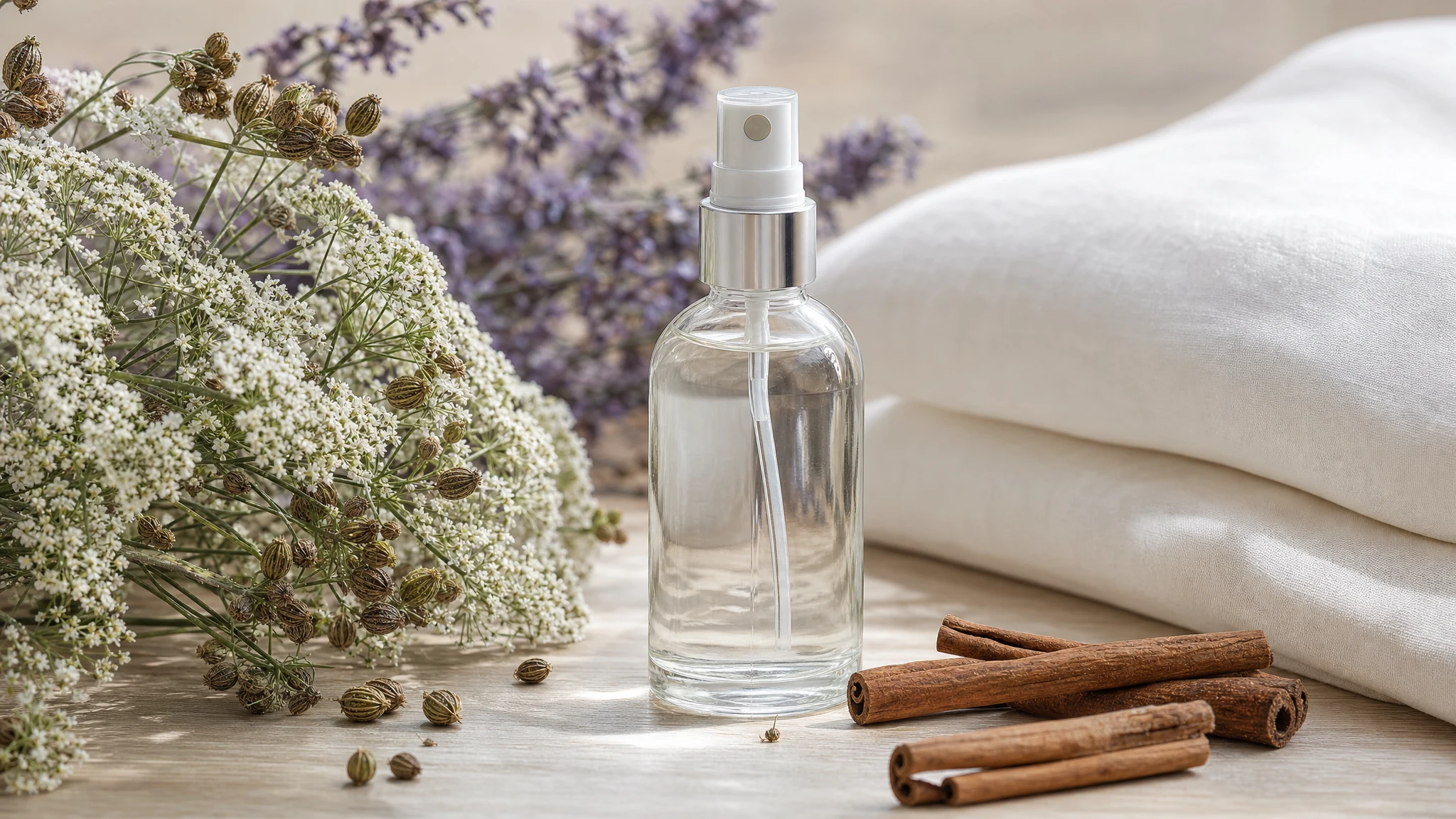
DIY Anise Room and Linen Spray Recipe
Essential oil will not mix into water, so dissolve it in polysorbate 20 first, then add distilled water and a preservative. With our anise oil, safety limits for estragole cap a fabric or room spray at roughly 0.02 to 0.05 percent oil, far lighter than the 3 percent in typical recipes. Test fabric first; keep it from cats and infants.
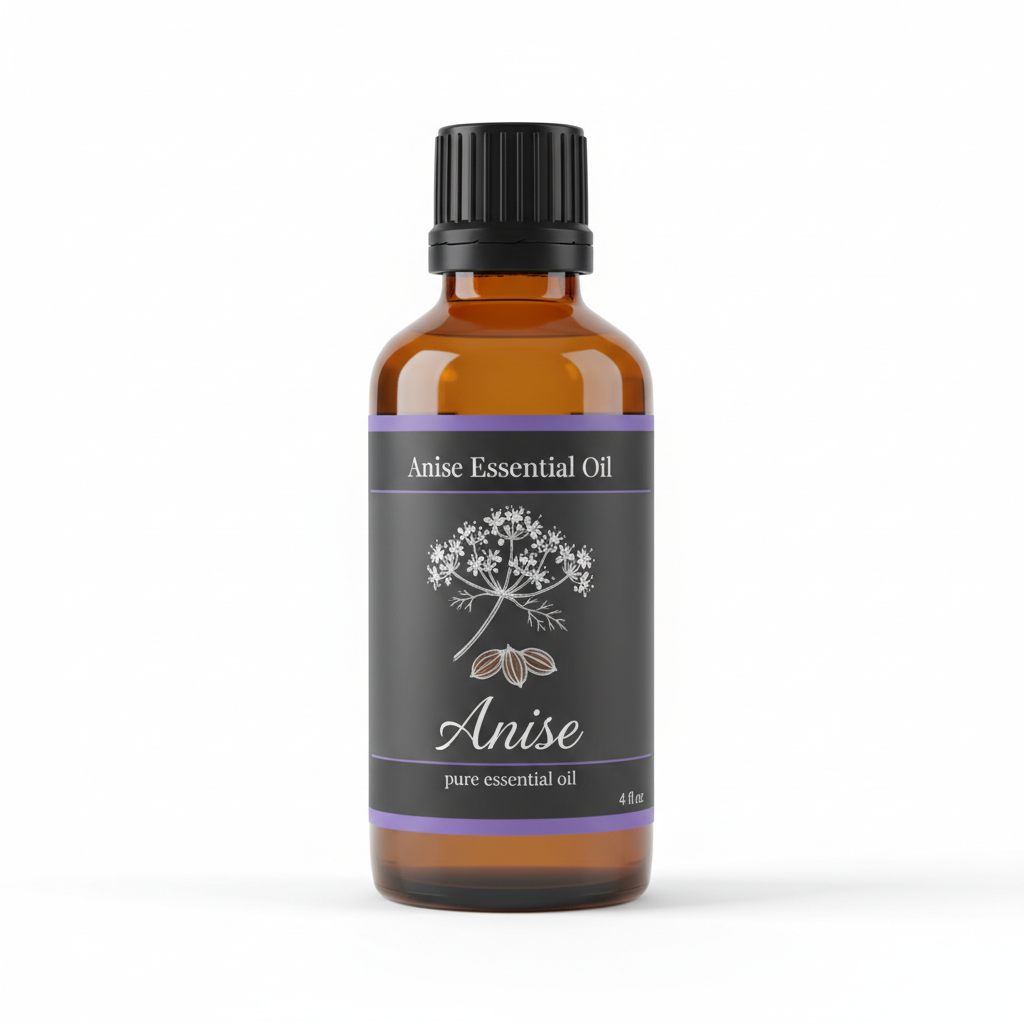
Anise Essential Oil
Our own Anise Essential Oil, in sizes from 0.5 oz to bulk.
From $7.99
Shop Now →Most room spray recipes you will find for this keyword were written for generic oils and give a round number like 3 percent. Anise is not a generic oil. It is almost entirely anethole, with a measurable share of estragole, and that constituent is what sets the dose. This page builds the recipe backward from the safety ceiling, then adds the solubilizer, the preservative and the pet cautions. For the baseline on dilution and patch testing, read our anise oil safety basics, and for diffuser blends see holiday room scenting with anise.
Step 1: Why oil and water separate, and what a solubilizer does
Essential oil floats on water because the two do not mix. Shaking only makes temporary droplets, which then spray out as oil spots. A solubilizer is a surfactant that wraps oil droplets so they stay dispersed. Polysorbate 20 is the common hobby choice for room sprays, and suppliers describe it as the solubilizer that stops a spray from separating. A cosmetic supplier, Aromantic, adds that it makes the spray slightly hazy and that some blends look milky.
Published ratios of polysorbate 20 to oil disagree, so treat them as starting points to test:
| Source | What it says about polysorbate 20 |
|---|---|
| PureNature NZ (supplier) | Minimum recommended usage is 1:1 up to 10:1 polysorbate to oil, and you may need more depending on the oil. |
| Aromantic (supplier recipe) | For light oils, equal amounts of oil and polysorbate 20. Heavier oils or higher amounts need more. Above 10 percent polysorbate 20 in the spray can start to feel sticky. |
| Aussie Soap Supplies (supplier) | Usage rate 2 to 7 percent, and up to 1:1 for solubilising fragrances and essential oils. A milky look is expected; use a translucent or opaque bottle to hide it. |
These ratios were written for oils used at 1 to 3 percent. At the tiny oil loads this recipe needs, the polysorbate you choose is the larger share, which is fine: even 10 times the oil is a trace of the whole bottle. We could not verify a ratio for alcohol-based sprays from an authoritative source, so we do not give one.
Step 2: Set the dose from the safety ceiling, not from a recipe card
Aromantic's published room spray is 3 percent essential oil, 3 percent polysorbate 20, 93 percent water and 1 percent of its own preservative. That is a fine formula for a low-risk oil. It is not a formula for ours.
The International Fragrance Association (IFRA) sets maximum finished-product levels for estragole in its 51st Amendment. A supplier's IFRA certificate reproducing the category annex sorts household sprays like this:
- "Air freshener sprays, manual, including aerosol and pump" are Category 10B.
- "Fabric enhancing sprays" and similar fabric products are Category 10A.
- "Pillow spray" is Category 11B.
Our published GC-MS report lists methyl chavicol (estragole) at 4.08 percent for the reported lot. Dividing each category's estragole limit by that fraction gives the most oil the finished product could hold:
| Spray use | IFRA category | Estragole limit | Maximum anise oil at 4.08% estragole | Oil in a 250 g bottle |
|---|---|---|---|---|
| Room spray (manual) | 10B | 0.0022% | 0.054% | 0.135 g |
| Linen or fabric spray | 10A | 0.00094% | 0.023% | 0.058 g |
| Pillow spray | 11B | 0.00021% | 0.0051% | 0.013 g |
Because a "room and linen spray" is used on both air and cloth, work to the stricter row, 0.02 percent. Pillow sprays go on bedding that touches the face, so we do not give a pillow rate.
How firm is the ceiling?
Read it as an order of magnitude. Our report is qualitative and gives area percent, not weight percent, so a lot-specific quantitative estragole assay is the proper basis. Estragole also varies between lots: the European Medicines Agency's 2008 assessment tabulated 0.5 to 6.1 percent for aniseed oil, and EFSA measured 0.52 to 1.08 percent across five batches. IFRA's 52nd Amendment completed consultation in 2026 and may change limits once notified, and its end-of-consultation letter mentions neither estragole nor anethole. IFRA also lists reed diffuser refills and pot-pourri oil under 10A, which is why the 20 to 25 percent reed diffuser ratio in our holiday scenting guide is a scent-performance figure, not a safety clearance for our oil.
Step 3: The recipe (percentages by weight)
This recipe is built from the supplier sources above and the ceiling in Step 2. We have not made or smelled it, and we make no claim about scent strength. At 0.02 percent, it may be faint. If that is not enough scent, our oil is the wrong ingredient for a spray, and a fragrance material with a higher ceiling is the honest answer.
| Ingredient | Weight % | For a 250 g bottle |
|---|---|---|
| Anise essential oil | 0.02 | 0.05 g |
| Polysorbate 20 (about 4 parts to 1 part oil) | 0.08 | 0.2 g |
| Preservative (rate per its supplier; Aromantic's own product is used at 1%) | per label | per label |
| Distilled water | to 100 | remainder |
The 4 to 1 polysorbate ratio sits inside the 1:1 to 10:1 range PureNature states. Weigh the oil on a scale that reads to 0.001 g; counting drops is too coarse at this size.
Method
- Wash the bottle and tools, then rinse with hot water. Dry them.
- Weigh the polysorbate 20 into a small cup and add the oil. Stir until the mixture is uniform.
- Add about a quarter of the water slowly, stirring, then the rest.
- Add the preservative at the rate its supplier states.
- Pour into an opaque or tinted spray bottle. Aromantic notes that heavier oils take longer to solubilise and should be left to stand, so give the mix time before judging clarity.
- Label with the date, the ingredients and "for fabric and air only, not for skin or pets."
Step 4: Preservative, shelf life and mold
Water supports microbial growth, and we found no source that supports relying on essential oil at these loads to protect a water-based spray. Aromantic's recipe includes a preservative. At FDA's 2011 public meeting on cosmetic microbiological safety, an Environmental Working Group speaker said that products with high water content are especially susceptible to contamination, and another speaker, summarizing FDA's recommendations, said each batch of a product that is not self-preserving should be tested for microbial contamination before release.
What follows is our reasoning, because we found no source giving a shelf life for a home-made preserved spray:
- With a broad-spectrum preservative used at its supplier's rate, the shelf life depends on that preservative and your formula. Ask the supplier for the stated range, write the make date on the bottle, and make small batches.
- Without a preservative, treat the spray as same-day use, and discard the leftovers. This is a conservative rule from our reasoning, not a verified number.
- Discard any bottle that turns cloudy beyond its original haze, develops an off smell or shows floating growth.
Home-made spray is not tested for preservation unless you test it. If you plan to sell or give batches to many people, talk to a cosmetic formulator first.
Step 5: Test the fabric before you spray
We found no published source on whether anethole-rich oils stain fabric, so we do not claim either way. Treat staining as possible. Aromantic's instruction is to always do a test spray in an inconspicuous area first, and we agree. Spray a hidden hem or seam, wait for it to dry fully, and check for rings, oil marks or color change. Polysorbate can also leave residue on dark or delicate cloth. Hold the bottle at arm's length and mist lightly; do not soak.
Pets, children and ventilation
Cats. Pet Poison Helpline's veterinary handout says cats lack an essential liver enzyme and have difficulty metabolizing and eliminating essential oils, and that the higher the concentration of oil, the greater the risk. It names room sprays among the long-standing ways oils are used at home and says the main hazard of passive diffusers is respiratory irritation, with signs including a watery nose or eyes, drooling, vomiting and difficulty breathing. Texas A&M's veterinary school adds that fine droplets can settle on fur and be swallowed when a cat grooms. The lists of oils known to poison cats in these sources do not name anise, but absence from a list is not clearance. Do not spray where a cat sleeps or can walk through damp mist.
Dogs and other pets. Our safety page recommends not using anise oil in a space dogs cannot leave and consulting a veterinarian first, and it flags birds as especially sensitive to airborne oils. If a pet is exposed and shows signs, call your veterinarian, the Pet Poison Helpline at (855) 764-7661 or the ASPCA Animal Poison Control Center at (888) 426-4435 (both numbers appear in the Texas A&M article).
Infants and children. Keep this spray out of nurseries and away from infants. Our safety page does not recommend use around children under 12 and advises asking a healthcare provider. The European Medicines Agency's summary says anise oil medicines must not be used in anyone under 18; that is about oral medicines, but it is the best published signal for a young child's exposure. Ask a pediatrician before using any scented spray around a baby.
Pregnancy and other cautions. The EMA's 2008 assessment advises avoiding aniseed oil during pregnancy and lactation as a precaution, and the EMA summary excludes people allergic to aniseed, anethole or Apiaceae plants such as celery and fennel. Ask your OB-GYN, midwife or physician.
Ventilation and use. Spray in a ventilated room, mist the air or a cloth, then leave the room for a while. Never spray it on skin, hair, pets or food. Store it out of reach of children and pets.
Frequently asked questions
Can I use witch hazel or vodka instead of polysorbate 20?
The holiday scenting guide mentions witch hazel with polysorbate. We could not verify oil-to-alcohol ratios from an authoritative source, so we do not offer one. Whatever the base, the dose ceiling in Step 2 and the preservative question still apply.
My spray turned cloudy. Is it ruined?
Some haze is expected with polysorbate 20, per Aromantic. Cloudiness that grows over days, or comes with a smell or floating growth, is a reason to discard it.
Can I add more oil for a stronger scent?
Not with this oil. More oil moves the spray above the ceiling in Step 2. Use a different scent for a stronger spray, or use anise only in products with a higher ceiling, like the container candle method.
Where can I get the oil, and how do I check what I have?
Our anise oil is on the shop page, and the lot's published reports are at the COA and GC-MS links on the site. For the question of which lot assay to request, see how to buy anise oil.
Anise Essential Oil
Anise Essential Oil from our own shop, in sizes from 0.5 oz to bulk.
From $7.99
Shop Now →Sources & Further Reading
- Aromantic R&D: Room Spray recipe
- PureNature NZ: Polysorbate 20 usage guidance
- Aussie Soap Supplies: Solubiliser Polysorbate 20
- IFRA Standards, 51st Amendment (compiled, January 2024): Estragole standard
- Supplier IFRA 51 certificate (4 Oct 2024) with category definitions
- IFRA: End of consultation letter for the 52nd Amendment
- FDA public meeting transcript: Cosmetic Microbiological Safety Issues (30 November 2011)
- Pet Poison Helpline: Essential Oils and Cats (Kia Benson, DVM)
- Texas A&M Veterinary Medicine: Essential oil diffusers and your cat (2019)
- EMA HMPC assessment report on aniseed (2008, superseded)
- EMA: Anise oil, summary for the public (2016)
- EFSA FEEDAP Panel (2023): anise oil as a feed additive
- Our published GC-MS report (qualitative, area percent)