
How to Buy Anise Oil: Quality, Purity, and Where to Find It
Key Takeaways
- Pure anise essential oil is distilled from Pimpinella anisum seeds; star anise oil comes from a different botanical source entirely.
- GC/MS testing reports are the single most reliable indicator of oil purity you can request from any supplier.
- The primary active constituent in anise oil is trans-anethole, which should typically comprise 80 to 95 percent of a high-quality sample.
- Retail options range from specialty aromatherapy shops to online marketplaces, but quality varies significantly between them.
- Food-grade and cosmetic-grade anise oils are distinct product categories with different labeling, testing, and safety requirements.
- Bulk purchasing makes economic sense for product makers, but requires vetting suppliers more rigorously.
Understanding What You Are Actually Buying
Before you search for anise oil near me or add a bottle to your online cart, it helps to understand that "anise oil" is an umbrella term covering at least two distinct botanical products. Getting this distinction clear saves you money and prevents surprises when the bottle arrives.
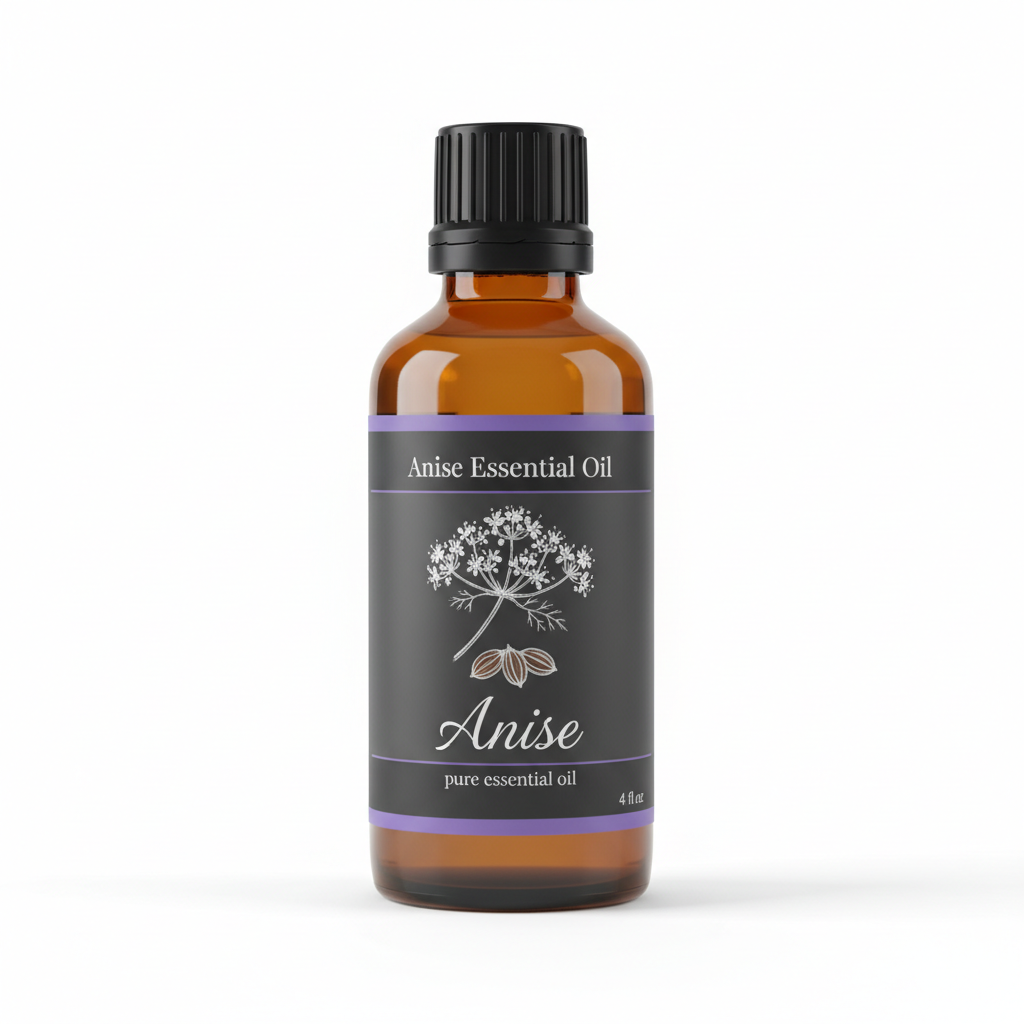
Anise Essential Oil
Our own Anise Essential Oil, in sizes from 0.5 oz to bulk.
From $8.99
Shop Now →Anise Essential Oil vs. Star Anise Oil
True anise essential oil is steam-distilled from the seeds of Pimpinella anisum, a flowering plant native to the eastern Mediterranean and Southwest Asia. Star anise oil, by contrast, is distilled from the dried fruits of Illicium verum, a tree native to southern China and Vietnam.
Both oils share a dominant aroma compound, trans-anethole, which explains why they smell remarkably similar. A shopper who does not read labels carefully can easily buy one while intending the other. They are not interchangeable in every context. If you are sourcing for a specific cosmetic formulation or aromatic project, knowing which botanical you need matters. For a deeper comparison of their respective quality markers and price points, see our guide on buying star anise essential oil.
Essential Oil vs. Fragrance Oil
A second confusion catches many first-time buyers. Anise fragrance oil is a synthetic or blended aromatic product designed to mimic the scent of anise. It is not distilled from a plant. Fragrance oils are used in candles, soaps, and diffuser blends where cost and scent consistency are priorities. They are not appropriate for skin-contact cosmetic formulations that call for a true botanical extract.
Fragrance oils are not inherently inferior products. They simply serve different purposes. If you are unsure which category fits your project, our comparison piece on anise fragrance oil vs. essential oil walks through the decision in detail.
Food-Grade vs. Cosmetic-Grade Anise Oil
A third distinction matters for buyers who want to use anise oil in baking or confectionery. Food-grade anise oil must meet safety standards specific to ingestible products and carries different labeling requirements than cosmetic-grade oil. The two categories overlap in some cases, but they are not automatically interchangeable. If your primary interest is culinary use, our dedicated resource on where to buy anise oil for baking covers food-grade sourcing specifically.
Throughout this guide, the focus is on pure anise essential oil for cosmetic and aromatic applications unless otherwise noted.
Quality Markers: How to Read an Anise Oil Before You Buy It
Quality in essential oils is not visible to the naked eye. A beautiful amber bottle with an elegant label tells you nothing about what is inside. Learning to read quality through chemistry, sourcing transparency, and physical characteristics puts you in a far stronger position as a buyer.
Botanical Name and Country of Origin
Any reputable supplier will display the full Latin botanical name on the label: Pimpinella anisum for true anise oil. The absence of a botanical name is a signal to look elsewhere. Country of origin matters too. Anise is grown in Turkey, Egypt, Spain, Germany, and parts of Eastern Europe. Each region produces oil with slightly different chemical profiles, influenced by soil, climate, and harvest timing.
Turkish and Egyptian anise oils are among the most commonly available in commercial supply chains. Spanish anise oil tends to command a premium and is sometimes noted for a slightly softer, more nuanced aromatic character. Neither origin is categorically superior. What matters is that the supplier knows and discloses where the material came from.
Extraction Method
Pure anise essential oil should be produced by steam distillation of the crushed seeds. Some suppliers offer CO2 extracts, which capture a broader aromatic profile than steam distillation and are worth considering for certain cosmetic applications. Cold pressing is not used for anise seed oil. If a listing claims cold-pressed anise essential oil, treat that as a red flag.
Anethole Content
Trans-anethole is the compound responsible for anise oil's characteristic sweet, licorice-adjacent aroma. In a high-quality sample, it should make up roughly 80 to 95 percent of the total chemical composition. Oils falling significantly below that range may be diluted, adulterated, or derived from lower-quality raw material.
Some suppliers list their typical anethole percentage on product pages or in accompanying documentation. When that figure is present and independently verified, it is a meaningful quality signal. For a full exploration of anise oil chemistry including anethole, linalool, and their aromatic contributions, see our piece on the chemistry of anise oil.
Appearance and Physical Properties
Pure anise essential oil is colorless to pale yellow. It is notable for solidifying at cooler temperatures, typically around 15 to 17 degrees Celsius (59 to 63 degrees Fahrenheit), because of its high anethole content. This solidification is not a defect. It is actually a useful authenticity indicator. If you receive a bottle labeled as pure anise oil and it remains fully liquid in a cold room that would normally cause solidification, that is worth investigating further.
The aroma should be intensely sweet, warmly spiced, and clean. A harsh, chemical, or off-note odor suggests either poor distillation practices or the presence of adulterants.
Harvest Date and Batch Information
Essential oils are agricultural products. Freshness matters. Anise oil has a shelf life of approximately two to three years when stored correctly (cool, dark, tightly sealed). A supplier that provides batch numbers and harvest or distillation dates is operating with a level of traceability that benefits the buyer. Oils sitting in a warehouse for three or four years before retail listing are not the same product as freshly distilled material.
Purity Testing and Documentation
Documentation is where serious buyers separate good suppliers from excellent ones. The essential oil industry is largely unregulated at the retail level, which means the burden of verification falls on the buyer. Knowing what documents to request and how to interpret them is a practical skill worth developing.
Gas Chromatography and Mass Spectrometry (GC/MS)
A GC/MS report is the industry standard tool for verifying essential oil composition. It separates the individual chemical constituents of an oil sample and identifies each one by mass. A genuine GC/MS report for pure anise oil will show trans-anethole as the dominant peak, with smaller amounts of other naturally occurring compounds such as estragole, pseudoisoeugenol, and anisaldehyde.
When a supplier provides a GC/MS report, check that it was conducted by an independent third-party laboratory rather than an in-house test. In-house testing is not inherently unreliable, but third-party verification carries more weight because there is no financial incentive to produce a favorable result.
Some buyers with a scientific background read GC/MS reports directly. For everyone else, the key thing to confirm is that trans-anethole appears as the dominant constituent at a percentage consistent with the quality range described in the previous section.
Certificate of Analysis (COA)
A Certificate of Analysis is a broader document that may include physical and chemical parameters such as specific gravity, refractive index, and optical rotation alongside GC/MS data. These physical parameters are harder to fake than a simple anethole percentage claim because they require physical measurement of the actual sample batch. A COA that matches a specific batch number and is issued by a credentialed laboratory is one of the stronger quality assurances available to buyers who are not running their own lab tests.
MSDS and Safety Data Sheets
A Material Safety Data Sheet (MSDS), now more commonly called an SDS (Safety Data Sheet), provides handling, storage, and safety information. For cosmetic formulators working with larger quantities, this document is a practical necessity. Its presence in a supplier's documentation package also signals that the company is operating at a professional level.
Organic Certification
Certified organic anise oil is available from a number of suppliers. In the United States, legitimate organic certification comes from USDA-accredited certifying agents and requires annual audits of farming practices. Organic certification does not automatically mean higher anethole content or better distillation quality. It does mean the source crop was grown without certain synthetic inputs.
Organic labeling without a named certifying body is not meaningful. Look for the certifier's name or logo alongside any organic claim.
A note on "100% pure" labeling: This phrase appears on nearly every essential oil bottle in every price range. By itself, it means very little because there is no regulatory body enforcing that claim for essential oils in the cosmetic and aromatic market. Documentation and supplier reputation carry far more weight than front-label language.
Where to Buy Anise Oil: A Channel-by-Channel Breakdown
Knowing where to buy anise oil requires matching your purchase context (quantity, intended use, urgency, budget) to the right sales channel. Each option below has genuine strengths and real limitations.
Specialty Aromatherapy and Natural Beauty Retailers
Dedicated aromatherapy shops, whether physical or online, tend to carry a more curated selection than general retailers. Staff at good specialty shops are often knowledgeable enough to help you choose between origins or product formats. Sourcing transparency is more common in this channel, and the likelihood of encountering GC/MS documentation is higher.
Physical specialty stores also allow you to smell a tester before committing, which is genuinely useful for anise oil given how dramatically quality can affect the aromatic experience. The price per milliliter is typically higher than mass-market options, which reflects smaller order volumes, better sourcing practices, and more attentive inventory management.
Online Direct-from-Distiller Suppliers
Purchasing directly from distillers or from importers who work closely with distillers represents the strongest model for quality assurance. These suppliers can often provide farm-to-bottle traceability, meaning you can trace the oil back to a specific growing region and distillation run. They are more likely to have current batch documentation readily available.
Several respected suppliers in this category operate primarily through their own e-commerce sites rather than through third-party marketplaces. The purchasing experience may be less polished than a major retail platform, but the sourcing integrity tends to be higher. Look for suppliers who publish batch-specific GC/MS reports on their product pages rather than keeping documentation locked behind a request process.
Large Online Marketplaces
Platforms like Amazon carry a wide range of anise essential oils at varying price points. Convenience and fast shipping are the obvious advantages. The limitations are significant, though. Marketplace listings make it easy for low-quality or adulterated oils to sit alongside well-sourced products, and the review systems do not differentiate between quality characteristics that matter (aroma fidelity, anethole content, documentation) and factors that do not (fast shipping, nice packaging).
If you choose to buy through a marketplace, prioritize sellers who link to third-party test results in their product descriptions, display full botanical names, and provide batch numbers. Price alone is not a reliable guide in this channel, because extremely low prices can indicate dilution or poor sourcing, while high prices on a marketplace do not guarantee quality either.
Health Food Stores and Co-ops
Physical health food stores carry a more limited essential oil selection but offer the advantage of immediate availability for buyers searching for anise oil near me. The brands stocked at this level tend to be larger national or international companies whose quality can be researched in advance. Some stores also carry locally sourced aromatherapy lines, which can be interesting from a regional provenance standpoint.
The main limitation is selection depth. You are unlikely to find multiple anise oil origins or formats at a typical health food store. For straightforward purchases of a standard retail size, this channel works well.
Craft and Soap-Making Supply Shops
If you are formulating soaps, lotions, or other cosmetic products, dedicated craft supply retailers often stock essential oils at larger volumes than standard retail sizes. Quality varies by retailer. Some craft supply companies source rigorously and publish documentation; others prioritize price competitiveness over traceability. Evaluating suppliers in this category using the quality markers described earlier in this guide is especially important.
Wholesale and Bulk Suppliers
Makers, formulators, and small businesses who use anise oil regularly will eventually reach a point where retail purchasing is not economically sensible. Wholesale suppliers offer significantly lower per-unit costs at volumes starting from 100 milliliters up to kilogram quantities. The vetting process for wholesale suppliers deserves more thoroughness than retail purchasing because the financial stakes and the volume going into finished products are both higher. Our wholesale anise oil bulk buying guide covers supplier evaluation, minimum order quantities, and pricing benchmarks in detail.
| Channel | Quality Transparency | Price Range | Availability | Best For |
|---|---|---|---|---|
| Specialty Aromatherapy Retail | High | Mid to Premium | Limited locations | Discerning buyers, small volumes |
| Direct-from-Distiller Online | Very High | Mid to Premium | Online only | Quality-focused buyers |
| Large Online Marketplaces | Variable | Budget to Premium | Wide | Convenient reorders of vetted brands |
| Health Food Stores | Moderate | Mid | Immediate local access | Urgent purchases, familiar brands |
| Craft and Soap Supply | Variable | Budget to Mid | Online and select retail | Formulators, mid-volume users |
| Wholesale Suppliers | High (when vetted) | Low per unit | Online primarily | Makers, businesses, high-volume use |
Red Flags and Common Adulteration Tactics
Adulteration in the essential oil industry is a genuine problem, not an abstract concern. It ranges from subtle stretching of pure oil with cheaper carrier oils to outright synthetic replacement. Anise oil, because of its relatively low retail price compared to some other essential oils, is not a high-value adulteration target, but quality dilution remains common at the lower end of the market.
Dilution with Carrier Oils
Adding a neutral carrier oil such as fractionated coconut oil or jojoba to essential oil is a common way to stretch volume while maintaining apparent aroma. Diluted essential oils sold as pure are misleading at best. A simple test at home: place a drop on uncoated white paper. Pure anise oil evaporates relatively cleanly within a few hours. A greasy ring that does not fully evaporate suggests a fixed oil has been added.
This test is imperfect and should not replace laboratory analysis, but it provides a quick initial assessment.
Synthetic Anethole Addition
Synthetic trans-anethole is commercially available and relatively inexpensive. Adding it to a low-grade or thin distillate can push the apparent anethole content into the acceptable range on a basic test while the full natural complexity of the oil is absent. A detailed GC/MS report from a qualified lab will show a suspicious absence of minor natural compounds that should be present alongside anethole in a genuine distillate. This is one reason why the presence of natural trace compounds on a GC/MS report is a positive quality indicator, not just a curiosity.
Substitution with Star Anise Oil
Because star anise oil and true anise oil share a dominant aroma profile, substituting one for the other is easy to conceal from a casual buyer. The chemical profiles differ in their minor constituents, and laboratory testing distinguishes them clearly. Botanical labeling on the product is the first check. If you have ordered Pimpinella anisum and the label on the delivered product reads Illicium verum, or the species name is absent entirely, that is worth questioning.
Pricing That Does Not Add Up
Pure anise essential oil has a genuine production cost attached to it: seed cultivation, harvest, distillation, quality testing, storage, and shipping. When a product is priced dramatically below the market range for comparable volumes, the economics of that pricing deserve scrutiny. Not every low-priced oil is adulterated, but pricing that seems too convenient relative to market rates is a useful prompt to ask harder questions about sourcing and testing.
Missing or Vague Label Information
A label that lacks a botanical name, country of origin, lot number, and supplier contact information is not providing the minimum information a buyer needs to verify the product. Reputable suppliers include these details as a matter of standard practice. Vague labeling does not always indicate a poor product, but it prevents any independent verification.
Quick red flag checklist: No botanical name on label. No country of origin listed. No batch or lot number. No documentation available on request. Price significantly below comparable products. Oil does not solidify at cool temperatures. Aroma seems flat, synthetic, or harsh rather than warmly sweet and clean.
Formats, Sizes, and Practical Buying Decisions
Once you have identified a trustworthy supplier and confirmed product quality, the next practical question is what format and volume to order. Anise oil is available in a range of bottle sizes and product configurations, and the right choice depends on your intended use and how quickly you are likely to work through the supply.
Standard Retail Sizes
Most specialty retailers sell anise essential oil in 5 ml, 10 ml, and 15 ml bottles. These sizes suit occasional users, people exploring the oil for the first time, and those who want to sample a supplier's quality before committing to larger quantities. The per-milliliter cost is highest at this scale, but the lower upfront investment and reduced risk of shelf degradation make small sizes practical for many buyers.
If you are new to anise oil, a 5 ml or 10 ml bottle gives you enough material to evaluate the aroma, test it in a formulation, and assess how well the supplier's documentation and service match their claims, all before spending significantly more. Our guide to anise essential oil bottle sizes walks through the decision framework in detail, including when upgrading to a larger size starts to make sense.
Mid-Volume Sizes
Sizes in the 30 ml to 100 ml range are appropriate for active formulators, small-batch soap and candle makers, and buyers who have already verified a supplier's quality and are confident in their usage rate. The per-milliliter price drops meaningfully at this scale. The tradeoff is that you are committing to a larger volume of a specific batch, so verifying quality documentation before ordering becomes more important.
Bulk Quantities
Quantities above 100 ml and up to kilogram volumes are the domain of commercial makers, product line formulators, and businesses incorporating anise oil as a consistent ingredient. At this scale, the economics shift considerably, and the relationship with the supplier matters as much as the per-unit price. Reliable batch consistency, responsive communication, and clear lead times become critical factors. See the wholesale anise oil guide for detailed guidance on this purchasing tier.
Pre-Diluted Blends
Some suppliers offer anise oil pre-diluted in a carrier oil, typically at a 2 to 5 percent concentration. These products are convenient for direct skin-contact applications but are not suitable as replacements for pure oil in formulations where you need to control dilution ratios yourself. Pre-diluted blends also tend to have a shorter effective shelf life than pure oil because the carrier oil introduces its own oxidation timeline.
Storage Considerations by Volume
Regardless of size, anise essential oil should be stored in dark glass bottles (amber or cobalt blue), away from heat and direct light, with the cap tightly sealed. Oxygen exposure is the primary driver of quality degradation. Larger volumes that will not be used quickly can be decanted into smaller bottles with minimal headspace to slow oxidation. If you purchase a 100 ml bottle but expect to use only 20 ml in the next few months, this decanting practice meaningfully extends useful shelf life.
Safe Use in Cosmetic and Aromatic Applications
Buying a high-quality oil is the first step. Using it safely is equally important. Anise essential oil is a potent aromatic material and requires sensible handling practices in cosmetic and aromatic contexts.
Dilution for Skin-Contact Applications
Anise essential oil should always be diluted before skin contact. Applying undiluted essential oils directly to skin is not a recommended practice and may cause sensitization or irritation. Standard cosmetic dilution guidelines suggest a maximum use level of around 0.5 to 1 percent in leave-on products such as lotions and serums. Rinse-off products such as soaps and body washes can typically accommodate slightly higher percentages.
Dilution percentages should be calculated based on total formula weight, not estimated. A basic reference: for a 1 percent dilution in 100 ml of carrier oil, use approximately 20 drops (roughly 1 ml) of essential oil. Precise drop counts vary by dropper size, so weight-based measurement is more accurate for formulation work.
Patch Testing
Before using any new anise oil product on a larger area of skin, a patch test is a sensible precaution. Apply a small amount of the properly diluted preparation to the inner forearm, cover lightly, and observe for 24 hours. If redness, itching, or other skin changes occur, do not continue use and consult a qualified healthcare provider.
Populations Who Should Exercise Caution
Anise essential oil contains compounds that are not appropriate for all users in all contexts. People who are pregnant or nursing, those with young children in the household, and individuals managing certain ongoing health situations should consult a qualified healthcare provider before incorporating anise oil into their routines. This is not a formality. It is a meaningful step that accounts for individual variation in how people respond to potent botanical materials.
Diffusion and Aromatic Use
Diffusing anise oil in a well-ventilated space is generally considered a lower-risk application than skin contact. Recommended diffusion practice involves intermittent use (30 to 60 minutes at a time with breaks) and appropriate dilution within the water reservoir of an ultrasonic diffuser. Anise oil's aroma is intensely sweet and can become overwhelming at high concentrations. Starting with fewer drops than you think you need is a good approach, then adjusting upward if desired.
In shared spaces, be mindful of others, particularly pets. Some companion animals are more sensitive to aerosolized essential oil compounds than humans. Providing animals with the ability to leave a diffused space is a basic consideration.
Storage and Handling Safety
Pure anise essential oil is flammable. Keep it away from open flames, heat sources, and sparks. Store it out of reach of children. If accidental skin contact occurs with undiluted oil, dilute the area with a carrier oil (not water) and rinse thoroughly. Contact a poison control center or healthcare provider if any ingestion occurs.
Your Pre-Purchase Checklist
Pulling everything in this guide into a single reference point, here is a practical checklist to work through before completing any anise oil purchase.
About the Product
- Does the label include the full Latin botanical name (Pimpinella anisum for true anise oil, or Illicium verum for star anise oil)?
- Is the country of origin disclosed?
- Is the extraction method identified as steam distillation?
- Does the product have a batch or lot number?
- Is a harvest or distillation date available?
- Is the product the correct grade for your intended use (cosmetic, aromatic, or food-grade)?
About the Supplier
- Does the supplier provide GC/MS reports, ideally from an independent third-party laboratory?
- Is a Certificate of Analysis available for the current batch?
- Does the supplier have a verifiable physical address and responsive customer service?
- Are there credible independent reviews of the supplier's sourcing practices and product quality?
- If organic certification is claimed, is the certifying body named?
About the Purchase Decision
- Does the price fall within a reasonable range for the volume and quality level?
- Is the bottle size appropriate for your expected usage rate and storage situation?
- Have you confirmed the oil is not pre-diluted unless that is specifically what your application requires?
- If purchasing through a marketplace, have you researched the selling brand independently rather than relying on platform reviews alone?
Before First Use
- Check for visual clarity, appropriate color (colorless to pale yellow), and solid or semi-solid state if the environment is cool.
- Evaluate the aroma: warmly sweet, clean, and unmistakably anise-forward without harsh or synthetic off-notes.
- Confirm your dilution calculations before any skin-contact application.
- Perform a patch test before wider skin-contact use.
- Consult a qualified healthcare provider if you have any questions about suitability for your specific situation.
Finding pure anise oil that meets a real quality standard is not complicated once you know what to look for. The channels exist, the documentation tools are available, and the sensory characteristics of a well-sourced oil are distinct enough to recognize with practice. Use this guide as a reference point on each purchase, and over time you will develop a clear sense of which suppliers consistently deliver the quality your projects deserve.