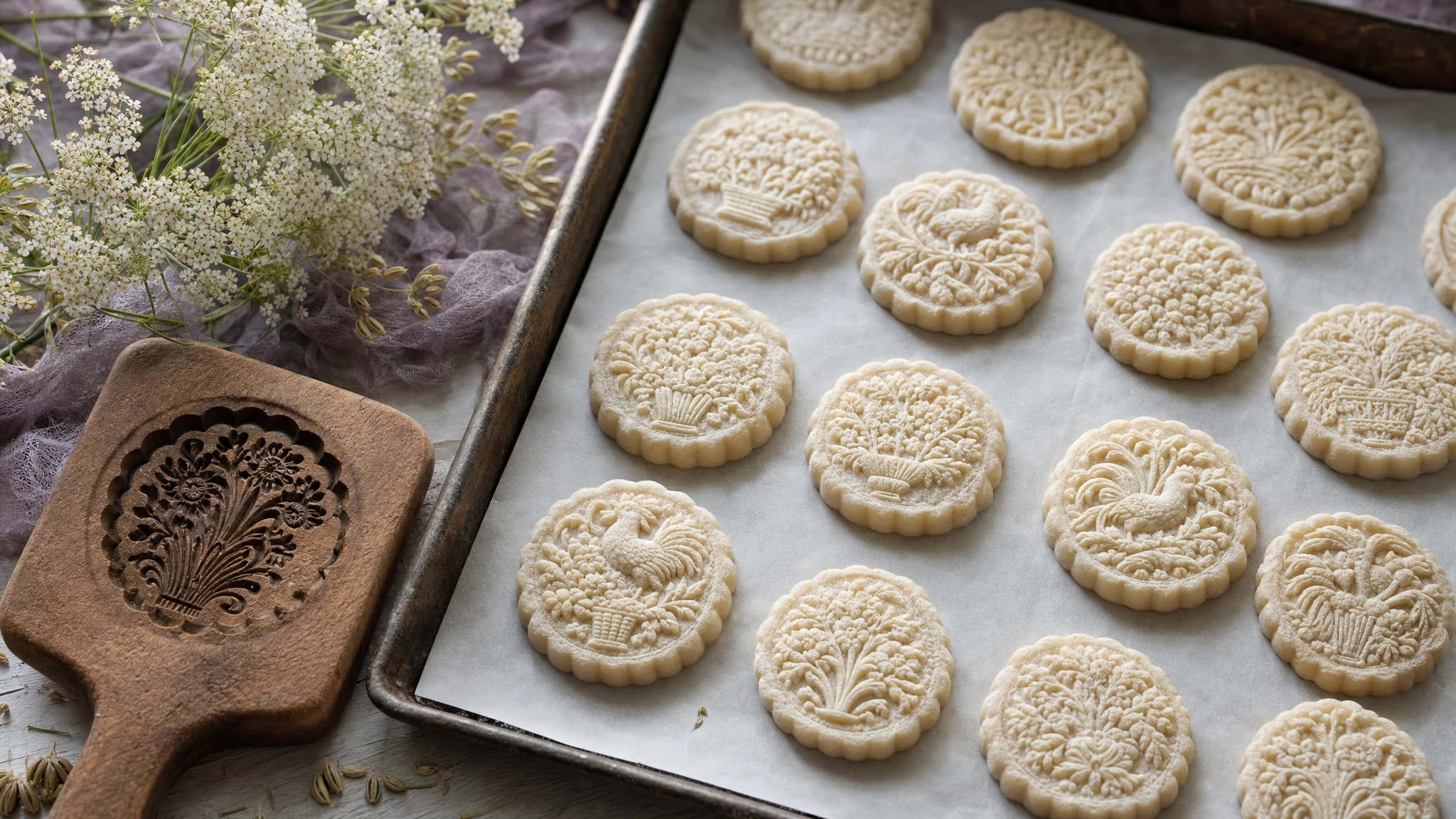
Springerle Cookies with Anise Oil: Molds, Drying and Flavor
Springerle are molded German anise cookies made from eggs, powdered sugar and flour. The dough is pressed into carved molds, dried at room temperature for about 24 hours so the image sets, then baked low and pale. Flavor comes from anise seed on the pan plus food-labeled anise flavoring, and they improve with weeks of aging.
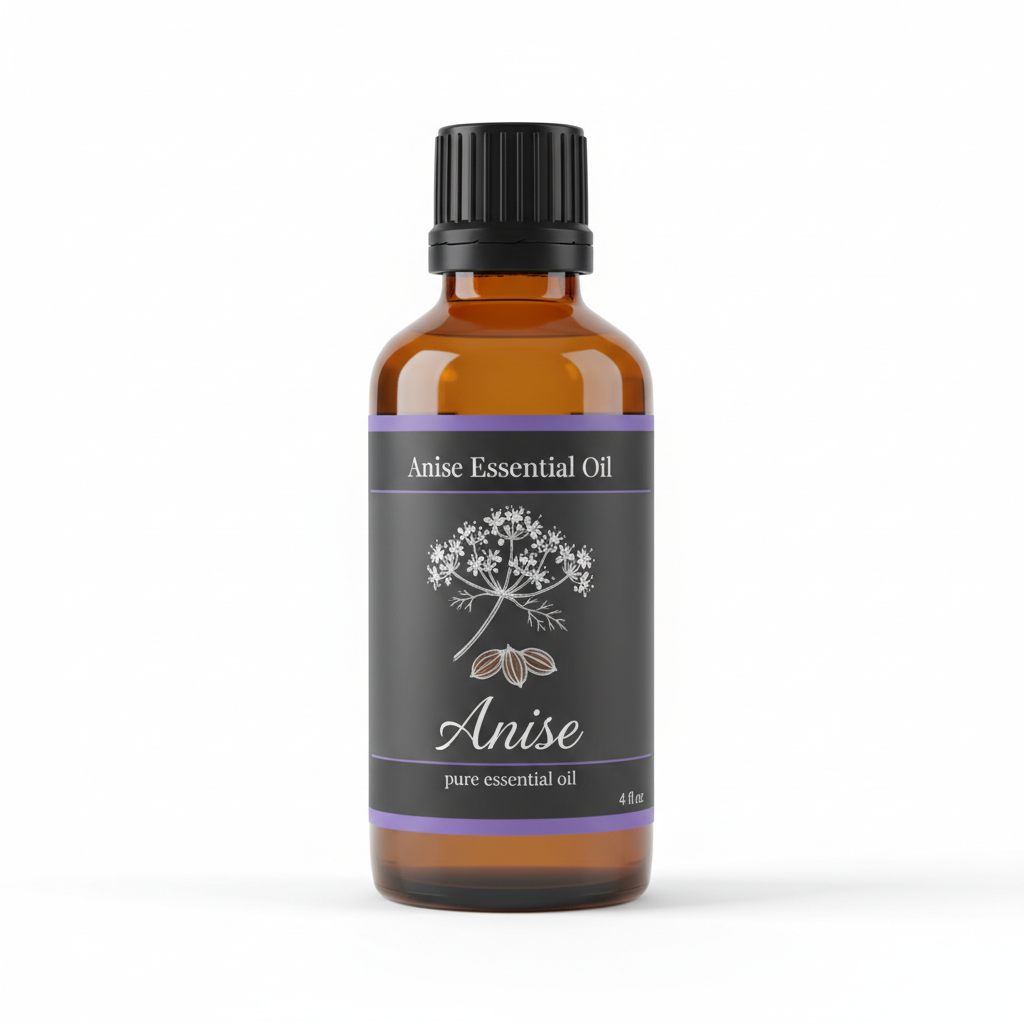
Anise Essential Oil
Our own Anise Essential Oil, in sizes from 0.5 oz to bulk.
From $7.99
Shop Now →First, the food-use rule
We sell Anise Essential Oil, and this site does not state that it is food grade. So we are not telling you to put our bottle in springerle dough. The anise flavoring used in food must be a product labeled and sold for food use. A bottle sold for aroma stays out of the dough. Our guide to where to buy anise oil for baking explains the label, and our comparison of anise oil vs anise extract explains why the two are not interchangeable at equal measures. Anyone pregnant, nursing, on medication or feeding a small child should ask a pharmacist or physician about concentrated flavoring oils first. Poison Control is 1-800-222-1222.
Where springerle come from, and what the sources agree on
Wikipedia traces springerle to at least the 14th century in southwestern Germany, mostly Swabia, and notes that one of the oldest surviving molds, in Zürich, dates from that century. Early mold motifs were religious; knights and ladies became popular in the 17th and 18th centuries. In Swabian dialect the cookies are anis-brödle, and in Switzerland Anisbrötli. The Daring Gourmet, whose recipe we use below, says the molds were carved by baking apprentices as a rite of passage and handed down as heirlooms. Zingerman's adds that owning a carved mold once signaled wealth, since you had to hire an artisan, and that molds were passed down in dowries. See Wikipedia, The Daring Gourmet and the Zingerman's Feed.
Sources disagree on two things. Wikipedia says the origin of the name is unknown and may refer to a jumping-horse mold motif or to the dough springing up as it bakes. Dating also varies slightly between pages, from the 1300s to the 15th century. You can safely say Swabia, at least the 14th century, and that the name's origin is uncertain. We did not find a source for stating the region's modern state borders, so we leave that out.
Molds, and why the dough must dry before it bakes
Molds can be carved wood, ceramic, stone or metal, according to Zingerman's, and a rolling pin carved with a repeated pattern does the same job. The dough is rolled to about 1/3 inch (1 cm), floured molds are pressed in, and the shapes are cut out. Then the cookies sit. Zingerman's describes that rest as drying the cookies out a bit and creating a thin crust on top that keeps the molded image from distorting in the oven. Wikipedia adds that drying sets the pattern so the leavening raises the cookie from the base, forming the characteristic "foot" along the edges.
Our reasoning from those descriptions: the skin on top is a lid, and the leavening has nowhere to go but out the bottom. That is why a damp kitchen and an eager baker are the two usual enemies. The Daring Gourmet suggests drying longer than 24 hours in humid conditions, and baking only when the surfaces are dry to the touch.
Hartshorn or baking powder?
Traditional recipes use hartshorn, which is ammonium carbonate and is also called baker's ammonia. The name comes from its old source, ground deer antler (Zingerman's), and it is now made industrially and sold at pharmacies according to that article. Wikipedia says it makes springerle lighter and softer than baking powder versions, and gives a crisper design and longer shelf life. Joe Pastry's page on baker's ammonia says it suits thin, crisp cookies such as springerle, that the kitchen smells of ammonia during baking, and that when it is used correctly the chemical evaporates and leaves nothing behind.
On substitution, sources split. Wikipedia says baking powder is a common substitute because hartshorn is hard to find. The Daring Gourmet warns against baking powder or baking soda, saying they produce a different texture and a soapy flavor. Joe Pastry gives a conversion of 1 1/4 teaspoons of baking soda per teaspoon of baker's ammonia, and warns not to swap in the other direction for thick batters because the ammonia may not bake out fully. He also says ammonia can "spoil" with age into a bad-smelling mixture, so buy a fresh jar.
Our position: use baker's ammonia if you can get it, and use it in thin cookies like these, never in thick ones. If you cannot, pick a springerle recipe written for baking powder rather than swapping amounts into this one. We have not tested a swap and will not invent a ratio.
Anise seed or anise flavoring: they do different jobs
Wikipedia says the anise seed is not mixed into the dough but dusted onto the greased baking sheets so the cookies rest on the crushed seed. The Daring Gourmet does both: 2 tablespoons of toasted whole anise seed under the cookies and pure anise oil (not extract) in the dough. Our reading: the seed gives the bottoms a toasted, aromatic crust, and the flavoring carries anise through the crumb. A "heady dose" is Zingerman's phrase, and not everyone likes it.
Dosing the flavoring, reasoned
The Daring Gourmet calls for 1/4 to 1/2 teaspoon of "100% pure anise oil" for 3 eggs, 3 cups of powdered sugar and 3 cups of flour. That is one author's figure, and it is large. Published conversions for neat oil run from roughly 4 to 1 to more than 100 to 1 against extract. If the oil were 100 times extract, 1/4 teaspoon would equal 25 teaspoons of extract, which no recipe uses. So either her bottle is far weaker than that, or it is a flavoring oil diluted in a carrier. Either way it tells you strengths vary by product and a spoon amount cannot be copied between bottles. If your label gives a usage rate, use it. If not, our reasoning is:
- Dose from the strong end and step up. You can add flavoring after you mix the dough, but you cannot take it out.
- Use a 1 percent working dilution. Stir 1/4 teaspoon of the food-labeled oil into 1/2 cup of neutral vegetable oil. Warm and mix the oil first if it has crystallized (see why anise oil turns solid or cloudy).
- Add it after the egg foam is built. The egg-and-sugar foam is whipped for 10 minutes in this recipe, and fat tends to work against foam. That is general baking reasoning, not something our sources test. Add the dilution when the flour goes in.
- Bake a scrap straight away. A scrap of dough baked right after mixing at 300 F for about 10 minutes will not have a foot, but it shows the flavor level before you commit to molding and drying.
| Step (cumulative, whole dough) | 1% dilution added | Equivalent neat oil |
|---|---|---|
| 1 | 1 teaspoon | 1/100 teaspoon |
| 2 | 2 teaspoons | 1/50 teaspoon |
| 3 (stop here) | 3 teaspoons (1 tablespoon) | 3/100 teaspoon |
Step 3 is still under one-eighth of the Daring Gourmet's low figure, and seed on the pan and aging (below) add more anise character. If step 3 is faint, check the label rather than adding more. Past that, you are guessing, and the cookie will be hard for weeks.
Recipe card: springerle with anise
These are the Daring Gourmet's traditional proportions (about 34 cookies, about a day and an hour from start to bake, including drying), with the flavoring step changed to the dosing above. We have not baked this version. Dough stiffness varies by flour and humidity, so adjust as she describes.
Ingredients
- 3 large eggs, room temperature
- 3 cups powdered sugar
- 1 teaspoon pure vanilla extract
- 3 cups pastry flour (Type 405 in Germany); if measuring by cups, start with 2 to 3 tablespoons less and add more only if the dough is too sticky
- 1/4 teaspoon baker's ammonia (slightly less than 1/4 teaspoon)
- 1/4 teaspoon salt
- Zest of 1 lemon
- 2 tablespoons whole anise seed, toasted, for the pan
- Anise flavoring labeled for food use: 1 teaspoon of the 1 percent working dilution to begin, or the amount on your label
- Flour for dusting the molds
Steps
- Beat the eggs in a stand mixer with the whisk until foamy. Add the powdered sugar gradually, then the vanilla. Beat for 10 minutes. The batter should be loose and airy.
- Whisk the flour, baker's ammonia and salt together. Add half to the egg mixture with the lemon zest and the first dose of anise flavoring, and beat for 15 minutes. Switch to the paddle if the whisk struggles.
- Add the remaining flour and beat 5 minutes with the paddle. The dough should be soft, not wet or sticky. Bake a scrap to check flavor and step up if needed, stopping at step 3.
- Shape into a disk about 1 inch thick, wrap, and chill at least 1 hour or overnight.
- Toast the anise seed in a dry pan over medium-high heat until fragrant, and spread it on a lined baking sheet.
- Roll the cold dough to about 1/3 inch on a floured surface. Press floured molds into it, then cut the shapes apart with a knife.
- Set the cookies on the seed and let them dry at room temperature for at least 24 hours, longer in humid weather, until the surfaces are dry to the touch.
- Press the bottoms lightly on a damp towel (the recipe says this helps them rise evenly), then return them to the sheet.
- Bake at 300 F with the rack in the middle for 20 to 30 minutes. The cookies should stay pale, not golden. Cool completely; they harden as they cool.
Storage and aging: why you wait
Wikipedia says fresh springerle are hard and are packed away to ripen for two to four weeks, becoming tender. The Daring Gourmet stores them airtight with half an apple to soften them slowly, replacing it from time to time, then removing it, and says to wait 3 to 4 weeks so flavor and texture develop. She notes that they are traditionally dunked in a hot beverage. Neither source says what changes chemically. A reasonable guess is that moisture redistributes through the cookie as it sits, but we have no source for that, so read it as a guess. If you want to give them as gifts, bake them weeks ahead, and for ideas on tying them into the season see anise in holiday baking traditions around the world.
Troubleshooting: what commonly goes wrong and why
| Problem | Likely cause | What to do |
|---|---|---|
| Design blurs or spreads | Surface not dry before baking (The Daring Gourmet's note) | Dry longer, especially in humid weather |
| No foot, flat bottoms | Skin cracked, oven too hot, or the top never formed a dry crust | Dry fully, bake at 300 F, keep them pale |
| Lopsided cookies | Uneven moisture on the bottoms | Press bottoms evenly on a damp towel |
| Dough too dry or stiff | Too much flour for the day's humidity | Work in a little lightly beaten egg (her tip); weigh flour next time |
| Dough too sticky | Flour is low or the dough is warm | Add 1 to 2 tablespoons flour, or rest overnight |
| Ammonia smell in the cookie | Thick cookie, or old ammonia that has degraded | Keep the dough to 1/3 inch and buy a fresh jar |
| Anise sharp and harsh | Overdose of oil; strengths vary by product | Start low with the working dilution; aging softens the edges |
Our position
Springerle are a patience cookie. The molds are the craft, the drying is the technique and the aging is the flavor, and the anise oil is the smallest part of the job. Use food-labeled flavoring, dose it in steps and give the seeds their share. If the only oil you own was bought for scent, buy a food-labeled bottle before you start.
Anise Essential Oil
Anise Essential Oil from our own shop, in sizes from 0.5 oz to bulk.
From $7.99
Shop Now →Sources & Further Reading
- The Daring Gourmet, Authentic German Springerle Cookies: proportions, drying, baking, storage, troubleshooting
- Wikipedia, Springerle: history, hartshorn, drying, aging
- Zingerman's Feed, Springerle: Swabia, molds, hartshorn, drying crust
- Joe Pastry, Baker's Ammonia a.k.a. Hartshorn: composition, odor, substitution, storage
- Anise in holiday baking traditions around the world