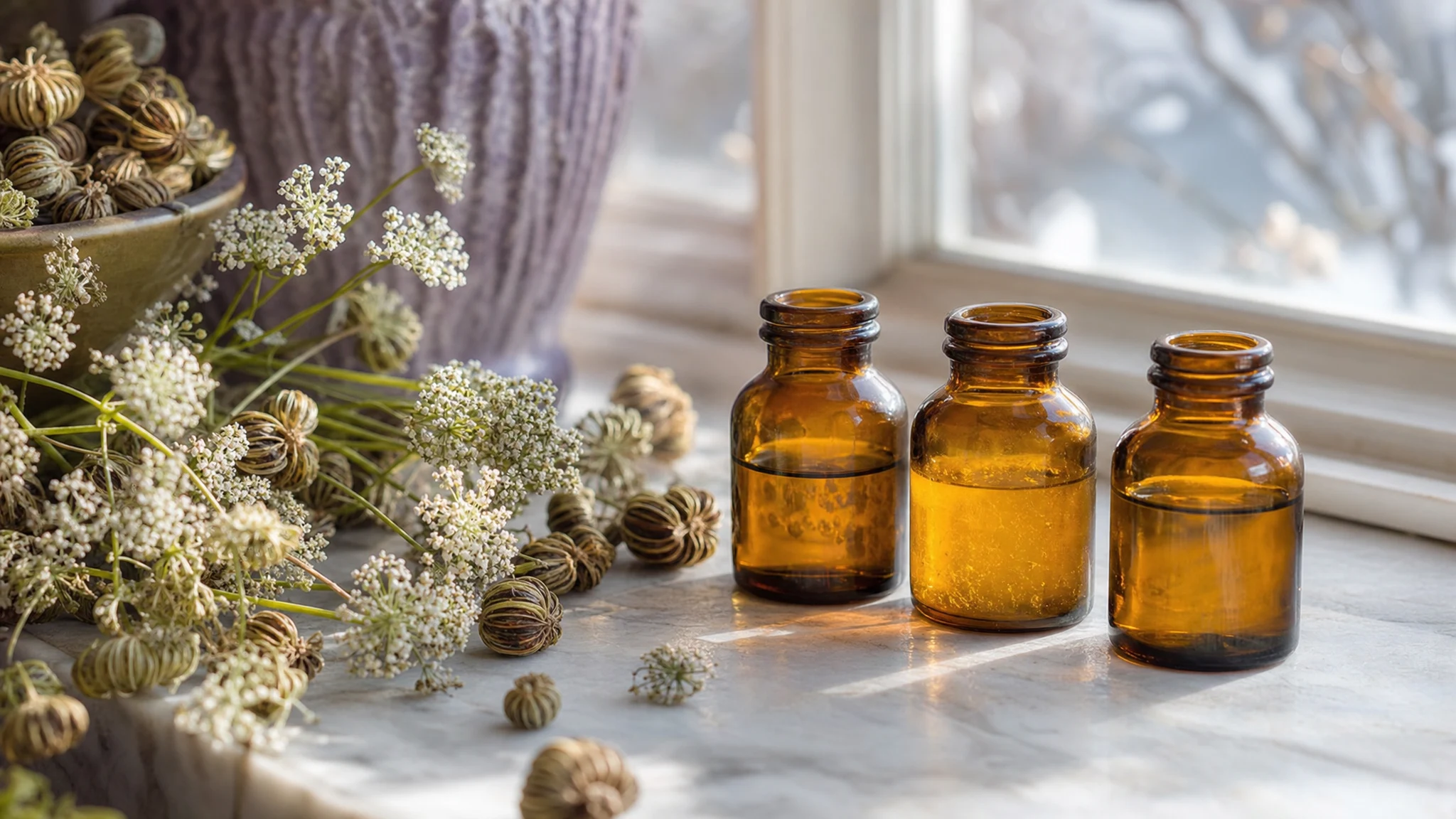
Why Anise Oil Turns Solid or Cloudy (And How to Fix It)
It is normal. Anise oil is mostly trans-anethole, which melts near 21 C (70 F), so a bottle kept in a cool room, cold car or refrigerator can turn cloudy or set into white crystals. Warm the sealed bottle gently in a water bath and it clears. The change is physical, and the oil is not damaged.
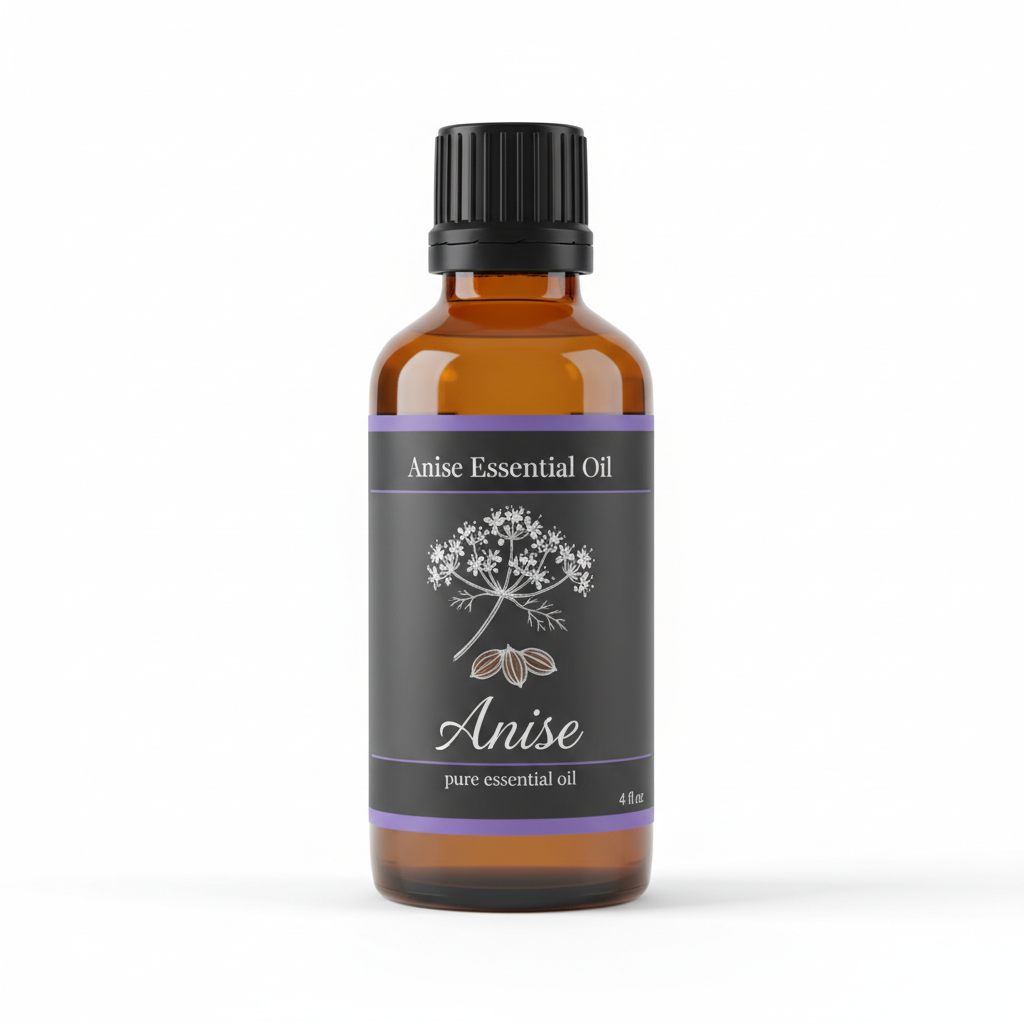
Anise Essential Oil
Our own Anise Essential Oil, in sizes from 0.5 oz to bulk.
From $7.99
Shop Now →What you are looking at
Open a bottle of anise oil in a cool room and you may find any of three things: a faint haze, a slush of fine white needles floating in clear oil, or a solid white mass that does not move when you tilt the bottle. All three are the same event at different stages. A compound inside the oil is leaving the liquid and forming crystals.
That compound is trans-anethole. The European Medicines Agency's assessment report on aniseed cites the European Pharmacopoeia range for anise oil as 87 to 94 percent trans-anethole. When one molecule makes up nearly nine tenths of an oil, the oil behaves a lot like that molecule. For the full picture of what else is in the bottle, see the chemistry of anise oil, and for the basics of the oil itself, what anise oil is.
The number that explains it
PubChem's record for trans-anethole lists a melting point of 21.3 C (70.4 F), citing the US National Toxicology Program's 1992 chemical datasheet. That is room temperature in a cool house. Below it, pure anethole is a solid. Above it, a liquid.
An oil is a mixture, so its own freezing behavior is not identical to the pure compound. The now-withdrawn ISO 3475:1975 standard for oil of aniseed gave a freezing point of 15 to 19.5 C and described the appearance as a clear liquid or crystalline mass. Note what that means: an international standard for this oil already listed "crystalline mass" as an expected appearance. The oil also contains minor components (linalool, limonene and methyl chavicol are typical), and it is consistent with ordinary freezing-point behavior that such a mixture sets a few degrees below the pure compound. That is our reasoning from the two figures, not a measurement.
| Reference point | Temperature | What it tells you |
|---|---|---|
| trans-Anethole melting point (PubChem, NTP 1992) | 21.3 C / 70.4 F | Pure anethole is solid below this |
| Oil of aniseed freezing point (ISO 3475:1975, withdrawn) | 15 to 19.5 C | The oil as a mixture sets a little lower |
| Typical refrigerator | Cooler than both | Expect a solid or slush |
| Anise oil closed-cup flash point (one supplier SDS) | 92.8 C | Far above any warming you need |
The practical reading: if your storage room sits below roughly 20 C, expect crystals some of the time. A winter windowsill, a garage shelf, a basement workshop and a shipping box left on a porch will all do it.
What the temperature actually does
Crystallization is a physical change, not a chemical one. The anethole molecules stay anethole; they only pack into an orderly lattice when cold and loosen into a liquid when warm. Nothing is lost and nothing new is made, which is why a melted bottle has the same scent as before. Contrast that with oxidation, where oxygen reacts with the oil and permanently changes it. That is a different problem with different signs, covered below.
One consequence deserves more attention than it usually gets, and it is our reasoning rather than a measured result. When a bottle is partly solid, the crystals are almost pure anethole, so the remaining liquid is relatively richer in the minor components. If you pour or measure from a half-frozen bottle, you are not drawing a representative sample of the oil. For a candle, soap or perfume batch where you scale by weight and care about the scent balance, melt the whole bottle first and swirl before you measure.
How to liquefy anise oil safely
You only need to get the oil a little above 21 C, so the method should be gentle. A supplier safety data sheet for anise oil lists a closed-cup flash point of 92.8 C, describes the oil as combustible, and says to keep it away from open flames, hot surfaces and ignition sources. Pure anethole's flash point in the PubChem record is 195 F (90.1 C). Those temperatures are far above warm tap water, which is exactly why a water bath is the right tool and a heat source is the wrong one.
- Tighten the cap. Keep it closed during the whole process so no vapor escapes and no water gets in.
- Fill a bowl or cup with warm tap water, comfortably warm to the hand and well under what you would use for tea. Anything noticeably above body temperature is enough, because the target is only above 21 C.
- Stand the bottle in the water so the oil level is below the waterline. Keep the cap and neck out of the water.
- Wait, then check every few minutes. Swirl the bottle gently; do not shake it hard.
- Continue until the liquid is clear and no crystals remain at the bottom or on the shoulder of the bottle. Dry the bottle off before opening.
Why melt everything and not just most of it? Any crystals left behind act as seeds, and the oil tends to set again faster around them. This is general crystallization behavior rather than something we measured on our oil, but it matches what the 1975 standard's "crystalline mass" wording implies about how readily the oil sets.
What not to do:
- Do not use a microwave. Heating is uneven and a sealed bottle can overheat in spots.
- Do not set the bottle on a stove, radiator, heating pad or under a hair dryer, and never near a flame or pilot light. The same SDS notes that vapors are heavier than air and can spread along surfaces to an ignition source.
If the bottle is in a bulk size, the same logic applies at larger scale, only slower: a pail or drum has far more oil to warm, so move the whole container to a warm room for a day or more before dispensing instead of trying to heat it from outside. A warm room is safer than a heater aimed at the container.
Is solid or cloudy oil still good?
Yes, as far as the crystallization itself goes. Because the change is physical, a bottle that has frozen and thawed several times has not lost anything to the cold. The things that do shorten the life of the oil are oxygen, heat and light, which is a separate topic in does anise oil go bad.
The question buyers more often ask is whether it proves anything about quality. Here we part ways with some of the advice online, including a guide elsewhere on this site that calls the cold test one of the most reliable checks for anise oil. We think that overstates what the behavior can tell you, and here is the reasoning.
Crystallization is not a purity test, in either direction
- A solid bottle does not prove purity. Anethole made synthetically is the same molecule as anethole from the plant, and the same molecule melts at the same temperature. A physical test cannot tell the two apart. In a 2024 study in Plants, Murphy and colleagues tested 30 commercial fennel, star anise and anise oils and found 27 percent (8 of 30) adulterated. GC/MS alone flagged 6; carbon isotope analysis found two more, and the authors recommended combining the two methods. They also reported that hydrogen isotope values for natural and synthetic anethole overlapped. If sophisticated chemical methods struggle with the question, a refrigerator will not settle it.
- A liquid bottle does not prove adulteration. An oil that stays clear in a cool room may simply be sitting in a room warmer than its freezing point, may have a different composition (as with oils from different regions), or may have been warmed in transit. Absence of crystals is not a defect either.
- Dilution changes the behavior, but not diagnostically. A large share of carrier or solvent would be expected to lower the setting temperature, but the effect depends on what was added and how much. Freezing point was one specification among several in the old standard, not a stand-alone verdict.
What does tell you about quality is documentation: a batch-specific certificate and GC-MS report, and a seller who will answer questions. We publish a COA and a GC-MS report. For a buying checklist see how to spot pure anise oil, and read the cold-test advice there with the limits above in mind.
Crystallization, oxidation or contamination: how to tell
Warm the oil first, then look. This single step sorts most cases.
| What you see | After gentle warming | Most likely cause |
|---|---|---|
| Haze, needles or white mass that is only present when cool | Clears fully to a transparent liquid | Crystallization (normal) |
| Cloudiness that stays at 25 C or above | Still cloudy, or droplets visible | Possible water or foreign material; see below |
| Color has deepened and the scent smells harsh, flat or sharp | Unchanged | Likely oxidation or age |
| Floating specks, sediment or a layer that does not mix | Unchanged | Contamination or a closure problem |
A few notes on each. Oxidation is judged mostly by smell and color, not by whether the oil sets; our shelf-life guide describes what an off bottle smells like. Persistent cloudiness after warming is unusual for a single-ingredient oil and is the case in which to write to us, because we cannot tell from here whether the cause is water that entered through the cap, a different product mixed into the bottle, or something else. Check your own handling first: a wet cap or a bottle stood in water above the cap line can introduce moisture.
Storing anise oil so this happens less (or does not matter)
You have two real options, and the right one depends on what you do with the oil.
- Accept it and plan for it. If your room is cool, crystallization will come and go with the seasons. That is fine. Keep a small warm-water bowl handy and build "melt, swirl, measure" into your routine.
- Store it a little warmer than 21 C but not hot. A closed cabinet in a room that stays above about 22 C will keep most bottles liquid. Warmth speeds oxidation, so a sunny shelf or a spot over an appliance is worse than a cool one.
Whatever you choose: keep the cap tight, keep the bottle out of direct light, keep it upright, and keep it where children and pets cannot reach it. Avoid trips between a cold refrigerator and a warm room, because condensation can wet the cap area.
Which size to buy if your room is cool
We sell the oil in 0.5 oz, 1 oz, 2 oz, 4 oz and 8 oz bottles, and in 16 oz, 5 lb, 25 lb, 100 lb and 400 lb quantities. This is our reasoning, not a tested claim. In a room that regularly drops below about 20 C, the oil will be melted and re-set repeatedly, and every melt means the bottle has to be opened and warmed, which brings headspace air and handling. A smaller bottle you will finish before the oil is repeatedly cycled is the more forgiving choice, and the 1 oz or 2 oz size is a sensible start for most home users. If you buy larger for cost, decant into smaller glass bottles filled close to the neck and keep the main container sealed. Makers who use it by the pound should plan on a warm room or a warming step before dispensing, because a bulk pail cannot be poured when set. Our bottle size guide goes through the sizes in detail, and the shop shows what is available.
If you are buying in the cold months, know that a bottle arriving solid is expected behavior, not a sign it was mishandled in shipping.
When to contact the shop
Write to [email protected] if:
- the oil stays cloudy, layered or speckled after full warming to room temperature;
- the scent is clearly different from what you remember, or has turned harsh;
- there is sediment, floating particles or a color change you did not expect;
- the bottle leaked or the seal arrived broken.
Include the size, the lot or batch information on the bottle and what you did to warm it. A photo helps. For general questions, our FAQ page collects the answers we get asked most. For a skin reaction or swallowed oil, contact a physician or US Poison Control at 1-800-222-1222, not the shop.
Frequently asked questions
Will melting the oil change how it smells?
Not by melting alone. Crystallization and melting are physical changes, and the molecules are the same afterward. A change in smell points to oxidation or to exposure to heat and air over time, which is a different issue.
Can I scoop out the crystals and use only the liquid?
We would not. The crystals are mostly anethole, so the liquid left behind has a different balance than the whole oil. Melt the entire bottle and mix it before using any.
Does solid oil mean it is old?
No. Age and temperature are separate. A brand-new bottle will set in a cold room, and an old bottle stored warm can stay liquid and still be oxidized. Judge age by smell, color and how it was stored.
Anise Essential Oil
Anise Essential Oil from our own shop, in sizes from 0.5 oz to bulk.
From $7.99
Shop Now →Sources & Further Reading
- PubChem: trans-Anethole (melting point, flash point, boiling point records)
- ISO 3475:1975 Oil of aniseed (withdrawn): scope, freezing point and appearance
- Supplier safety data sheet for anise oil: flash point, storage and fire-fighting statements
- Murphy et al., Authentication of Fennel, Star Anise, and Anise Essential Oils by GC/MS and GC/IRMS, Plants 2024
- EMA/HMPC Assessment report on Pimpinella anisum fructus and aetheroleum (EMEA/HMPC/321181/2012, 12 November 2013)