
What Is Anise Oil? The Complete Guide to the Sweet Licorice Aroma
Key Takeaways
- Anise oil is an essential oil steam-distilled from the seeds (technically fruits) of Pimpinella anisum, a flowering Mediterranean herb.
- Its primary chemical constituent, trans-anethole, accounts for 75 to 90 percent of the oil's composition and is responsible for its signature sweet, licorice-like scent.
- True anise oil and star anise oil smell nearly identical but come from entirely different botanical families.
- Anise essential oil and anise extract are not interchangeable: the essential oil is far more concentrated and requires careful dilution before any skin contact.
- Quality matters enormously. Sourcing, distillation method, and storage all affect the oil's aromatic profile and longevity.
- Always dilute properly, conduct a patch test, and consult a qualified healthcare provider before introducing any essential oil into your routine.
What Is Anise Oil?
Anise oil is an essential oil obtained from the seeds of the anise plant, Pimpinella anisum. The oil is typically produced through steam distillation, a process that uses pressurized water vapor to pull volatile aromatic compounds out of the plant material. What comes through on the other side is a concentrated, intensely fragrant liquid with a sweetness that most people immediately recognize as licorice.
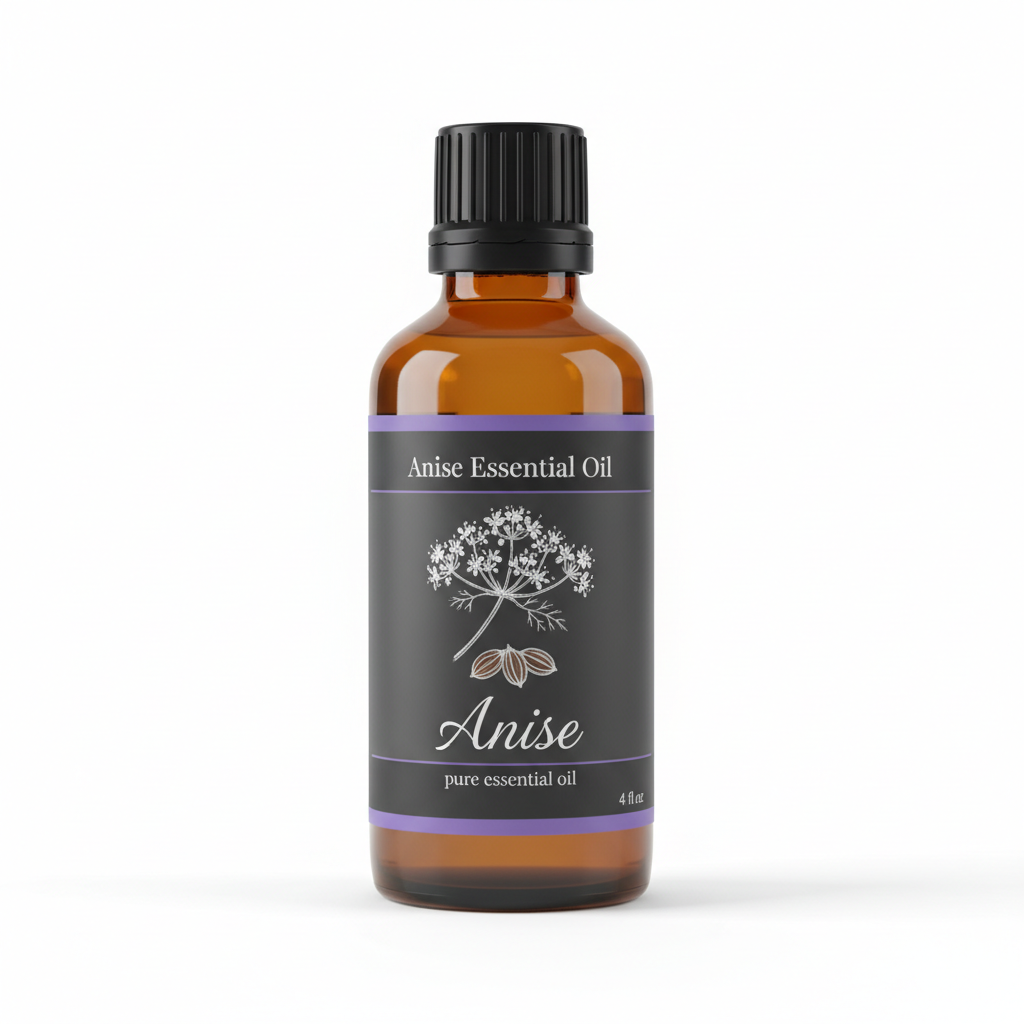
Anise Essential Oil
Our own Anise Essential Oil, in sizes from 0.5 oz to bulk.
From $8.99
Shop Now →The phrase "oil of anise" has been used in botanical and culinary literature for centuries. You will find it in old European pharmacopeias, in the flavor notes of classic spirits like absinthe and pastis, and in the ingredient lists of artisan perfumers working with anisic accords. It occupies a surprisingly wide corner of aromatic history for a plant that most people only know from a licorice candy wrapper.
From a technical standpoint, anise essential oil is classified as a seed oil (some producers label it a fruit oil, since the "seeds" are botanically the dried fruits of the plant). It is a pale yellow to nearly colorless liquid at room temperature, though it has an important quirk: it solidifies just below room temperature. If you have ever opened a bottle of anise oil in a cool room and found a semi-solid or cloudy substance, you have encountered this characteristic firsthand. It melts back to liquid easily with gentle warmth, and the quality is not affected.
Understanding what anise oil actually is requires separating it from several things it is commonly confused with: star anise oil (a different plant entirely), anise extract (a different product format), fennel oil (a botanical cousin with a similar but distinct scent), and licorice root extract (a food ingredient with no real overlap in production or use). This guide untangles all of that.
Botanical Origins: The Plant Behind the Oil
Meet Pimpinella anisum
Pimpinella anisum is a delicate annual herb in the Apiaceae family, the same broad family that includes carrot, celery, fennel, dill, coriander, and cumin. It grows to about 30 to 50 centimeters tall, producing fine, feathery leaves and clusters of tiny white flowers in umbrella-shaped formations called umbels. The seeds, which are the part that matters most for essential oil production, form after those flowers are pollinated and dry on the plant.
The plant's origins trace back to the eastern Mediterranean and Middle East. Ancient Egypt, Greece, and Rome all have documented records of anise cultivation. It was traded across early spice routes and gradually spread into central Europe during the medieval period. Today, the largest commercial producers include Turkey, Egypt, Spain, China, and parts of Eastern Europe. The origin of the seeds affects the aromatic character of the oil: Turkish anise, for example, is prized for its particularly full, rounded sweetness, while some Egyptian varieties lean slightly more herbaceous.
For a much deeper look at the plant's biology, cultivation history, and what makes Pimpinella anisum such a compelling aromatic source, visit our full profile: Pimpinella Anisum: The Mediterranean Seed Behind Anise Oil.
Harvesting for Oil Production
Timing the harvest is critical. Anise seeds reach peak aroma concentration just as they begin to ripen and shift from green to grayish-brown. Harvesting too early yields underdeveloped seeds with lower anethole content. Harvesting too late, after full maturation, risks losing volatile compounds to the environment before distillation even begins.
Commercial harvests typically cut the entire plant and allow it to dry before threshing the seeds free. The dried seeds are then either distilled on-site or transported to distillation facilities. Freshness at the time of distillation plays a measurable role in oil quality: seeds that have been stored for extended periods before distillation often yield a flatter, less vibrant oil.
A Note on Organic vs. Conventional Sourcing
Certified organic anise oil comes from seeds grown without synthetic pesticides or herbicides, and the designation is meaningful if you care about what ends up in a product applied to skin. Conventional anise oil is not inherently inferior in terms of scent, but if you are formulating cosmetics or using the oil in close skin contact applications, many formulators prefer certified organic sourcing for peace of mind. Look for third-party certification rather than simply taking a supplier's word for it.
Chemical Composition: Why It Smells Like Licorice
The Dominant Molecule: Trans-Anethole
If you want to understand why anise oil smells the way it does, the answer is almost entirely captured in a single molecule: trans-anethole. In a high-quality anise essential oil, trans-anethole typically makes up 75 to 90 percent of the total composition. It is a phenylpropanoid compound, meaning it is derived from the amino acid phenylalanine through the plant's natural biosynthetic pathways. It is also the reason that anise, star anise, and fennel all smell so similar despite being botanically unrelated: all three produce significant quantities of trans-anethole.
Trans-anethole has a sweet, warm, anisic character that most people perceive as licorice even though true licorice comes from the root of Glycyrrhiza glabra, a completely different plant. The association is a learned cultural shorthand. What you are actually smelling when you open a bottle of anise oil is trans-anethole.
Supporting Compounds
Beyond trans-anethole, anise oil contains a supporting cast of minor constituents that shape its full aromatic character. These typically include:
- Pseudoisoeugenol: Adds a warm, slightly spicy, woody undertone that keeps the sweetness from being one-dimensional.
- Anisaldehyde: A bright, slightly floral aldehyde that contributes lift and luminosity to the top notes.
- Estragole (methyl chavicol): Present in small quantities in some lots; adds a slightly tarragon-like, green nuance.
- Gamma-himachalene and other sesquiterpenes: Trace amounts that contribute depth and longevity to the dry-down.
- Anise ketone (para-methoxyphenylacetone): Reinforces the sweet anisic character.
The precise ratio of these supporting compounds varies based on plant origin, growing conditions, harvest timing, and distillation parameters. This is why a Turkish anise oil and a Spanish anise oil, while broadly recognizable as the same material, can smell subtly but perceptibly different to a trained nose.
Cis-Anethole: A Quality Indicator Worth Knowing
Anethole exists in two geometric isomers: the trans form and the cis form. Trans-anethole is the desirable, sweet-smelling compound. Cis-anethole smells quite different and is considered an undesirable adulterant in quality anise oil. Reputable suppliers will provide gas chromatography (GC) analysis showing a cis-anethole content well below one percent. If a supplier cannot or will not share GC data, that is worth noting.
What Adulteration Looks Like
Anise oil is sometimes adulterated with synthetic trans-anethole, fennel oil, or star anise oil. All of these adulterants smell similar enough to fool most consumers. GC-mass spectrometry testing is the reliable way to identify them. When you are buying anise essential oil for cosmetic formulation or serious aromatherapy blending, sourcing from a supplier who provides batch-specific GC reports is a meaningful standard to hold.
How Anise Oil Is Made
Steam Distillation: The Standard Method
The vast majority of commercial anise essential oil is produced by steam distillation of the dried seeds. In this process, steam passes through a vessel packed with anise seeds, vaporizing the volatile aromatic compounds along the way. That vapor mixture then travels through a condenser, where it cools back into liquid form. Because essential oil and water do not mix, they separate naturally: the oil floats on top and is drawn off, while the remaining water (called hydrosol or floral water) is collected separately and sometimes sold on its own.
The distillation process takes roughly two to four hours for anise seeds, though this varies with still design, seed load, and the distiller's target aromatic profile. Shorter distillation times can capture brighter, more volatile top notes. Longer runs extract a broader range of compounds including some of the heavier sesquiterpenes that add depth to the dry-down.
For a thorough look at the distillation process, including what home distillers need to know, read: How Anise Oil Is Made: Steam Distilling Seeds at Home.
Cold Pressing and CO2 Extraction
Cold pressing, which is used for citrus peel oils, is not applicable to anise seeds. CO2 (supercritical carbon dioxide) extraction is used by some specialty producers to capture a broader aromatic spectrum, including compounds that degrade under the heat of steam distillation. CO2 extracts from anise seeds tend to have a fuller, more rounded character and are typically more expensive. They are sometimes labeled as CO2 selects or CO2 totals, depending on the extraction parameters used.
Yield and Economics
Anise seeds have a relatively generous essential oil yield compared to many other aromatic plants. Depending on seed quality and distillation method, yields typically range from 1.5 to 3.5 percent by weight. This means roughly 30 to 65 kilograms of seeds are required to produce one kilogram of oil. This yield is considerably better than rose (which requires several tons of petals per kilogram of oil) but still requires meaningful agricultural and processing investment. It explains why genuinely high-quality anise oil carries a different price point from cheap commodity versions.
The Scent Profile: What to Expect When You Open the Bottle
First Impressions
Opening a bottle of quality anise essential oil is an immediate, full-presence experience. The scent is sweet, warm, and intensely anisic in a way that fills a room quickly. There is nothing shy about it. The top notes are bright and almost candy-like, though not cloying: there is a clean, slightly herbal edge underneath the sweetness that keeps it grounded.
Most people who grew up eating black licorice candies will have an instant, visceral recognition. Even those who claim to dislike licorice often find the oil interesting in small amounts, when its warmth and spice character become more apparent than the straight sweetness of the candy association.
Mid Notes and Dry-Down
As the top notes settle over the first few minutes, the oil reveals more warmth and a gentle spice quality. This is where the pseudoisoeugenol and the minor sesquiterpene fraction make their presence felt. The dry-down on skin or on a scent strip has a soft, balsamic sweetness that lingers without demanding attention.
Anise oil is a strong odor in perfumery terms, meaning a little goes a long way in a blend. Even at one or two percent in a diffuser blend, it can be the loudest voice in the room. Skilled blenders use it at low percentages as a supporting note or as a bridge between sweeter floral accords and drier spice or wood notes.
How Scent Varies by Batch and Origin
As noted in the chemistry section, origin matters. Turkish anise oil from the Burdur and Isparta regions is often described as having exceptional sweetness and a particularly full body. Spanish anise from Alicante has a long artisan tradition and a slightly more complex herbal undertone. Chinese and Egyptian oils, while often more affordable, can vary more in quality and sometimes show a sharper or more medicinal-leaning character.
This variation is part of what makes sourcing from a knowledgeable supplier worthwhile. The best suppliers can tell you the country and sometimes the region of origin, the harvest year, and the GC data for each batch.
For the full sensory deep-dive, including fragrance wheel placement and blending suggestions, see: What Does Anise Oil Smell Like? A Sweet Licorice Scent.
Fragrance Family and Blending Companions
In perfumery classification, anise oil sits within the spicy-sweet and oriental fragrance families. It blends well with a specific set of aromatic partners:
- Warm spices: Cinnamon leaf, clove bud, cardamom, nutmeg (use all of these with dilution care).
- Resins and balsams: Benzoin, Peru balsam, labdanum, frankincense. These extend anise's sweet dry-down beautifully.
- Citrus: Sweet orange, mandarin, and bergamot offer brightness that lifts anise without fighting it.
- Florals: Lavender is the classic companion: it softens anise's intensity and creates a balanced, approachable accord.
- Herbaceous oils: Basil, tarragon, and fennel share anise's anethole chemistry and create coherent herbal-sweet blends.
- Woody bases: Cedarwood, sandalwood, and vetiver provide grounding and help extend the overall blend's longevity.
Anise Oil vs. Star Anise Oil: Understanding the Difference
Two Plants, One Familiar Scent
This is one of the most common points of confusion in the essential oil world, and it deserves a clear answer. Anise oil and star anise oil smell almost identical to most people. Both are dominated by trans-anethole. Both are sweet and licorice-like. But they come from completely unrelated plants.
Anise oil comes from Pimpinella anisum, a small Mediterranean annual in the carrot family. Star anise oil comes from Illicium verum, a medium-sized evergreen tree native to southern China and northern Vietnam, in an entirely different plant order. The star-shaped pods of Illicium verum are what you see whole in spice shops: they look nothing like anise seeds.
The two converged on the same primary volatile compound (trans-anethole) through independent evolutionary paths, a phenomenon called convergent chemistry. It is remarkable from a botanical perspective, and it creates genuine confusion in the marketplace.
Practical Differences for the Essential Oil User
| Characteristic | Anise Oil (Pimpinella anisum) | Star Anise Oil (Illicium verum) |
|---|---|---|
| Botanical source | Annual herb, Mediterranean | Evergreen tree, Southeast Asia |
| Part distilled | Dried seeds (fruits) | Dried star pods and leaves |
| Trans-anethole content | 75 to 90 percent | 80 to 90 percent |
| Scent character | Sweeter, slightly herbal | Slightly sharper, more spicy |
| Typical price point | Moderate to high | Lower (higher yield, lower production cost) |
| Common adulteration | Sometimes cut with star anise oil | Sometimes substituted for anise oil |
Star anise oil is typically less expensive than true anise oil because the trees produce substantial quantities of material and the oil yields are robust. This price difference is also why star anise oil is frequently used to adulterate or substitute for true anise oil in lower-quality products.
For cosmetic and aromatic purposes, the two oils are often interchangeable in practice. A consumer blending a personal fragrance or a room diffuser blend is unlikely to notice a meaningful difference. A perfumer working on a precise formulation, or a botanically minded buyer who simply wants the authentic Pimpinella anisum product, will care about the distinction. GC testing can confirm which oil you actually have.
Read the full comparison: Anise vs. Star Anise Oil: Two Plants, One Familiar Scent.
Anise Essential Oil vs. Anise Extract
They Are Not the Same Product
Anise extract and anise essential oil are produced differently, serve different purposes, and are not interchangeable. Anise extract is made by steeping anise seeds in a carrier liquid, usually food-grade alcohol, to create a flavoring agent. It is diluted by design and formulated for use in food and beverages. It contains water, alcohol, and a relatively low concentration of aromatic compounds.
Anise essential oil is a concentrated, pure aromatic extract with no added alcohol or carrier. It is several times more potent than anise extract by weight. One drop of quality anise essential oil contains far more trans-anethole than a full teaspoon of most commercial anise extracts.
Concentration and Potency
This concentration difference is important for two reasons. First, it means anise essential oil requires careful dilution before any contact with skin (more on that in the safety section). Second, it means the two products serve completely different use contexts. Anise extract is a food product. Anise essential oil is an aromatic and cosmetic ingredient.
People sometimes ask whether anise essential oil can be used in baking the way extract is. The short answer is: do not attempt to substitute one for the other without very careful research and appropriate food-grade sourcing. Essential oils intended for cosmetic or aromatic use are not tested or regulated as food additives. Some companies do produce food-grade anise oil specifically for culinary use, but this is a distinct category with different regulatory oversight.
What Each Is Good For
- Anise extract: Baking (cookies, cakes, breads), flavoring beverages, confectionery production.
- Anise essential oil: Diffuser blends, personal fragrance formulation, cosmetic and soap making, scented candle production, bath and body product formulation.
For the complete breakdown of concentration differences, pricing, and substitution guidance: Anise Oil vs. Anise Extract: Strength, Uses, and Substitutions.
Cosmetic and Aromatic Uses
Diffusion and Atmospheric Fragrance
Diffusing anise essential oil is the most accessible entry point for most people. A few drops in an ultrasonic or nebulizing diffuser fills a room with a warm, sweet, spice-market atmosphere. It works beautifully for an evening wind-down ritual, a cozy autumn ambiance, or as a backdrop for a dinner gathering. The scent reads as sophisticated and distinctive without being polarizing (provided the people in the room enjoy anise flavors in general).
Suggested diffuser starting points:
- 2 drops anise oil plus 3 drops sweet orange plus 2 drops cinnamon leaf: a warm, festive blend
- 3 drops anise oil plus 4 drops lavender plus 2 drops cedarwood: a calming evening blend
- 2 drops anise oil plus 3 drops bergamot plus 2 drops fennel: a layered anisic accord for the curious
Keep in mind that anise oil is a strong odor in diffuser blends. Start with fewer drops than you think you need and adjust upward. Overpowering a room with anise is easy to do.
Personal Fragrance and Perfumery
Anise oil has a legitimate place in the perfumer's palette. In classical perfumery, anisic accords appear in the oriental and fougere families. Modern niche perfumers continue to use anise as an accent note in everything from aquatic-spice blends to warm amber compositions.
For home perfumers blending in jojoba or another carrier oil, anise essential oil typically performs well at 0.5 to 2 percent of the total formula. Above that concentration, it can dominate the composition. For alcohol-based perfumes (eau de toilette or eau de parfum formulations), it is typically used as an accent in the heart or base note phase.
Soap and Candle Making
Anise essential oil holds up reasonably well in cold process soap, though anethole can occasionally accelerate trace in certain base oil combinations. Hot process and melt-and-pour soap formulations tend to be more straightforward. The scent retention in finished soap bars is moderate to good.
In soy and coconut wax candles, anise oil performs well as a scent component, particularly when blended with complementary notes like vanilla, cinnamon, or orange. The recommended fragrance load follows the candle wax manufacturer's guidelines, with anise oil typically comprising a portion of a larger fragrance blend rather than serving as the sole scent.
Bath and Body Formulations
Anise essential oil can be incorporated into a range of rinse-off and leave-on cosmetic formulations, always at appropriate dilutions. Common applications include:
- Body scrubs: At 0.5 to 1 percent in a sugar or salt scrub base, anise adds a warming, sweet scent to an exfoliating ritual.
- Bath salts: Dispersed in a carrier oil before adding to salts, anise oil creates a fragrant bathing experience.
- Body lotion and cream: At appropriately conservative dilutions (see the safety section), anise can be part of a warming, spice-forward body moisturizer.
- Shampoo and conditioner: Small amounts of anise oil appear in some hair care formulations for its scent contribution.
- Lip balm: Some formulators incorporate trace amounts of anise oil into lip balm for mild flavor and scent. Lip products require particular attention to usage rates given proximity to the mouth and mucous membranes.
Linen and Home Fragrance
Beyond the diffuser, anise oil can be used to scent drawer sachets, homemade linen sprays (diluted in water with a small amount of alcohol as an emulsifier), or potpourri blends. These applications let you enjoy the fragrance without any skin contact, making them a good starting point for anyone who wants to explore the scent before committing to topical use.
Safety, Dilution, and Storage
Why Dilution Is Non-Negotiable
Anise essential oil is a concentrated aromatic substance. Applying it undiluted (neat) to skin is not recommended. The high trans-anethole content, while responsible for the oil's appealing scent, can cause sensitization in some individuals when applied at excessive concentrations. Sensitization is a cumulative process: an individual may have no reaction initially but develop one over repeated exposures at high concentrations.
The International Fragrance Association (IFRA) publishes usage guidelines for anethole-containing materials in cosmetics. These guidelines establish maximum usage levels in different product categories, from rinse-off products like shampoo to leave-on products like lotions to products used near the lips. Following these guidelines is the responsible approach for any serious formulator.
Dilution Guidelines for Home Use
The following dilution guidelines are based on general industry standards for adult topical use. Always consult current IFRA guidelines and your formulation reference for the specific product type you are making.
| Application Type | Suggested Maximum Dilution | Notes |
|---|---|---|
| Rinse-off body products (shower gel, shampoo) | 1 to 2 percent | Shorter skin contact time reduces sensitization risk |
| Leave-on body lotion or cream | 0.5 to 1 percent | Conservative due to prolonged skin contact |
| Bath salts or bath oil (pre-dispersed in carrier) | 1 to 2 percent in carrier oil | Always disperse in carrier before adding to water |
| Diffuser blend | 2 to 4 drops per 100ml water | Not a skin application; inhalation guidelines apply |
| Personal fragrance oil (jojoba base) | 0.5 to 2 percent | Patch test before regular use |
Patch Testing: Always Do It
Before using any new essential oil topically, apply a small amount of the diluted product to a discreet area of skin (inner forearm is common) and wait 24 hours. If redness, itching, or irritation develops, do not use the product. This simple step catches individual sensitivities before they become a larger issue.
Populations Who Should Exercise Extra Caution
Certain groups should consult a qualified healthcare provider before using anise essential oil in any topical or inhalation context:
- Pregnant individuals (anethole-containing oils are traditionally avoided during pregnancy)
- Nursing individuals
- Infants and young children
- Individuals with known sensitivities to aniseed, fennel, or related plants
- Individuals with hormone-sensitive conditions (anethole has been studied for its structural similarity to estrogens; consult a healthcare provider)
This list is informational, not exhaustive. When in doubt, speak with a qualified healthcare provider before adding any concentrated aromatic substance to your routine.
Solidification: Not a Quality Issue
As mentioned earlier, anise essential oil solidifies below approximately 15 to 18 degrees Celsius (59 to 64 degrees Fahrenheit). This is a normal physical property of high-anethole oils. To re-liquefy, place the sealed bottle in a bowl of warm (not hot) water for a few minutes. Do not microwave or apply direct heat. The aromatic quality is not affected by natural solidification and liquefaction.
Storage Best Practices
Proper storage protects the aromatic integrity of your anise oil and extends its usable life. The key factors are light, heat, and oxygen.
- Use dark glass bottles: UV light degrades essential oils over time. Amber or cobalt blue glass is standard.
- Store in a cool, consistent temperature environment: A dedicated essential oil storage box kept away from direct sunlight and heat sources works well. A dark cupboard is fine.
- Keep lids tightly closed: Oxygen exposure causes oxidation, which changes the scent profile and can increase the potential for skin sensitization in oxidized oils.
- Keep away from children and pets: All essential oils should be stored out of reach.
For a thorough guide to shelf life and how to tell when your oil has passed its prime: Does Anise Oil Go Bad? Storage and Shelf Life Explained.
Buying Guide: What to Look for in a Quality Anise Oil
Reading the Label
A well-labeled anise essential oil bottle should include, at minimum:
- The full botanical name: Pimpinella anisum
- The country of origin
- The plant part used (seed or fruit)
- The extraction method (steam distilled is standard)
- The batch or lot number
- The volume and concentration (100 percent pure essential oil, undiluted)
If a label simply says "anise oil" without the Latin name and country of origin, you have limited basis for assessing what you are actually buying. It could be star anise oil, fennel oil, or a diluted product in a carrier oil, all sold under the same general term.
GC Reports and Third-Party Testing
The most reliable quality signal in the essential oil market is batch-specific gas chromatography (GC) or GC-mass spectrometry (GC-MS) data. These analytical reports reveal the precise chemical composition of the oil: what compounds are present, in what percentages, and whether anything unexpected (adulterants, off-ratio constituent levels) is present.
Reputable suppliers make these reports available to customers, either on request or through a public database linked to the batch or lot number. If a supplier cannot provide GC data and is charging a premium price, that is worth questioning.
Price as a Signal
Anise essential oil is not among the most expensive oils on the market, but genuine Pimpinella anisum oil from quality-controlled sources will cost more than the cheapest options available online. Very low prices often signal adulteration with star anise oil, synthetic anethole, or dilution in a carrier. Very high prices do not automatically guarantee quality, but they should be accompanied by verifiable sourcing transparency.
As a general orientation: at the time of writing, pure, quality-tested anise oil (Pimpinella anisum) from a reputable aromatherapy supplier typically ranges from moderate to somewhat higher in price compared to common commodity oils like lavender or eucalyptus. Prices vary by region and market conditions, so use price as one signal among several rather than a definitive guide.
Supplier Reputation and Transparency
Look for suppliers who:
- Provide botanical names consistently across their catalog
- List country of origin for every oil
- Publish or provide GC testing data
- Have a clear returns or satisfaction policy
- Can answer specific questions about sourcing when asked
- Do not make exaggerated or unsubstantiated claims about their oils
Suppliers who make sweeping claims about their oils being able to fix specific conditions are often prioritizing marketing over accuracy. The most trustworthy sellers tend to be the most measured in their language.
Organic Certification
Certified organic anise oil carries a meaningful designation if the certification is from a recognized body (USDA Organic, Ecocert, Soil Association, or equivalent). It does not automatically mean the oil smells better or has a superior chemical profile, but it does add traceability and confirms specific growing practices. For formulators making cosmetics marketed as organic or natural, certified organic sourcing is often a requirement of the certification frameworks they work within.
Small Bottle Testing
If you are new to anise essential oil and considering a significant purchase for formulation purposes, buy a small sample bottle first. Scent perception is personal, batch character varies, and a small test lets you evaluate the oil's aromatic quality before committing to a larger quantity. Most serious essential oil suppliers offer 1ml, 2ml, or 5ml sample sizes for exactly this reason.
A note on whole-market perspective: The essential oil market has a wide spectrum of quality and a meaningful amount of mislabeling and adulteration. This is not a reason to avoid essential oils. It is a reason to buy from transparent, knowledgeable suppliers who can back their products with data. The best oils in the market are genuinely excellent. Finding them requires a little due diligence, but it is worth it.
Where This Guide Fits in the Bigger Picture
This guide has introduced you to anise essential oil from the ground up: its botanical origins, its chemistry, its scent profile, how it is made, how it compares to related products, and how to use and buy it responsibly. Each of those topics has its own depth worth exploring.
The internal links throughout this guide point to detailed companion articles on specific aspects: the botany of Pimpinella anisum, the distillation process, the anise vs. star anise comparison, the oil vs. extract distinction, and storage guidance. Together, they form a complete resource for anyone who wants to understand this remarkable aromatic material fully.
Anise oil is one of the oldest aromatic materials in recorded human culture. From ancient Egyptian seed offerings to medieval European confections to contemporary artisan perfumes, it has occupied a persistent and beloved corner of the human sensory world. Its sweetness is familiar and evocative, its chemistry is fascinating, and its place in modern cosmetic and aromatic practice is well-earned. Getting to know it properly is a pleasure.