
Anise vs Star Anise Oil: Two Plants, One Familiar Scent
Pick up a bottle of anise essential oil and a bottle of star anise essential oil. Open both. The scent that rises from each is so strikingly similar that many shoppers assume they are buying the same thing with different labels. They are not. These two oils come from entirely different plants, grown in different parts of the world, processed through different methods, and carrying some meaningful differences in composition, price, and practical character.
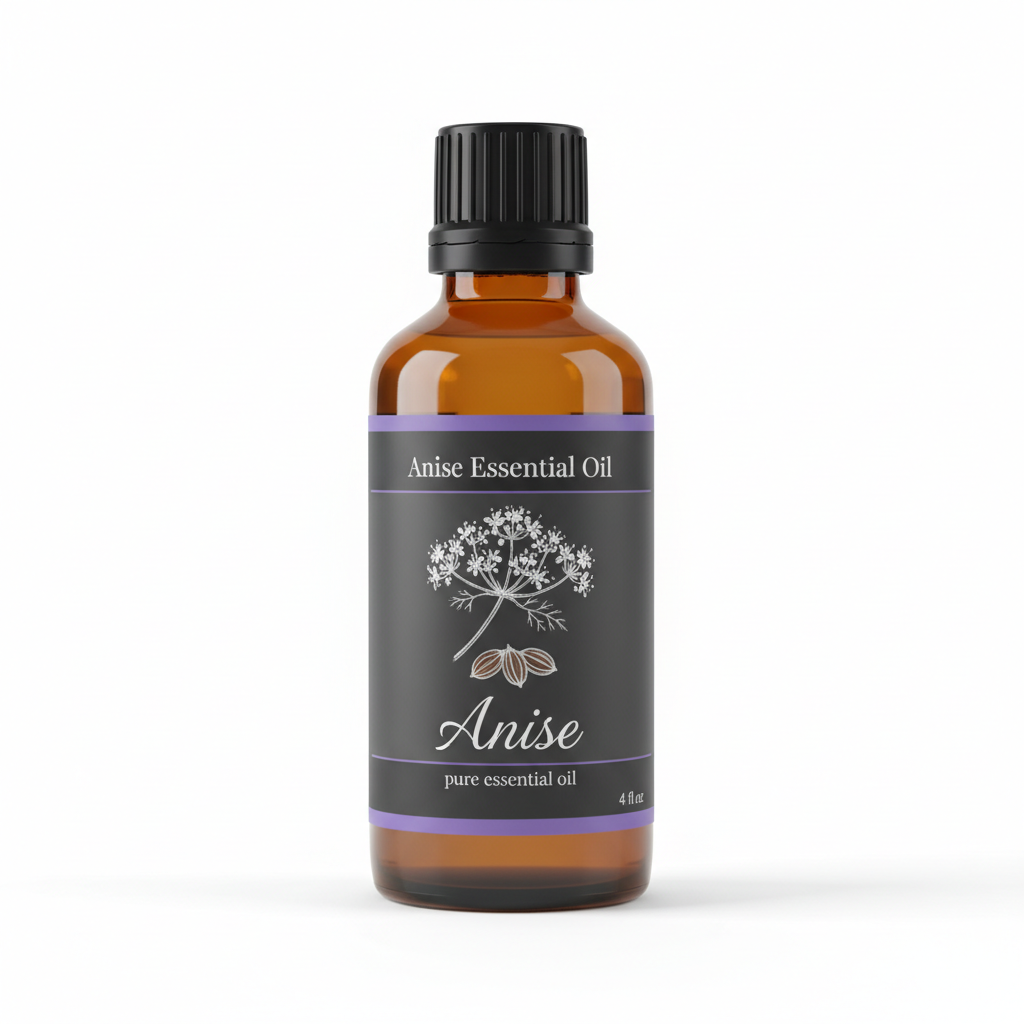
Anise Essential Oil
Our own Anise Essential Oil, in sizes from 0.5 oz to bulk.
From $8.99
Shop Now →That said, the similarity is real and not accidental. Both oils are dominated by a single aromatic compound that gives them their shared signature. Understanding where they overlap and where they diverge will help you make a smarter purchasing decision, whether you are building a fragrance collection, stocking a cosmetic formulation bench, or simply choosing a diffuser oil for your kitchen.
This guide walks through both oils with honest detail. No hype, no shortcuts. If you want the full background on anise oil before diving into the comparison, the complete guide to anise oil is a good place to start.
The Two Plants Behind the Oils
Anise (Pimpinella anisum)
Anise is a flowering herb in the carrot family, native to the eastern Mediterranean and Southwest Asia. It grows as a delicate annual plant reaching about two feet tall, with feathery leaves and small white flower clusters. The essential oil is steam-distilled from the dried seeds, which are technically small fruits called schizocarps. Major producing regions include Egypt, Turkey, Spain, and parts of Eastern Europe. The plant has been cultivated for thousands of years and holds a long place in culinary and aromatic traditions across the Mediterranean world.
Star Anise (Illicium verum)
Star anise comes from a small evergreen tree native to southwest China and northern Vietnam. The distinctive eight-pointed seed pods are harvested before they fully ripen, then dried. Steam distillation of these pods, and sometimes the leaves, produces star anise essential oil. China supplies the overwhelming majority of the world's star anise, making it deeply tied to the spice traditions of Southeast and East Asia. Despite sharing almost no botanical relationship with anise, the two plants converged on similar aromatic chemistry through a remarkable case of parallel evolution.
Why They Smell the Same
Both oils are dominated by trans-anethole, a phenylpropanoid compound that is responsible for the characteristic sweet, warm, licorice-like scent most people associate with both plants. In high-quality anise oil, trans-anethole typically makes up between 80 and 90 percent of the total composition. In star anise essential oil, that figure is often even higher, sometimes exceeding 90 percent.
This is the chemical foundation of their shared identity. When trans-anethole is the dominant note by such a wide margin, the resulting oils will smell nearly identical to most noses. The differences are subtle rather than dramatic, and they matter more in professional fragrance work than in everyday aromatherapy or home use.
Beyond trans-anethole, each oil carries a small supporting cast of minor compounds. Anise oil commonly contains methyl chavicol (estragole), pseudoisoeugenol, and small amounts of anisaldehyde. Star anise oil may contain foeniculin, limonene, and various sesquiterpenes. These secondary compounds contribute texture and depth to the scent, and they account for the nuances that experienced noses can detect.
Scent Profile: Subtle Differences Worth Knowing
Both oils open with that sweet, warm, unmistakably licorice-forward note. Spend a little more time with each, though, and patterns emerge.
Anise oil from Pimpinella anisum tends to have a slightly softer, grassier character in its background notes. There is a faint herbal quality underneath the sweetness, a reminder that this oil comes from a delicate annual herb rather than a robust tree. Some describe it as cleaner or more delicate in the mid-notes.
Star anise essential oil often reads as slightly bolder, warmer, and more resinous in the base. The scent has a bit more weight and body, which some perfumers and formulators find more useful for compositions that need anchoring. It also tends to linger on a surface a touch longer.
For diffusing in a living space or kitchen, most people would not notice the difference. In a fine fragrance or precision cosmetic formulation, the distinction becomes worth considering.
Anise vs Star Anise, Side by Side
People ask about anise and star anise in several ways. Anise vs star anise, anise seeds vs star anise, anise seed vs star anise pod: the answer lands in the same place each time. Anise is the seed of a small Mediterranean herb, star anise is the dried fruit of a Chinese evergreen tree, and the two share a licorice signature only because both are rich in trans-anethole. Here is how they line up on chemistry, scent, kitchen use, and price.
| Attribute | Anise Essential Oil | Star Anise Essential Oil |
|---|---|---|
| Botanical source | Pimpinella anisum | Illicium verum |
| Plant family | Apiaceae (carrot family) | Schisandraceae |
| Plant type | Annual herb | Evergreen tree |
| Whole spice form | Small oval seeds, roughly 3 to 5 mm long | Eight-pointed dried pods, roughly 25 to 35 mm across |
| Primary origin | Mediterranean, Eastern Europe | China, Vietnam |
| Distillation source | Seeds | Pods (and sometimes leaves) |
| Trans-anethole content | Typically 80 to 90% | Typically 85 to 93% |
| Scent character | Sweet, licorice, slightly herbal | Sweet, licorice, warm, slightly resinous |
| Typical kitchen use | Cookies, breads, hard candy, and anise liqueurs | Braises, broths, five spice blends, and mulled drinks |
| Relative cost | Moderate to higher | Generally lower |
| Availability | Widely available | Very widely available |
| Color | Colorless to pale yellow | Colorless to pale yellow |
| Typical specific gravity | 0.975 to 1.010 | 0.978 to 0.993 |
| Common adulteration risk | Moderate | Low to moderate |
Sourcing and Quality Considerations
Price is one of the most practical differences between these two oils. Star anise essential oil is typically less expensive, sometimes significantly so, because the Illicium verum tree produces large quantities of seed pods and China's well-established supply chain keeps production efficient. Anise oil from Pimpinella anisum involves more labor-intensive annual cultivation and tends to command a higher price per milliliter.
This price gap has an unintended consequence. Because anise oil costs more, it is sometimes adulterated with the cheaper star anise oil, or with synthetic anethole, to cut costs. When you are buying anise oil and the price seems unusually low, that is a signal worth investigating. A reputable supplier should be able to provide a gas chromatography/mass spectrometry (GC/MS) report confirming the oil's composition and botanical identity.
Star anise oil faces a different concern. Because Illicium verum grows near other Illicium species, there is a small but documented risk of contamination or substitution with Japanese star anise (Illicium anisatum), which contains different compounds not present in the true species. This is rarely an issue with established suppliers but is worth understanding. Again, GC/MS documentation and a trustworthy source are your best protections.
For both oils, look for suppliers who disclose the country of origin, the plant part used, and the distillation method. Organic certification is available for both and worth seeking if you plan to use the oils in products that contact skin.
Pros and Cons
Anise Essential Oil (Pimpinella anisum)
Pros
- Long, well-documented aromatic and culinary history in Western traditions
- Slightly softer, more nuanced scent profile that blends well with citrus and floral notes
- Strong cultural and regional identity, which can be relevant for product storytelling
- Widely studied composition with a clearly established GC/MS profile for quality verification
Cons
- Higher cost per milliliter compared to star anise oil
- Greater adulteration risk due to price differential
- Slightly lower trans-anethole ceiling, which may matter in precision formulations
- Supply can be more variable depending on Mediterranean harvest conditions
Star Anise Essential Oil (Illicium verum)
Pros
- Generally more affordable and consistently available
- Often slightly higher trans-anethole content, giving a robust, full-bodied scent
- Stable, well-established supply chain from China
- Excellent value for diffuser blends, candle fragrance, and cosmetic manufacturing at scale
Cons
- Slight risk of species confusion if the supplier is not rigorous (see Illicium anisatum above)
- Scent can read as slightly heavier, which may not suit every application
- Less culturally specific, which matters if regional botanical provenance is part of your brand narrative
Safety Profile: What Both Oils Share
Because both oils are so high in trans-anethole, their safety considerations are similar. Trans-anethole is generally well-tolerated in properly diluted topical applications, but both oils require the same careful handling as any concentrated essential oil.
Standard cosmetic dilution guidance for these oils is typically 0.25 to 1 percent in leave-on products, depending on the application and the formulation guidelines from your regional regulatory body. The International Fragrance Association (IFRA) publishes specific usage limits for anethole-containing oils in different product categories, and those limits are worth consulting before you formulate.
Both oils should be kept away from children. Both are inappropriate for use during pregnancy without guidance from a qualified healthcare provider. If you are pregnant, nursing, or have any underlying health considerations, please consult a qualified healthcare provider before incorporating either oil into your personal care routine.
Patch testing before any new topical application is always a good habit. Apply a small amount of your diluted blend to the inner forearm, wait 24 hours, and check for any reaction before wider use.
For a closer look at how anise oil compares to anise extract, including dilution and concentration differences, the article on anise oil vs anise extract covers that ground in detail.
Best For: Matching Each Oil to Its Strongest Use Cases
Choose Anise Essential Oil When:
- You are creating a Mediterranean or European-themed product and botanical provenance matters to your story
- You want a softer, slightly more herbal background in a fine fragrance or complex blend
- You are working at small batch scale where the higher cost per milliliter is manageable
- You need to meet specifications that call explicitly for Pimpinella anisum by INCI name
Choose Star Anise Essential Oil When:
- You are formulating at scale and cost efficiency is a meaningful factor
- You want a bold, full-bodied licorice note in a diffuser blend, candle, or room fragrance
- You are building an Asian-inspired spice blend or product collection where the Chinese origin adds authenticity
- You need consistent, high trans-anethole content and your supplier offers reliable GC/MS documentation
Either Oil Works Well For:
- Diffuser blends for kitchen or dining spaces
- Sweet, spiced home fragrance formulations
- Seasonal candles and wax melts
- Soap and body wash fragrance (within IFRA limits)
- Aromatic bath salts and scrubs (properly diluted)
Blending Notes: Where Each Oil Shines
Both oils sit in the middle-to-base register of a fragrance composition. They blend well with warm, sweet, and spiced notes: fennel, cardamom, clove bud, cinnamon bark (use sparingly given that oil's own safety limits), and sweet orange. They also pair surprisingly well with lavender and vanilla absolute when you want to soften the licorice edge.
Anise oil's slightly softer herbal quality makes it a better candidate for floral-spice fusions. Star anise oil's warmer, denser character works particularly well in deep gourmand or oriental fragrance directions.
In diffuser blends, start both oils at modest ratios: around 10 to 15 percent of the total blend. Trans-anethole can be quite forward, and a little goes a long way in a diffuser. You can always increase the proportion once you have evaluated the initial blend.
Storage and Shelf Life
Proper storage matters for both oils. Trans-anethole is relatively stable compared to more oxidation-prone compounds like limonene, but essential oils are still vulnerable to heat, light, and air exposure. Store both anise and star anise oil in tightly sealed amber or dark glass bottles, away from direct light, in a cool location. A pantry shelf or a dark cabinet works well.
One specific behavior worth knowing: anise oil can solidify or become cloudy at cooler temperatures. This is normal and not a sign of spoilage. The trans-anethole crystalizes slightly when chilled. A brief warm water bath (not direct heat) will return it to a liquid state without damage.
For more detail on how to assess whether either of these oils has passed its prime, the article on anise oil storage and shelf life covers the signs to look for and how to extend usable life.
The Verdict
For most home and small-batch uses, star anise essential oil offers excellent value without meaningful sacrifice in scent quality. Its bold, clean anethole character diffuses beautifully, blends predictably, and comes with a price point that makes experimentation practical. If your work calls for a specifically Mediterranean botanical identity, or if a softer, more herbal depth in the background is important to your formulation, anise oil from Pimpinella anisum is worth the premium.
The honest answer for most buyers is that the choice is less dramatic than the botanical gap between the two plants might suggest. Get GC/MS documentation from your supplier regardless of which you choose. Store both oils correctly. Dilute both responsibly. Work within IFRA and regional cosmetic guidelines when formulating products for others.
Both oils reward attention to sourcing quality far more than they reward picking one species over the other. A well-sourced, properly documented star anise oil will outperform a cheap, adulterated anise oil every time. Prioritize supplier transparency, and you will get excellent results from either bottle.