
Pimpinella Anisum: The Mediterranean Seed Behind Anise Oil
There is a moment in any aromatic garden when the anise plant gives itself away completely. Brush against its feathery foliage and the air fills with that warm, sweet, licorice-like scent that has fascinated botanists, perfumers, and spice traders for centuries. That scent comes from a single small seed. Pressed or distilled, Pimpinella anisum yields one of the most chemically distinctive essential oils in the aromatic world.
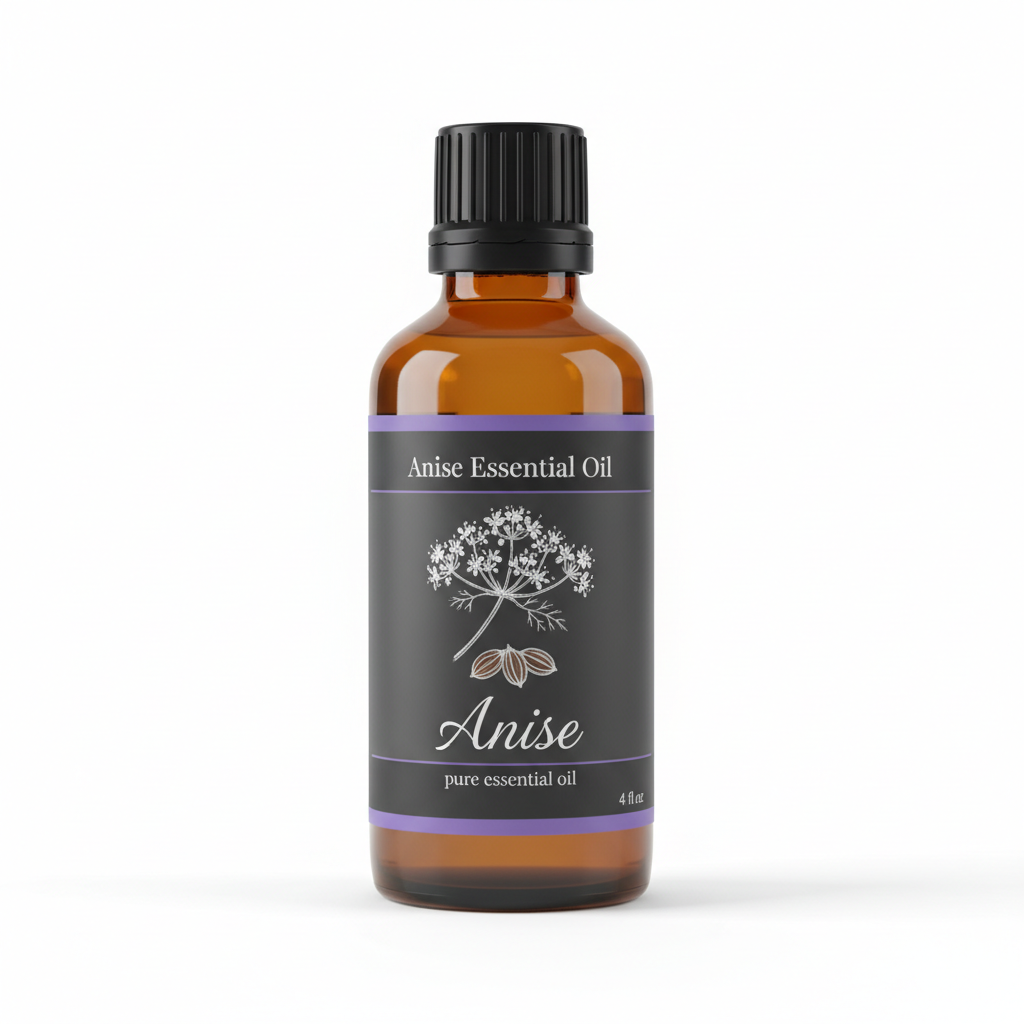
Anise Essential Oil
Our own Anise Essential Oil, in sizes from 0.5 oz to bulk.
From $8.99
Shop Now →This deep dive unpacks what is actually inside that seed: the primary compounds that define its profile, what current research observes about those compounds, and the practical sourcing and safety knowledge every informed buyer should carry. If you are just getting acquainted with the oil itself, the complete guide to anise oil is a helpful starting point before returning here for the chemistry detail.
Meet the Plant: Botanical Identity and Growing Range
Pimpinella anisum belongs to the family Apiaceae, the sprawling clan that also includes fennel, carrot, dill, and coriander. It is an annual herb, rarely exceeding sixty centimeters in height, with delicate white flower clusters arranged in compound umbels typical of the family. The seeds (botanically, they are small dry fruits called schizocarps) develop after flowering and carry the plant's signature volatile oil in specialized secretory canals running along each seed coat.
Native to the eastern Mediterranean and southwestern Asia, the plant has been cultivated since antiquity across Egypt, Greece, Turkey, and the Levant. Commercial cultivation today spans a broad arc: Turkey and Egypt remain significant producers, while Spain, India, and parts of Central and South America contribute substantially to global supply. Growing conditions matter enormously to oil quality. The plant prefers well-drained, moderately fertile soils and a warm, dry growing season. Excessive moisture during seed maturation dilutes the volatile oil content and can shift the chemical balance in ways that affect both scent and composition.
Chemical Composition: What Is Actually Inside the Seed
Anise seed essential oil is dominated, sometimes overwhelmingly, by a single phenylpropanoid compound: trans-anethole. Published analyses of Pimpinella anisum essential oil consistently report trans-anethole concentrations ranging from roughly 75 percent to over 90 percent of total composition, depending on geographic origin, harvest timing, and distillation method. That single compound is responsible for the oil's characteristic sweet, warm, licorice-like aroma.
Beyond trans-anethole, anise seed oil contains a collection of minor constituents that contribute nuance to its aromatic profile and form the subject of ongoing compositional research.
Key Compounds at a Glance
| Compound | Typical Concentration Range | Aromatic Character |
|---|---|---|
| trans-Anethole | 75% to 92% | Sweet, anise, warm |
| Estragole (methyl chavicol) | 1% to 6% | Herbaceous, slightly spicy |
| Pseudoisoeugenol II | Trace to 2% | Soft floral, spicy undertone |
| Anisaldehyde | Trace to 1% | Sweet, floral, powdery |
| cis-Anethole | Trace to 0.5% | Similar to trans-anethole, less intense |
| Limonene | Trace to 1% | Bright citrus |
| gamma-Himachalene | Variable | Woody, earthy |
The dominance of trans-anethole is what makes anise seed oil such a consistent aromatic ingredient. A perfumer or cosmetic formulator working with a high-quality oil from Egypt and one from Turkey will find the top note remarkably similar, even though the minor compound profiles may differ noticeably. The nuance lives in the supporting cast.
It is worth noting that the compositional signature of Pimpinella anisum oil closely resembles that of star anise oil (Illicium verum), despite the two plants being entirely unrelated. Both produce trans-anethole as the dominant constituent, which explains why they share an almost interchangeable scent profile. The comparison of anise and star anise oils explores those similarities and their practical implications for buyers in more detail.
What Research Observes: A Carefully Framed Look at the Literature
Research into Pimpinella anisum and its constituent compounds is active and growing. It is important to read that literature with calibrated expectations. Laboratory and in vitro studies observe how isolated compounds behave in controlled conditions. Those observations do not translate directly into claims about what a diluted cosmetic oil will do on human skin or in an aromatherapy diffuser. With that framing clearly in place, the research landscape is genuinely interesting.
Trans-Anethole
Trans-anethole has attracted considerable scientific attention over the decades. Some research suggests it interacts with certain biological receptor pathways, and in vitro studies have observed varied cellular responses to the compound in controlled settings. A 2016 review published in the Journal of Applied Microbiology noted observations about anethole's behavior in laboratory assays, though the authors were careful to note the gap between such findings and any established real-world applications.
From an aromatic and cosmetic formulation standpoint, what matters more practically is trans-anethole's volatility profile and its behavior in emulsions and carrier bases. It is a relatively polar compound compared to many terpene-dominant essential oils, which affects its solubility and how it performs in water-in-oil versus oil-in-water formulations.
Estragole
Estragole (also called methyl chavicol) is present at low concentrations in anise seed essential oil and deserves specific attention because it has been the subject of safety-related research. The European Food Safety Authority and other scientific bodies have reviewed estragole and noted that, in high doses in animal studies, the compound showed genotoxic potential. The concentrations relevant to those findings are substantially higher than what appears in a properly diluted topical cosmetic application, but the research is cited consistently in quality safety profiles of the oil. Buyers seeking very low estragole fractions should look for oils that include detailed constituent breakdowns from gas chromatography-mass spectrometry (GC-MS) testing.
Anisaldehyde
Present only in trace amounts, anisaldehyde contributes a sweeter, more floral dimension to the oil's aroma. Some fragrance research has noted it as a potential contact sensitizer at higher concentrations, which underscores the importance of appropriate dilution in cosmetic and aromatic applications.
Safety Profile and Contraindications
Anise seed essential oil carries a reasonable safety profile when used as directed, but it has specific contraindications that every user should know before opening a bottle.
Dermal Application Guidelines
The International Fragrance Association (IFRA) and the Research Institute for Fragrance Materials (RIFM) have established dermal use limits for trans-anethole-containing oils based on sensitization data. For leave-on cosmetic products, recommended usage concentrations are typically low, often cited in the range of 0.1 to 0.5 percent of the finished product. Rinse-off applications may permit slightly higher concentrations, though formulation context matters significantly.
For general aromatic use in a home diffuser, standard dilution guidance applies: start low, ensure good ventilation, and limit continuous diffusion sessions. The oil is potent. A little goes a long way both aromatically and in formulations.
Patch Testing
Anyone using anise seed essential oil in a new topical application should perform a patch test before broader use. Apply a small amount of the properly diluted oil to the inner forearm, cover lightly, and wait 24 to 48 hours. Any redness, itching, or irritation is a signal to discontinue use and reassess.
Key Contraindications
- Pregnancy and breastfeeding: Anise seed oil is generally not recommended during pregnancy or while breastfeeding due to its estrogenic activity, attributed primarily to trans-anethole. Consult a qualified healthcare provider before any use during these periods.
- Hormone-sensitive conditions: Because research suggests trans-anethole may interact with estrogen receptor pathways, individuals with hormone-sensitive health histories should discuss use with their healthcare provider.
- Young children: Essential oils containing phenylpropanoids are generally considered unsuitable for infants and young children. Avoid diffusing or applying anise seed oil around small children without professional guidance.
- Carrier interactions: Trans-anethole can solidify at lower temperatures (its melting point is close to 22 degrees Celsius), which may cause anise seed oil to thicken or partially solidify in cool storage. This is a physical property, not a sign of spoilage, but it affects how the oil handles in formulation.
These points are educational observations drawn from established safety literature. They are not a substitute for individualized advice from a qualified healthcare provider, who should be consulted whenever there is a specific health question or concern.
Sourcing and Quality Indicators
Understanding the chemistry of Pimpinella anisum oil is only half the picture. Knowing how to evaluate what arrives in a bottle is equally important.
Geographic Origin and Its Influence
Turkish and Egyptian anise seed oils are widely regarded among aromatherapy suppliers as benchmark origins, producing oils with high trans-anethole content and clean, well-rounded aromatic profiles. Spanish anise seed oil also commands respect, particularly from producers who harvest at peak seed maturity and use careful low-temperature distillation. Indian-origin oils are available at lower price points, but quality can be more variable, and buyers should request constituent testing data.
The distillation process itself has a direct effect on oil quality. Steam distillation of freshly dried seeds, conducted at moderate pressures and temperatures, preserves the delicate minor compounds that give a fine oil its aromatic complexity. Longer distillation times or higher pressures can drive off lighter volatile fractions and shift the chemical profile. For a detailed look at how that process works, the guide to steam distilling anise seeds walks through both commercial and small-batch production approaches.
Reading a GC-MS Report
A gas chromatography-mass spectrometry (GC-MS) report is the most reliable quality document available for essential oils. When evaluating anise seed essential oil, look for the following in a GC-MS report:
- Trans-anethole listed as the dominant peak, ideally above 80 percent for a high-grade oil.
- Estragole at a low fraction, ideally below 3 percent.
- cis-Anethole at trace levels only. Elevated cis-anethole relative to trans-anethole can indicate poor harvesting or storage conditions.
- No peaks suggesting synthetic anethole adulteration. Pure steam-distilled oils have a characteristic minor compound fingerprint that synthetic blends often lack.
Reputable suppliers provide GC-MS batch reports either on request or directly via their product pages. If a supplier cannot or will not provide this documentation, that absence is itself informative.
Visual and Aromatic Quality Checks
Beyond laboratory testing, a high-quality anise seed essential oil should be colorless to very pale yellow, with a fluid consistency at room temperature above approximately 22 degrees Celsius. The aroma should be intensely sweet and warm, with a clean, slightly spicy base note that does not suggest off-notes from oxidation. Stale, musty, or sharp chemical undertones may indicate improper storage, excessive age, or adulteration.
Storage matters after purchase. Keep anise seed oil in a dark glass bottle, tightly sealed, away from heat and light. Proper storage significantly extends the useful aromatic life of the oil, which under good conditions can remain stable for several years.
A Compound Worth Understanding
Trans-anethole is one of the most studied phenylpropanoid compounds in the aromatic plant world. The seed that produces it has been grown and traded across the Mediterranean for thousands of years. That long history of use is not evidence of efficacy in any clinical sense, but it does tell you something about the oil's enduring place in aromatic and cosmetic traditions.
Knowing what is in a bottle of anise seed essential oil, where it comes from, how to evaluate its quality, and where its safety limits sit puts you in a genuinely different position as a buyer and formulator. The chemistry is not intimidating once you have a map. And Pimpinella anisum is, as it turns out, a remarkably legible plant once you learn to read it.