Anise in Holiday Baking Traditions Around the World
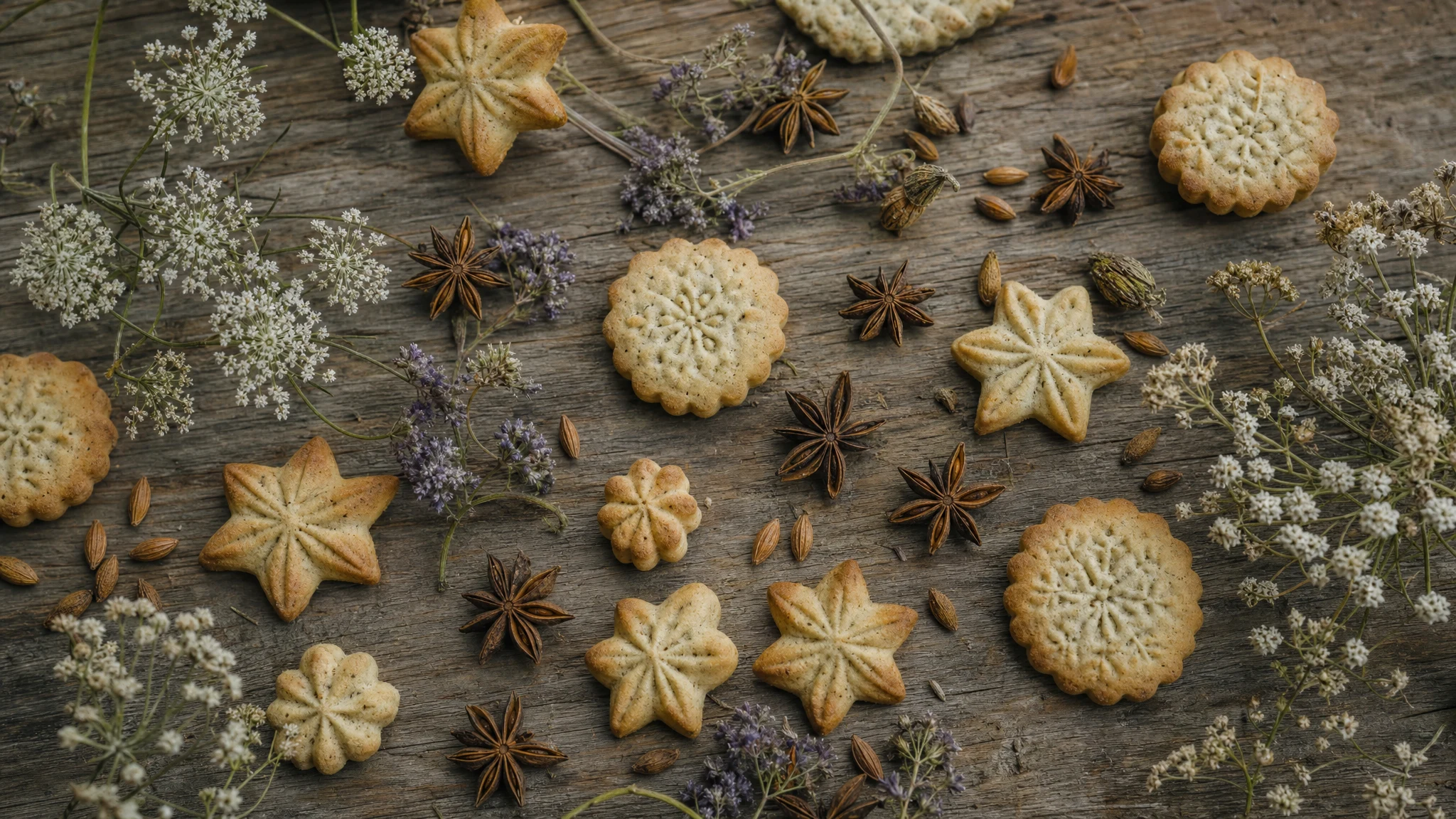
Anise shows up in Christmas cookies across Italy, Germany, Switzerland, New Mexico, Spain, Norway and Sweden, usually as whole seed or as a concentrated flavoring. Italian pizzelle, German springerle, and New Mexico's bizcochitos are the best documented. The seed and the concentrate are not interchangeable, and which one a tradition wants is the real baking question.
Anise Essential Oil
Our own Anise Essential Oil, in sizes from 0.5 oz to bulk.
From $7.99
Shop Now →This guide is for bakers who want to know what each tradition actually uses and why, so you can pick the right form for your own batch. It sticks to what we could verify. Where a famous origin story could not be confirmed, we say so. One rule applies throughout: our Anise Essential Oil is sold for aromatic and cosmetic use and is not labeled for food, so any baking with a concentrate should use a product that is labeled and sold for food use. We keep a sourcing guide at where to buy anise oil for baking: food grade options, and the general conversion rules live in our baking with anise oil guide.
Our position: seed and concentrate are different ingredients
Most holiday recipes treat "anise" as one flavor. We think that hides the decision that matters. Whole aniseed is a fruit: you taste it in bursts, you see it, and it adds a slight texture. A concentrated flavoring is a uniform wash with no particles. The tradition usually tells you which one it wants.
- Use seed when the seed is part of the look and the bite. Springerle, Norwegian aniskringler, and New Mexico's bizcochitos are all documented as seed-based, as the sources below show.
- Use a food-labeled concentrate when you need even flavor without specks. Pizzelle batter is thin and pressed in an iron, and published pizzelle recipes use anise as ground seed, oil or extract. Anisplätzchen are documented with either seed or oil.
- Do not swap by volume. A concentrate is far stronger than seed. Read the label of the product you bought and use the conversion guidance for that product.
This is our recommendation, drawn from how the traditions below are documented, and not from side-by-side baking tests of our own.
Italy: pizzelle and the iron
Pizzelle are thin waffle-style cookies pressed in a decorated iron. Italian-American food writing describes them as believed to have originated in Abruzzo, where they are called ferratelle after lu ferro, the iron used to bake them. L'Italo-Americano describes the early irons as having two rectangular plates on long locking handles held over an open fire, with the inside plates etched with a grate-like design. It adds that families often owned an iron, frequently given as a wedding gift and engraved with initials or a family insignia. Anise is a common flavoring, as ground seed, oil or extract, and the base recipe in that article calls for a quarter to a half teaspoon of anise oil for about 30 cookies.
A word of caution on origins. The town of Ortona is often credited, but several areas of Abruzzo, Molise and Lazio claim the cookie, and popular sites repeat a story linking pizzelle to the snake festival at Cocullo. We found no historical evidence for that story and do not repeat it. Wikipedia's article ties pizzelle to the ancient Roman crustulum but marks that claim as needing clarification. Why anise? Our reading: the iron gives a thin, crisp, nearly plain sheet, so a flavoring has to carry the whole cookie, and an even concentrate does that better than seed.
Our recipe pages are anise pizzelle and anise biscotti, and the older family-style guide is Italian anise cookies. We did not find a source we could verify for taralli, so we leave them out rather than guess.
Germany and Switzerland: springerle and Anisplätzchen
Springerle are embossed cookies. The dough is pressed with a carved mold and the pictures are left to dry before baking so the design holds. Wikipedia's article traces them to at least the 14th century in southwestern Germany, mostly Swabia, and reports that one of the oldest surviving molds, at the Swiss National Museum in Zürich, dates from the 14th century. They are called Anis-Brödle in Swabian dialect and Anisbrötli in Switzerland, which tells you the flavor is in the name. The anise is traditionally not mixed into the dough but dusted onto the baking sheets, so the cookie sits on crushed seed. Molds show springerle were baked for religious and secular occasions through the year, and they are now most associated with Christmas. The dough dries for about 24 hours, according to the same article. Details are in our springerle guide.
Anisplätzchen are a different cookie. The German Wikipedia article describes small round pastries made from a whole egg, sugar and flour sponge-type batter, flavored with anise seeds or anise oil, piped as dots and dried until they form a skin. Well made ones have a "Fuß" (foot), so they look somewhat mushroom-shaped. The article cites 19th-century cookbook author Henriette Davidis, who considered them suitable for the Christmas tree, and notes that an 1897 American edition of her cookbook rendered the name as "anise wafers". That is a small but concrete trace of the tradition crossing the Atlantic.
New Mexico and Mexico: bizcochitos and pan de muerto
These are two different traditions, and they are often confused. Bizcochitos (also spelled biscochitos) are the official state cookie of New Mexico, designated in 1989, and the first state cookie in the country according to the Wikipedia summary. State Symbols USA, citing the New Mexico Secretary of State, calls it a small anise and cinnamon flavored shortbread cookie introduced by early Spaniards in the 16th century. The state's recipe uses anise seeds creamed with lard and sugar, plus eggs, brandy and cinnamon. The legislature's aim was to preserve traditional home baking, and the cookie is typical of weddings, baptisms and the Christmas season.
Pan de muerto belongs to Mexico's Day of the Dead on November 1 and 2, not Christmas. Wikipedia describes the classic version as a sweet bread, often with anise seeds, and others with orange flower water or orange zest. It descends from the Spanish pan de ánimas (soul bread) in the account supported by scholars such as Stanley Brandes and Elsa Malvido, although some Mexican government bodies credit pre-Hispanic origins. We include it because it shows that anise is not always a "Christmas" flavor, and because the origin dispute is real. We could not verify more than that, and we are not going to settle it for you.
Why anise here? The documented link is Spanish baking: the bizcochito arrived with Spanish colonists and pan de muerto descends from Spanish soul bread. Our reading of why seed suits the bizcochito is that the lard dough is plain enough for the seed to be tasted and seen, but that is reasoning, not a documented reason.
Spain: roscos, bunyols and anís
Spain is the clearest example of anise showing up both in the oven and in the bottle. Foods and Wines from Spain describes the traditional Christmas rosco as a crumbly cookie made with flour, olive oil, sugar, icing sugar, aniseed and sweet anís, with no region given. It also lists bunyols from the Empordà in Catalonia, doughnuts with anís in the dough that are dipped in the spirit and sugar-coated, and casadielles from Asturias, pastry rolls filled with walnuts, cinnamon, butter, honey and anise. The same article says anís production in Rute, in Córdoba province, goes back to the 1630s, and that Anís del Mono, from Badalona near Barcelona, dates to 1870, though a Catalan encyclopedia gives 1880, so sources disagree.
The lesson for bakers is that in Spain the spirit and the seed are used together. The seed gives texture, the liqueur gives alcohol-carried aroma that bakes off more softly. If you want that second effect, our homemade anise liqueur guide covers making your own from whole seed, with the legal notes you need first.
Greece: koulourakia, ouzo, and a correction about vasilopita
Koulourakia are twisted butter cookies traditionally served at Easter, and some recipes are also made at Christmas. One recipe source says they can be flavored with anise seed, coriander seed, lemon, orange or ouzo, and its own version uses a half teaspoon of ground anise seed with a tablespoon of ouzo. That is a recipe, not a history, so we treat it as one example among several.
We did not find a source we could open that ties anise to vasilopita, the New Year's cake, so we do not claim it. Anise belongs to Greece through ouzo, which Wikipedia's anisette article lists as the Greek anise spirit, and through cookie recipes that vary by household, not through every holiday bread.
Scandinavia: limpa and aniskringler
Sweden's Christmas vörtbröd or vörtlimpa is a yeast-raised, spiced loaf sweetened with brown sugar and molasses, historically leavened with brewer's wort. Wikipedia lists traditional flavorings as anise, caraway, fennel seeds and bitter orange, and notes it is a typical dish at the Christmas Eve julbord. The article carries an accuracy-dispute notice, so treat the spice list as typical and not fixed. In Norway, aniskringler are soft anise pretzels with seed scattered on top, baked at Christmas, and recipes appear in housewife cookbooks from the late 1800s according to one food blogger. We found no verifiable anise Christmas bread for Denmark, so we do not claim one.
At a glance
| Region | Named dish | Form of anise | What we could verify |
|---|---|---|---|
| Abruzzo, Italy | Pizzelle (ferratelle) | Ground seed, oil or extract | Believed origin Abruzzo; iron; wedding gift tradition. Roman and snake-festival links unproven. |
| Swabia and Switzerland | Springerle (Anis-Brödle) | Seed dusted under the cookie | 14th-century molds, including one in Zürich. |
| Germany | Anisplätzchen | Seed or oil in a sponge batter | 19th-century cookbooks, including Davidis; 1897 American edition. |
| New Mexico | Bizcochitos | Seed creamed with lard | State cookie since 1989; introduced by Spaniards, per state sources. |
| Mexico | Pan de muerto | Often seed | Day of the Dead; origin debated between Spanish and pre-Hispanic accounts. |
| Spain | Roscos, bunyols, casadielles | Seed and anís spirit | Rute anís from the 1630s; Anís del Mono 1870 or 1880. |
| Greece | Koulourakia | Seed and ouzo, varies by recipe | Recipe-level source only; no anise source found for vasilopita. |
| Sweden and Norway | Vörtlimpa, aniskringler | Seed | Wikipedia and a recipe blog, both flagged as lighter sourcing. |
What to do with this when you bake
- Pick the tradition first, then the form of anise. Seed for springerle, bizcochitos and pretzels; a food-labeled concentrate or ground seed for thin batters.
- If you use a concentrate, use one labeled for food and follow its label. Our oil is for aromatic and cosmetic use, so keep it out of the mixing bowl.
- Measure the concentrate rather than judging it by smell. It is strong enough that a small error shows up in every cookie.
- For a candy-shop version of the same flavor, see old-fashioned anise hard candy.
If you want the smell of the season in the room instead of the oven, the oil we sell is on the shop page, for aromatic use.
Anise Essential Oil
Anise Essential Oil from our own shop, in sizes from 0.5 oz to bulk.
From $7.99
Shop Now →Sources & Further Reading
- L'Italo-Americano, Pizzelle: Holiday Waffles (Adri Barr Crocetti, 2016)
- Pizzelle, Wikipedia
- Springerle, Wikipedia
- Anisplätzchen, Wikipedia (German), citing Davidis, 1894 and 1897 editions
- State Symbols USA, New Mexico state cookie, biscochito (recipe from the NM Secretary of State)
- Bizcochito, Wikipedia
- Pan de muerto, Wikipedia
- Foods and Wines from Spain, Anís: cocktails, aperitifs and sweets (2023)
- Global Kitchen Travels, Koularakia
- Anisette, Wikipedia
- Limpa, Wikipedia
- North Wild Kitchen, Norwegian anise pretzels (2024)