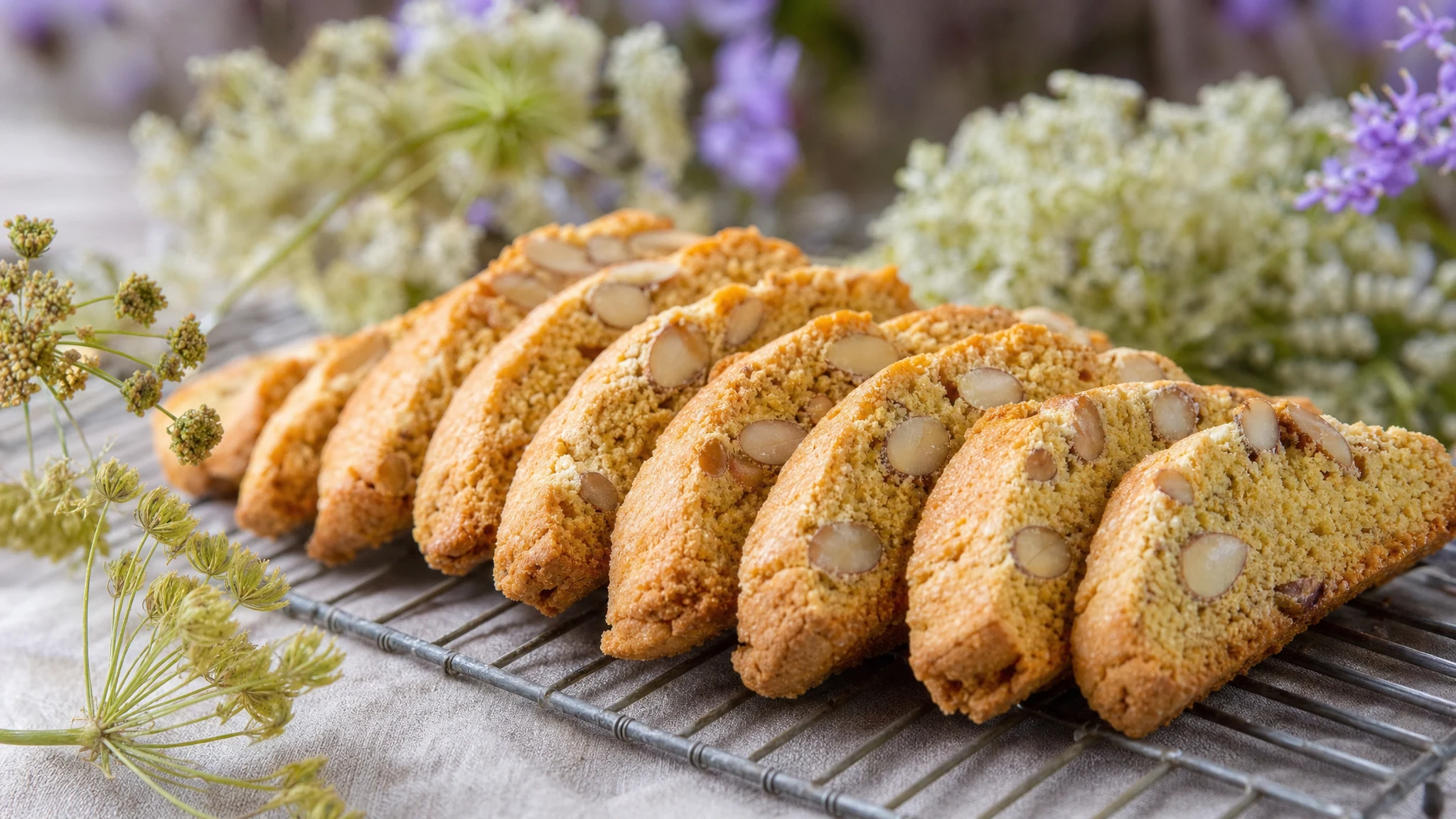
Anise Biscotti Recipe with Anise Oil
Anise biscotti are baked twice: a soft log first, then slices dried in the oven until crisp. Use a butter-egg dough with toasted almonds, slice when the log is warm but not hot, and flavor with anise labeled for food use, added in small steps. Oil is far stronger than extract.
Anise Essential Oil
Our own Anise Essential Oil, in sizes from 0.5 oz to bulk.
From $7.99
Shop Now →The food-use rule comes before the recipe
We sell Anise Essential Oil, and this site does not state that it is food grade. So this recipe does not tell you to put our bottle in the dough. Anise flavoring that goes into food must be a product labeled and sold for food use: an extract, a flavoring oil or a food-labeled essential oil. A bottle sold for aroma stays out of the kitchen. The guide to where to buy anise oil for baking shows what a food-use label looks like, and the baking hub covers measuring in general. If anyone eating these is pregnant, nursing, on medication or a young child, ask a pharmacist or physician first about concentrated flavoring oils. Poison Control is 1-800-222-1222.
What "biscotti" means, and what we can say about the original
Wikipedia describes biscotti as Italian almond biscuits originating in Prato, Tuscany, also called cantucci or biscotti di Prato. The word comes from Medieval Latin biscoctus, "twice-cooked," and the entry notes that the second baking made them very dry so they could be stored for a long time. It also says the traditional mixture is only flour, sugar, eggs and almonds, with no yeast or fat, and that in Italy they are served with Vin Santo, a Tuscan dessert wine, for dunking. See the Wikipedia entry on biscotti.
That matters for this recipe. The version below includes butter, which is what the American-style recipes in our sources use, and it gives a slightly more tender bite than the no-fat original. Anise is a modern or regional addition; the entry says only that modern recipes may use spices such as anise or cinnamon. It does not say anise is part of the Prato original. We chose to follow a documented anise biscotti, not to claim a tradition we cannot source.
Flavor dosing: reasoned, because oil is not extract
Published anise biscotti recipes measure extract. The Clever Carrot recipe, written with King Arthur flour, uses 2 teaspoons of anise extract, or up to 1 tablespoon for a stronger flavor, for 2 eggs and about 265 g of flour. Ciao Italia's biscotti di anice uses 2 tablespoons of extract for 6 eggs and 3 1/4 cups of flour, which scales to about 3 2/3 teaspoons for our flour amount. So the traditional extract range here is about 2 to 3 2/3 teaspoons. That is a lot of extract, and it says nothing about oil.
Published conversions for neat oil run from roughly 4 to 1 to more than 100 to 1, and our anise oil vs anise extract guide shows the spread. We do not know where a given food-labeled oil sits, and we will not print one ratio as if we did. If your label gives an extract-equivalent or a usage rate, follow it and skip to the recipe. If it does not, here is the reasoning we would apply:
- Assume the strong case. Over-flavoring cannot be undone in a dough that is about to be baked twice; under-flavoring can be fixed by kneading in more.
- Make a 1 percent working dilution. Stir 1/4 teaspoon of the food-labeled oil into 1/2 cup (about 24 teaspoons) of neutral vegetable oil. A spoon can measure that; it cannot measure a few drops. If your oil has crystallized in a cool room, warm and mix it first (see why anise oil turns solid or cloudy). Use up the jar in other cooking and label it.
- Test-bake a piece of dough before shaping. Raw egg dough should not be tasted, but a flattened teaspoon of dough baked for about 8 minutes at 325 F shows you the anise level in a form close to the finished cookie.
| Step (cumulative, whole dough) | 1% dilution added | Extract-equivalent if your oil is 250 times extract | Extract-equivalent if your oil is 100 times extract |
|---|---|---|---|
| 1 | 1/2 teaspoon | about 1 1/4 teaspoons | 1/2 teaspoon |
| 2 | 1 teaspoon | about 2 1/2 teaspoons | 1 teaspoon |
| 3 (stop here) | 1 1/2 teaspoons | about 3 3/4 teaspoons | 1 1/2 teaspoons |
Each teaspoon of the dilution holds 1/100 teaspoon of oil. Multiply by the assumed strength ratio and you get the extract it replaces. If step 3 is still faint, your oil is weaker than the 100 to 1 case, so stop and check the label or ask the seller for a usage rate rather than pouring in more. One caution on the second bake: it drives off water and concentrates what is left, which is our reasoning from how drying works, not a measured result. That is another reason to start low.
Recipe card: anise almond biscotti
The dough proportions follow The Clever Carrot's Italian anise biscotti (28 to 32 pieces), and the almond amount is scaled from Ciao Italia's 1 cup of almonds per 3 1/4 cups of flour, to about 2/3 cup (about 95 g) for 2 cups of flour. We have not baked this version. These are traditional proportions from published sources, and flour absorbs differently by brand, so expect to adjust.
Ingredients
- 2/3 cup (about 95 g) whole almonds
- 120 g (8 tablespoons) unsalted butter, softened
- 150 g (3/4 cup) granulated sugar
- 2 large eggs
- 1 teaspoon vanilla extract
- 265 g (2 cups, by the source's measure) all-purpose flour, plus extra for the board
- 1 1/2 teaspoons baking powder
- 1/2 teaspoon fine sea salt
- Anise flavoring labeled for food use: begin with 1/2 teaspoon of the 1 percent working dilution, or the amount on your label, and use the steps above
Steps
- Toast the almonds on an ungreased sheet at 350 F for 10 minutes, stirring once or twice, as Ciao Italia directs. Cool, then chop coarsely.
- Lower the oven to 325 F. Grease a sheet pan and line it with parchment.
- Cream the butter and sugar for about 2 minutes. Beat in the eggs one at a time, then the vanilla and the first dose of anise flavoring.
- Sift the flour, baking powder and salt together. Add gradually, mixing until just combined, then fold in the almonds. If the dough is too sticky, add flour 1 tablespoon at a time until soft and workable but not wet.
- Bake a flattened teaspoon of dough for about 8 minutes, taste it, and knead in the next step of flavoring if needed. Stop at step 3.
- On a floured surface, divide the dough in half and shape each half into a log about 8 inches long. Place 5 inches apart on the pan and flatten to 2 1/2 to 2 3/4 inches wide.
- First bake: 25 to 30 minutes on the center rack, until pale and just starting to turn golden at the edges. Surface cracks are normal.
- Cool the logs on a rack for 20 to 30 minutes. Cut on the diagonal into 1/2-inch slices with a serrated knife.
- Second bake: lay the slices cut side down on the pan and bake at 325 F for about 20 minutes, flipping halfway. Aim for a lightly darkened outside and an almond-colored middle, and add a few minutes if they still feel soft.
- Cool on a rack. Keep airtight at room temperature for several weeks.
Two 8-inch logs cut at 1/2 inch give about 16 slices each, so about 32 biscotti, in line with the 28 to 32 the source gives. Total time is about 1 hour 20 minutes.
Slicing temperature: the step where biscotti break
Sources disagree on timing. The Clever Carrot cools the logs 20 to 30 minutes and slices while still slightly warm. King Arthur's American-style vanilla biscotti waits only 5 minutes after the first bake, after lightly spritzing the logs with room-temperature water, because "softening the crust just this little bit will make slicing the biscotti much easier." They also say to cut straight up and down, perpendicular to the pan, so the slices stand up for the second bake. Our reasoning: a log cut straight from the oven is steamy and tears; a fully cold one has a hard crust that shatters under the knife. The window between is warm, and the water mist is a tool for logs that have gone cold or are crumbling. Use a serrated knife and a sawing motion with little downward pressure.
Almonds, dryness and what the second bake is for
Wikipedia notes that the second baking determines how hard biscotti become. King Arthur's advice is to bake until they "feel very dry and are beginning to turn golden," and adds that a slightly moist center is normal because they keep drying as they cool. Almonds toasted first add flavor and crunch, but they also carry oil, so very coarse chunks make slicing harder. Chop them coarsely, not into whole nuts, if you want clean slices.
Troubleshooting: what commonly goes wrong and why
| Problem | Likely cause | What to do |
|---|---|---|
| Slices crumble | Log cut too cold, or knife pressure too heavy | Mist lightly with water as King Arthur suggests, wait a few minutes, saw gently |
| Dough too sticky to shape | Flour absorbs differently by brand; The Clever Carrot notes one tester needed 4 to 5 extra tablespoons with another brand | Weigh the flour, then add 1 tablespoon at a time |
| Rock hard, tooth-cracking | Second bake too long or too hot | Shorten to 15 minutes and check; remember they firm as they cool |
| Dry and sandy inside | Over-baked first log, too much flour, or too little fat or egg | Pull the logs when pale and just golden at the edges; do not flour the dough heavily |
| Soft center after cooling | Second bake too short | Return slices for 5 to 10 minutes |
| Anise harsh, bitter or uneven | Overdose, or neat oil not dispersed into the butter | Use the working dilution and cream it into the butter and sugar first |
Our position
Do not trust any single printed oil-to-extract ratio, ours included. A cookie that spends 50 minutes in the oven and then sits in a tin for weeks is a poor place to find out you overdosed. Start with a small dose of food-labeled flavoring, test-bake a scrap, and step up. For more on how anise shows up in other holiday bakes, see anise in holiday baking traditions around the world.
Anise Essential Oil
Anise Essential Oil from our own shop, in sizes from 0.5 oz to bulk.
From $7.99
Shop Now →Sources & Further Reading
- The Clever Carrot, Italian Anise Biscotti: proportions, temperatures, times, troubleshooting
- Ciao Italia, Anise Cookie / Biscotti di Anice: almond ratio, toasting, biscotti definition
- King Arthur Baking, American-Style Vanilla Biscotti: water spritz, slicing, second bake
- Wikipedia, Biscotti: Prato origin, etymology, traditional ingredients
- Where to buy anise oil for baking