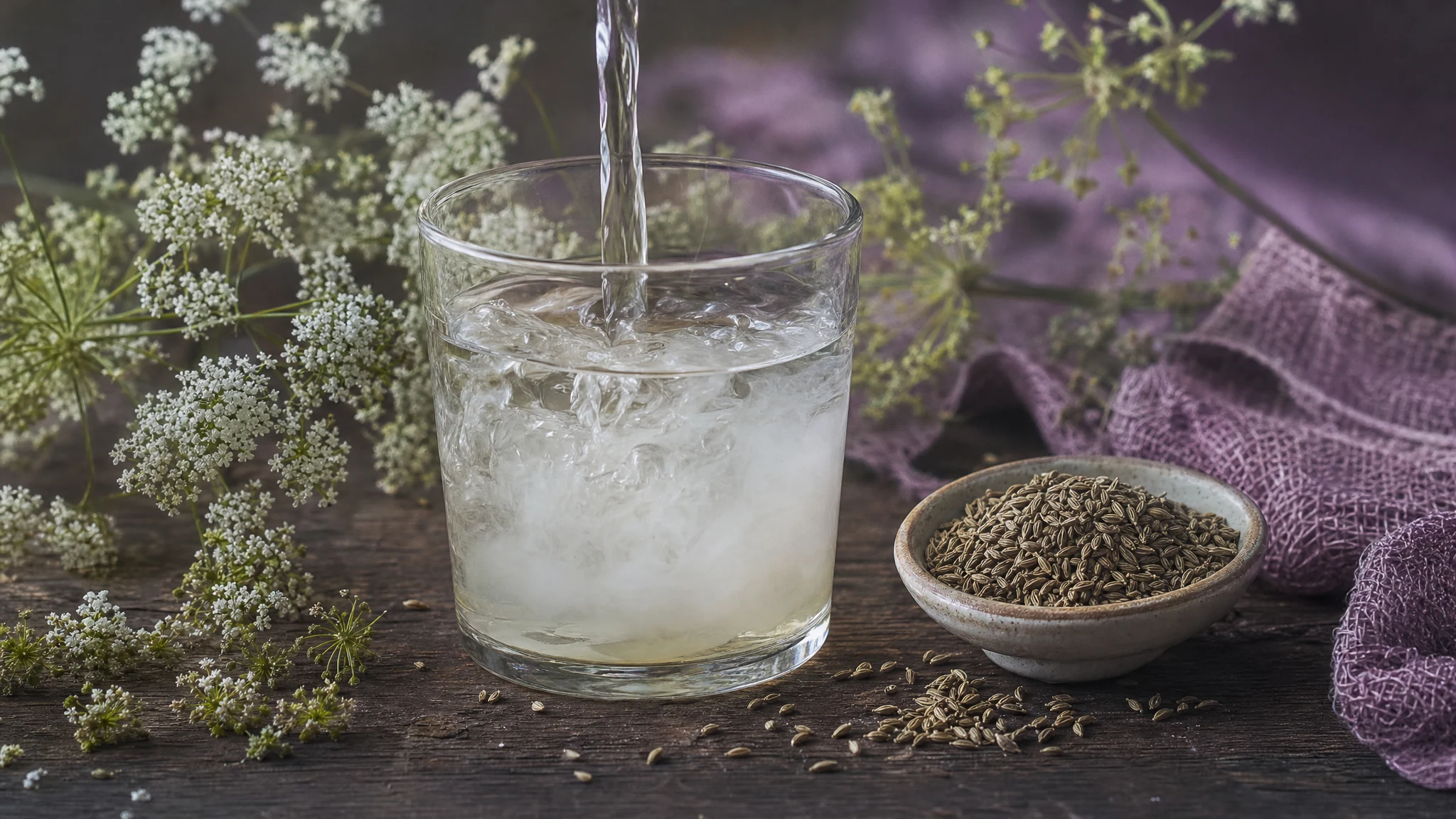
Homemade Anise Liqueur and the Ouzo Effect Explained
Homemade anisette is made by steeping crushed aniseed in a spirit you bought, then sweetening and filtering it. The ouzo effect is the milky cloud that appears when water is added: anethole, dissolved in alcohol, drops out as tiny droplets. Both come down to one fact. Anethole dissolves in ethanol and barely dissolves in water.
Anise Essential Oil
Our own Anise Essential Oil, in sizes from 0.5 oz to bulk.
From $7.99
Shop Now →That one fact explains most of what goes right and wrong in a homemade batch, so we start with the chemistry, then the law, then a recipe. First, a plain statement about our own product. Our Anise Essential Oil is sold for aromatic and cosmetic use. It is not labeled or sold as a food. Do not put it in a drink. Every recipe below uses whole aniseed, or a flavoring that is labeled and sold for food use. If you want to understand why we draw that line, read can you eat anise essential oil, and for sourcing food-labeled anise flavoring see where to buy anise oil for baking: food grade options.
The ouzo effect: what is actually happening in the glass
Ouzo, pastis, sambuca and Spanish anís all go cloudy when diluted. The name comes from the Greek spirit, and the phenomenon was formally described in the physical chemistry literature by Stephen Vitale and Joseph Katz, in Langmuir 19(10), pages 4105 to 4110, published in 2003 under the title "Liquid Droplet Dispersions Formed by Homogeneous Liquid-Liquid Nucleation: The Ouzo Effect" (DOI 10.1021/la026842o). One detail worth knowing: as summarized by later researchers, Vitale and Katz did not use anethole. They used divinylbenzene in water and alcohol mixtures, and showed that a mixture of a water-miscible solvent and a water-insoluble oil forms a long-lived fine emulsion with no surfactant when it is poured into water. They reported droplets of roughly 1 to 3 micrometers. Anethole behaves the same way, which is why the name stuck. We have not been able to open the paper itself, so these details come from the 2024 work by Archer and colleagues, listed below.
The mechanism, in the words of that 2024 paper, is straightforward. Ouzo is about 60 percent water and 40 percent ethanol, with a small amount of trans-anethole. Adding water reduces the alcohol available to hold the oil in solution, so the mixture spontaneously emulsifies into a cloudy dispersion without any stirring. The authors calculated that a typical serving, one part spirit to four parts water, lands near 92 percent water, 8 percent alcohol and 0.01 percent oil by weight, and that the droplets are around 1 micrometer. Those droplets scatter light, which is why the drink looks white. The French name for the look is louche.
The solubility numbers behind it
PubChem compiles two relevant figures for anethole. A water solubility of 0.111 grams per liter at 25 C, from the Aquasol database (Yalkowsky and Dannenfelser, 1992), and, from Fenaroli's Handbook of Flavor Ingredients (1975), a solubility of 1 part in 8 parts of 80 percent alcohol. PubChem labels the record "anethole" without always naming the isomer, so treat the figures as approximate. The gap is the point: a tiny amount stays dissolved in water, and a far larger amount stays dissolved in strong alcohol. Everything in between is the louche zone.
Reading the louche in your own liqueur
Most home guides treat the cloud as decoration. We think it is more useful as a test, because it tells you how much anethole your infusion actually pulled out and how close your bottle sits to the edge. This is reasoning from the phase behavior above, not a measured result from our own batches, so use it as a guide and not a lab assay.
| What you see | Likely reason | What to do |
|---|---|---|
| Bottle is clear at room temperature, clouds when you add water or ice | Normal louche. Anethole is stable in the strong liqueur and falls out as dilution lowers the ethanol share. | Nothing. This is the expected behavior. A glass poured over ice will cloud. |
| Bottle itself is hazy straight from the infusion | The finished strength is too low for the anethole load, or fine seed particles and seed oils passed the strainer. | Filter again through a paper coffee filter. If it still clouds, the next batch needs fewer seeds or a stronger base spirit. |
| Bottle was clear, clouds after time in the refrigerator | Lower temperature reduces what the liquid can hold, so anethole comes out of solution. | Let it return to room temperature and see whether it clears. Serve it cloudy, or store it at room temperature. |
| Liqueur never clouds on dilution | Very little anethole was extracted, or the flavor came from something other than aniseed. | Steep longer or use more seed next time, and taste before you decide. |
| Oily sheen or droplets on the surface | Anethole or seed oil above the limit the liquid can hold. | Reduce the seed amount. Strain after resting. |
The practical lesson is that sugar and strength change the picture. Archer and colleagues measured the ouzo region in an ethanol, water and anethole system, not in a sugar syrup, so a sweet liqueur will not match their numbers exactly. If you want the density and sweetness of a liqueur, expect a milky glass. If you want a clear glass, this is the wrong spirit. For the chemistry of anethole itself, see the chemistry of anise oil.
The legal line: distilling is not allowed, infusing is a different question
This section is general information, not legal advice. For your situation, ask your state alcohol beverage control agency or an attorney.
On distilling, the federal answer is clear. The Alcohol and Tobacco Tax and Trade Bureau (TTB) says on its home distilling page that federal law strictly prohibits individuals from producing distilled spirits at home, citing 26 U.S.C. 5042(a)(2) and 5053(e), and that wine and beer for personal or family use are treated differently. TTB's alcohol FAQ adds: "There are no personal exemptions for production of distilled spirits." Producing outside a qualified distilled spirits plant can bring felony charges. Court activity around this ban has been reported, and the situation may change, so check TTB for the current position rather than relying on news summaries. Nothing in this article involves a still.
Infusing is different in kind: you start with spirits that were already produced and taxed, and you add flavor. Here we owe you a careful answer. We reviewed TTB's FAQ and home distilling page and neither mentions flavoring or infusing purchased spirits for personal use, so we cannot cite TTB as affirmatively approving it. The closest federal statement we found is a 2012 TTB position, reported by the Libation Law Blog, that covers bars and restaurants infusing taxpaid spirits for on-premises service, in which TTB chose enforcement discretion. That is a commercial setting and not a home one. Our reading is that mixing flavor into a bottle you bought, for your own use, is a different activity from producing spirits, but that is our reading and not a ruling. States and localities vary, so confirm locally. Do not sell, trade or serve the result to the public, which moves you into licensing territory.
On age, federal highway-funding law at 23 U.S.C. 158 penalizes states that allow people under 21 to buy or publicly possess alcohol, and the age is 21 across the United States as a result. Treat this as an adults-only project, make it away from children, and store the finished bottle where children cannot reach it.
A whole-aniseed anisette (starting-point recipe)
We have not published batch logs or tasting results for this recipe, so read it as a starting formulation, not a tested one. It scales the method used in published anise liqueur recipes: steep seeds in alcohol for weeks, filter, then combine with a cooled sugar syrup. One Italian recipe from Calendario Valtellinese macerates 100 grams of anise seed per liter of 95 percent alcohol for about 30 days, mixes with a syrup made from 1.5 kilograms of sugar and 1.5 liters of water, and lets it settle for at least 2 days. Ninety-five percent spirits are not generally sold for drinking in the United States, so the version below uses ordinary 80-proof vodka, which extracts more slowly. Start light and taste.
Ingredients
- 750 mL purchased vodka, 40 percent alcohol by volume (80 proof)
- 2 tablespoons whole aniseed (Pimpinella anisum), lightly crushed, from the spice aisle or a food-labeled supplier
- 1 cup sugar and 1 cup water, for the syrup
Method
- Crush the seed lightly with the flat of a knife so the surface opens, then put it in a clean glass jar with the vodka. Seal it and keep it in a cool, dark place.
- Shake gently every few days. Taste a drop on day 3, then weekly. The published Italian method runs about 30 days; with weaker spirit, expect to stop when the flavor suits you, not when a calendar says so.
- Dissolve the sugar in the water over low heat and cool it completely.
- Strain the vodka through a fine sieve, then again through a paper coffee filter.
- Stir in about two thirds of the syrup (roughly 240 mL), taste, and add more only if you want it sweeter. By simple arithmetic this lands near 30 percent alcohol by volume (60 proof), ignoring the small shrinkage that happens when alcohol and water mix.
- Rest the bottle for a few days before judging it. The Italian recipe waits a few days to a few weeks for a rounder flavor.
- Test it: pour 1 ounce over ice, add 3 ounces of cold water, and watch for the louche.
If you want a flavored-vodka shortcut
Use a flavoring that is labeled and sold for food use and follow its label exactly, including any limit on use in beverages. We do not give a drop count here because we cannot see what is in your bottle. In the United States, anise oil from Pimpinella anisum appears in the FDA list of essential oils generally recognized as safe for their intended use (21 CFR 182.20). That listing is about the substance in food use. It does not turn a bottle labeled for cosmetic or aromatic use into a food product, and it does not describe our oil. Star anise is not on that same list entry, which is one more reason to follow the label of whatever food flavoring you buy.
The strength of whole seed versus a concentrate is a bigger difference than most recipe pages admit. Seeds release flavor slowly and gently, so you can stop steeping at the right moment. A concentrate gives you no such control: once it is in, it is in. That is our reason for recommending seed for a first batch. For how anise concentrates compare with extract in baking, see anise oil vs anise extract and the baking with anise oil guide, which cover only products sold for food.
Who should not make or drink this
- Anyone under 21, and anyone who has been told to avoid alcohol.
- Anyone who is pregnant, trying to become pregnant, or breastfeeding. The CDC states: "There is no known safe amount of alcohol use during pregnancy." Ask your OB-GYN or midwife.
- Anyone taking medicines that interact with alcohol. Ask a pharmacist or physician before drinking.
- Anyone with a history of alcohol use disorder, liver disease, or an allergy to anise or related plants.
- Anyone about to drive or operate machinery.
Drink in moderation, never mix it with other sedating substances, and do not leave an open bottle where a child or pet can reach it. If a child or pet swallows liqueur or an anise flavoring, call poison control at 1-800-222-1222 or your veterinarian. This article makes no health claims about anise or alcohol, and nothing here replaces advice from your physician.
Common questions
Is anisette the same as sambuca or ouzo?
No. Anisette is a sweet, usually clear liqueur flavored with aniseed. Sambuca is an Italian anisette with a required minimum sugar content, and pastis also uses licorice root, according to the summary on Wikipedia's anisette page. Ouzo is the Greek anise spirit. Naming rules differ by country, so the label tells you more than the flavor does.
Can I use star anise instead of aniseed?
People do. CooksInfo notes that Italian versions may use star anise rather than aniseed. They are different plants, so the flavor and the oil composition differ, and we explain the gap in anise vs star anise. Use only a star anise sold as a food spice, and read our guide to the Japanese star anise mix-up before you buy it loose.
Why did my batch go cloudy in the refrigerator?
Most likely because cold lowers what the liquid can hold, and anethole came out of solution. Warm it to room temperature and see whether it clears. If it does, nothing is wrong. That is the same effect as the louche, triggered by temperature instead of water.
If you are exploring anise for room scent or crafts instead, the oil we sell is on the shop page, for aromatic and cosmetic use only.
Anise Essential Oil
Anise Essential Oil from our own shop, in sizes from 0.5 oz to bulk.
From $7.99
Shop Now →Sources & Further Reading
- Ouzo effect, Wikipedia (reference list for Vitale and Katz, Langmuir 19(10):4105-4110, 2003, DOI 10.1021/la026842o)
- Archer et al., Experimental and Theoretical Bulk Phase Diagram and Interfacial Tension of Ouzo (arXiv:2404.18524, 2024)
- PubChem, anethole solubility records (Aquasol; Fenaroli's Handbook of Flavor Ingredients, 1975)
- TTB, Home Distilling
- TTB, Alcohol FAQs (G1, G8)
- Libation Law Blog, 2012 summary of the TTB opinion on alcohol infusions (retail on-premises)
- 23 U.S.C. 158, National minimum drinking age
- CDC, About Alcohol Use During Pregnancy
- 21 CFR 182.20, Essential oils, oleoresins, and natural extractives
- Calendario Valtellinese, Homemade Anise Liqueur recipe
- Anisette, Wikipedia
- CooksInfo, Anisette