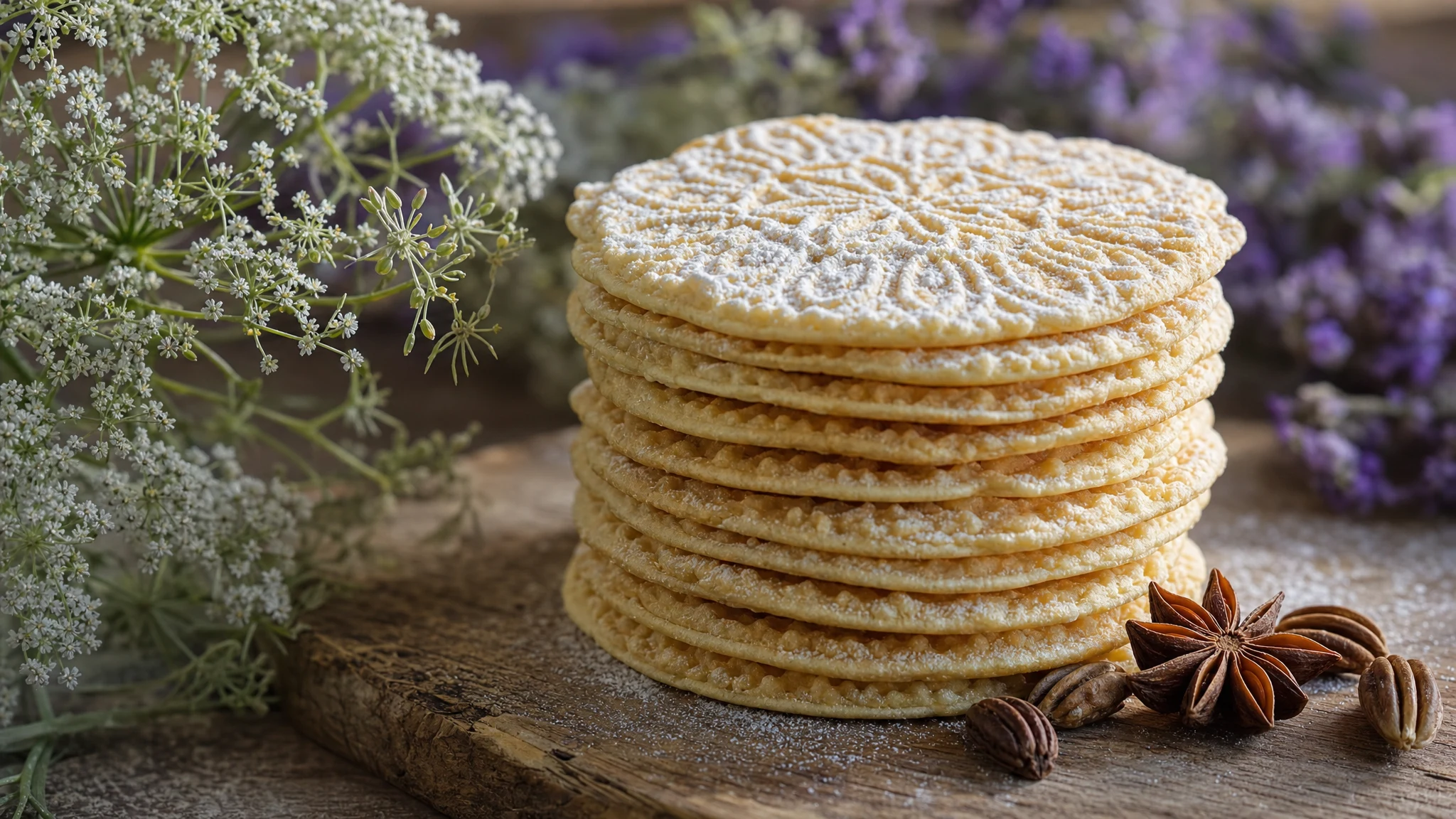
Anise Pizzelle Recipe Made with Anise Oil
Anise pizzelle are thin waffle cookies made from a thick egg, butter and flour batter, cooked 45 seconds to 2.5 minutes in a hot pizzelle iron. The batter is easy. The flavoring is where batches fail: neat anise oil is not extract, and anything you put in food must be labeled and sold for food use.
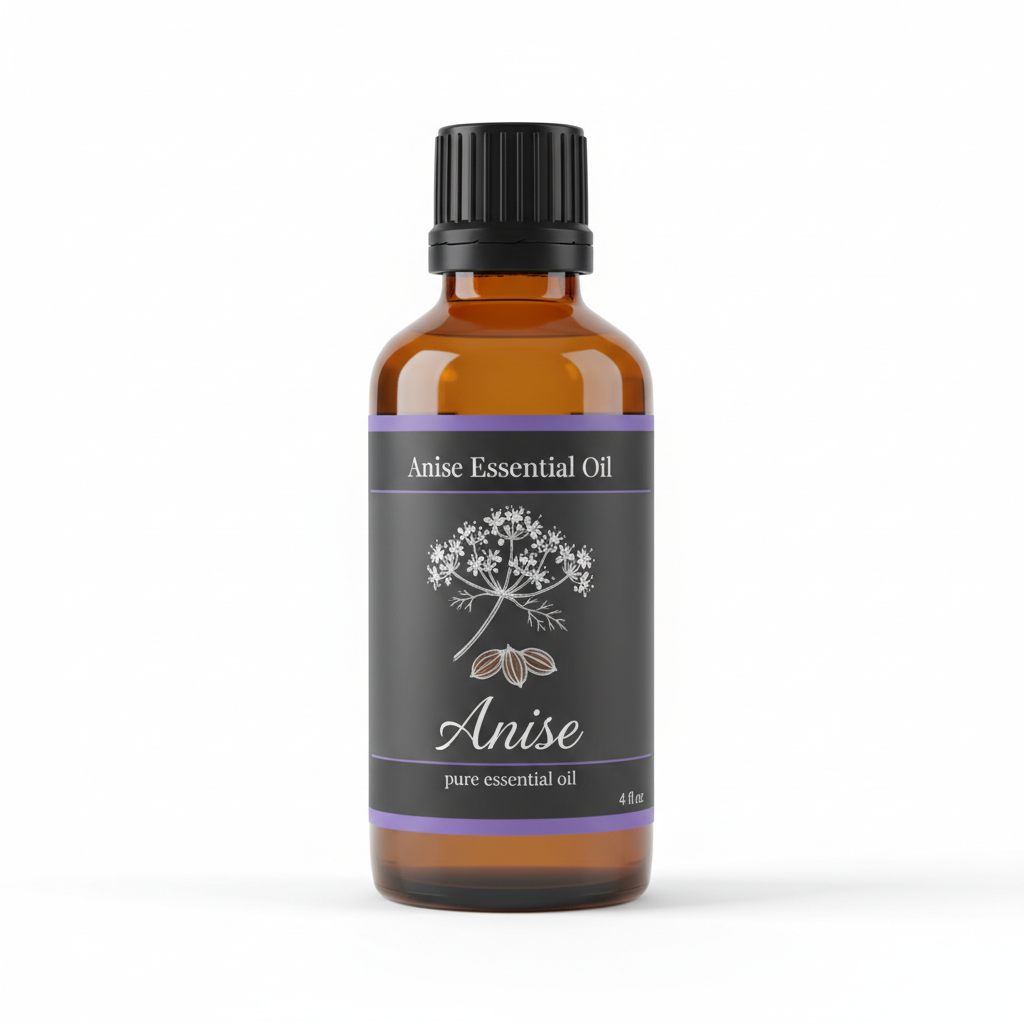
Anise Essential Oil
Our own Anise Essential Oil, in sizes from 0.5 oz to bulk.
From $7.99
Shop Now →Read this first: which anise oil goes in a cookie
Our shop sells Anise Essential Oil in sizes from 0.5 oz to 400 lb, and this site does not state that it is food grade. So we are not telling you to put our bottle in these pizzelle. The anise flavoring in food has to be a product labeled and sold for food use, whether that is an extract, a flavoring oil or a food-labeled essential oil. If the bottle says "for external use" or "aromatherapy," it stays out of the batter. Our guide to where to buy anise oil for baking explains what to look for on a label, and the baking hub covers measuring in general.
Why be this firm? A listing in the U.S. food regulations is about a substance used as a flavoring in food. Anise (Pimpinella anisum L.) appears in the list of essential oils, oleoresins and natural extractives in 21 CFR 182.20. That tells you the plant material has a regulatory status as a flavoring. It does not tell you that a particular bottle, made and sold for aroma, was produced and handled for food. Only the seller of that bottle can say so, and the label is where they say it. If you cannot find the statement, buy a different bottle. Anyone who is pregnant, nursing, on medication or cooking for a small child should ask a pharmacist or physician before serving foods flavored with concentrated oils, and if you suspect a bad reaction call Poison Control at 1-800-222-1222.
What a pizzelle is, and what we could and could not verify
Pizzelle are Italian waffle cookies made with flour, eggs, sugar, butter or oil and a flavoring, usually anise or anisette, with vanilla or lemon zest as alternatives, according to the Wikipedia entry on pizzelle, which cites NYT Cooking for that list. The same entry says they began in the municipality of Ortona in Abruzzo and spread to nearby Molise and Lazio, and that in parts of Abruzzo they are also called ferratelle, nevole or catarrette. "Ferratelle" echoes ferro, the Italian word for iron, which fits the tool that makes them.
You will also read that pizzelle were invented in the Abruzzo village of Cocullo, where a procession for San Domenico Abate is famous for its snakes. That story is common on food sites. We could not find a primary source for it. The L'Italo-Americano piece on Cocullo describes the festival and the village in the Apennines but never mentions pizzelle. Read the snake story as a legend, and take "Abruzzo" as the safe claim.
On the iron: Wikipedia describes it as resembling a small waffle iron, with older irons held by hand over a stovetop burner and most modern ones electric. Two plates are engraved with a pattern, and the batter stiffens as the plates heat. That matters for the batter, because the pattern only prints well from a thick batter that does not run.
The dosing problem, stated plainly
Recipe writers give anise in extract. King Arthur's pizzelle page says classic pizzelle are often flavored with anise extract or anise seed and suggests starting with 1/4 teaspoon of extract and adjusting, because extract strength varies. Martha Stewart's version on PBS Food uses 1 teaspoon of pure anise extract plus 1 1/4 teaspoons of toasted, ground anise seed for 2 eggs and 1 1/4 cups of flour. So the traditional range for extract is about 1/4 teaspoon to 1 1/2 teaspoons for a three-egg batch, scaled from those two recipes.
Converting that to a bottle of oil is where the sources split. Published conversions for neat anise oil run from roughly 4 to 1 up to more than 100 to 1, and the comparison in our anise oil vs anise extract guide shows why a single number is slippery. We do not know where a given food-labeled oil falls, and a verified, source-backed number for neat oil does not exist in the references we could open. Picking one ratio and printing it as fact would be a guess dressed as precision. If your label gives an extract-equivalent, use it and skip this section. If it does not, this is the logic we would apply, and it is reasoning, not a test result:
- Assume the strongest case. An overdose cannot be taken out of a batter, while an underdose can be corrected. So dose as if the oil is very strong and step up.
- Make the oil measurable. Neat oil at a few drops cannot be portioned with a spoon. Make a 1 percent working dilution: 1/4 teaspoon of the food-labeled oil stirred into 1/2 cup (about 24 teaspoons) of neutral vegetable oil. Use it up in other cooking, and label the jar. If your oil has crystallized in a cool room, warm and mix it first, because solid flakes dose unevenly (see why anise oil turns solid or cloudy).
- Add in steps and cook a test pizzelle between steps. A pizzelle takes minutes, which is why this recipe suits the method better than a dough that bakes for an hour.
| Step (cumulative, whole batter) | 1% dilution added | Extract-equivalent if your oil is 250 times extract | Extract-equivalent if your oil is 100 times extract |
|---|---|---|---|
| 1 | 1/4 teaspoon | about 5/8 teaspoon | 1/4 teaspoon |
| 2 | 1/2 teaspoon | about 1 1/4 teaspoons | 1/2 teaspoon |
| 3 (stop here) | 3/4 teaspoon | about 1 7/8 teaspoons | 3/4 teaspoon |
The arithmetic is plain: 1 teaspoon of a 1 percent dilution holds 1/100 teaspoon of oil. Multiply by the assumed strength ratio and you get the extract amount it stands in for. Compare the columns with the 1/4 to 1 1/2 teaspoon extract range above. If step 3 is still faint, your oil is weaker than the 100 to 1 case. Do not keep adding; check the label or ask the seller for a usage rate. The 1 percent dilution adds less than a teaspoon of oil to a batter that already holds 8 tablespoons of butter.
Recipe card: anise pizzelle
The proportions are King Arthur's classic pizzelle batter, with anise added. King Arthur's page lists a yield of 30 to 50 pizzelle depending on iron size. We have not baked this version. These are traditional proportions from a published source, and your iron's manual governs the cook time.
Ingredients
- 3 large eggs
- 3/4 cup (149 g) granulated sugar
- 3/8 teaspoon table salt
- 1 teaspoon pure vanilla extract
- 1 3/4 cups (210 g) all-purpose flour
- 2 teaspoons baking powder
- 8 tablespoons (113 g) unsalted butter, melted and cooled slightly
- Anise flavoring labeled for food use: start with 1/4 teaspoon of the 1 percent working dilution described above, or the amount your label gives (see the dosing table)
- Optional: 1 3/4 teaspoons anise seed, toasted and finely ground (Martha Stewart's 1 1/4 teaspoons per 1 1/4 cups of flour, scaled to 1 3/4 cups)
- Confectioners' sugar for dusting, optional
Steps
- Heat the pizzelle iron as the manufacturer directs, and grease it if the manual says to. One King Arthur reader wipes the plates with a towel dipped in vegetable oil instead of using spray.
- Whisk the eggs, sugar, salt and vanilla until well combined.
- Stir in the flour and baking powder (and the ground seed, if using) until smooth.
- Mix in the cooled butter until smooth. The batter will be thick and soft.
- Stir in the first dose of anise flavoring. Cook one pizzelle, let it cool for a minute and taste it.
- If the anise is faint, stir in the next step from the table and cook another test. Stop at step 3.
- Cook the remaining batter, one pizzelle per pattern. King Arthur gives 45 seconds to 2 1/2 minutes to brown, which depends on the iron. Lift each cookie with a small spatula.
- Cool flat on a wire rack. Trim ragged edges with scissors if you like, and dust with confectioners' sugar.
Crisp or soft: it is mostly time on the iron and what happens after
King Arthur describes these as crisp and buttery, and Wikipedia says the cookie is crisp once cooled. A pizzelle is thin and sugary, and sugar attracts moisture from the air, so a cookie that was crisp at the table can go limp in a humid kitchen or an unsealed container. That is reasoning from how sugar behaves, not a measured result. If you want soft, pull them when they are pale gold and expect them to stay flexible for a short time. If you want crisp, cook until evenly golden, cool flat on a rack and seal them once completely cool. King Arthur says pizzelle are best eaten immediately, and keeps leftovers for up to a week airtight or a month frozen.
Why too much anise turns harsh
An overdosed pizzelle tastes less like candy and more like harsh, bitter licorice with a sharp edge that lingers after you swallow. Because the cookie is thin and baked in seconds, there is no long bake to mellow the flavor and no crumb to dilute it. The main aroma compound is anethole, covered in our chemistry of anise oil article. Our position: under-flavor the first batch. A faint pizzelle can be rescued with confectioners' sugar and a good cup of coffee. An overpowering one goes in the trash.
Troubleshooting: what commonly goes wrong and why
| Problem | Likely cause | What to do |
|---|---|---|
| Cookie sticks to the plates | Iron not hot enough or not greased as the manual says; residue from aerosol spray builds up | Preheat fully and wipe the plates with a lightly oiled towel, as the King Arthur reader suggests |
| Pattern is faint | Batter too thin, or too little batter | Make sure the batter is thick and soft; add a spoonful of flour only if it runs |
| Pale, soft cookies | Cooked too briefly for your iron | Add 10 to 15 seconds; a range of 45 seconds to 2 1/2 minutes is normal across irons |
| Dark brown edges, bitter taste | Iron too hot or cooked too long | Lower the heat setting or shorten the time |
| Uneven anise, pockets of strong flavor | Neat oil dropped into the batter without being dispersed, or crystals in cold oil | Use the working dilution and whisk it fully into the butter before adding |
| Cookies go chewy after a day | Moisture from the air reaches the sugar | Cool completely, store airtight, and re-crisp in a low oven if needed |
If you want to compare with a cookie that needs no iron
Our existing Italian anise cookies use an oven instead of an iron, and our anise biscotti take the other direction, baking twice for dryness. Use the dosing steps here for any of them, because the food-label rule and the strength uncertainty apply to all.
Our position
Do not convert oil to extract by a single printed ratio, ours or anyone else's. Follow the label if it gives a usage rate. If it does not, dose low in measured steps, and tell yourself that a pizzelle you can fix is better than one you cannot. And if the only anise oil in your house is a bottle bought for aroma, buy a bottle meant for food before you bake.
Anise Essential Oil
Anise Essential Oil from our own shop, in sizes from 0.5 oz to bulk.
From $7.99
Shop Now →Sources & Further Reading
- King Arthur Baking, Pizzelle (Italian Christmas Cookies): proportions, yield, cook time, flavoring tip, storage
- PBS Food, Anise Pizzelle (Martha Stewart, Martha Bakes, 2018)
- Wikipedia, Pizzelle: origin in Ortona, Abruzzo, names, iron, texture
- L'Italo-Americano, Cocullo, the medieval town where snakes are kings (May 28, 2023)
- 21 CFR 182.20, essential oils, oleoresins and natural extractives (Cornell LII)
- Where to buy anise oil for baking
- Anise oil vs anise extract: strength, uses and substitutions