Why Anise Oil Turns Solid or Cloudy, and How to Fix It
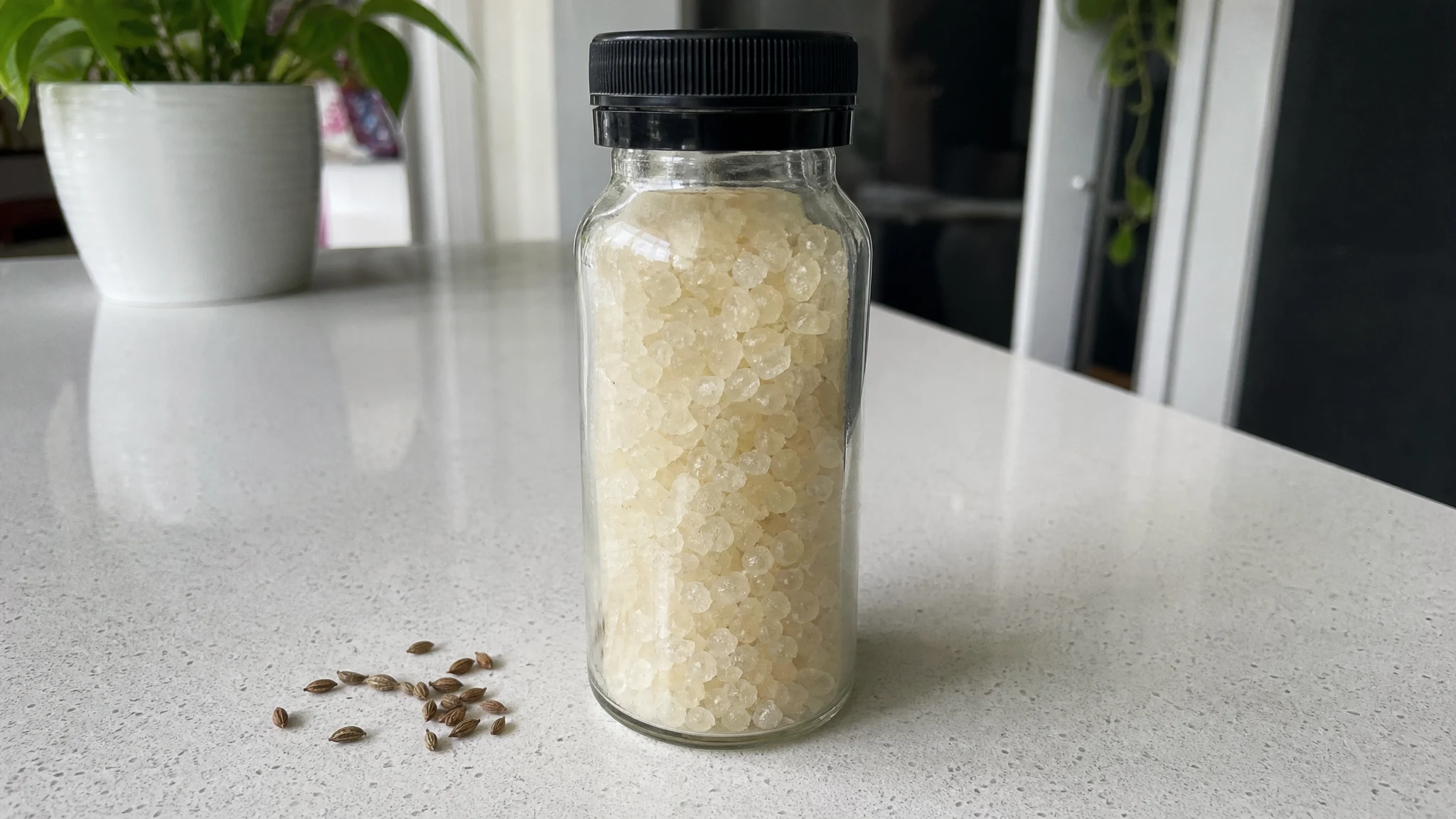
You reach for the anise oil on a chilly morning and the bottle looks like it is full of tiny white needles, or has set into a solid white block. Take a breath: this is entirely normal, and a few minutes in warm water will bring it back.
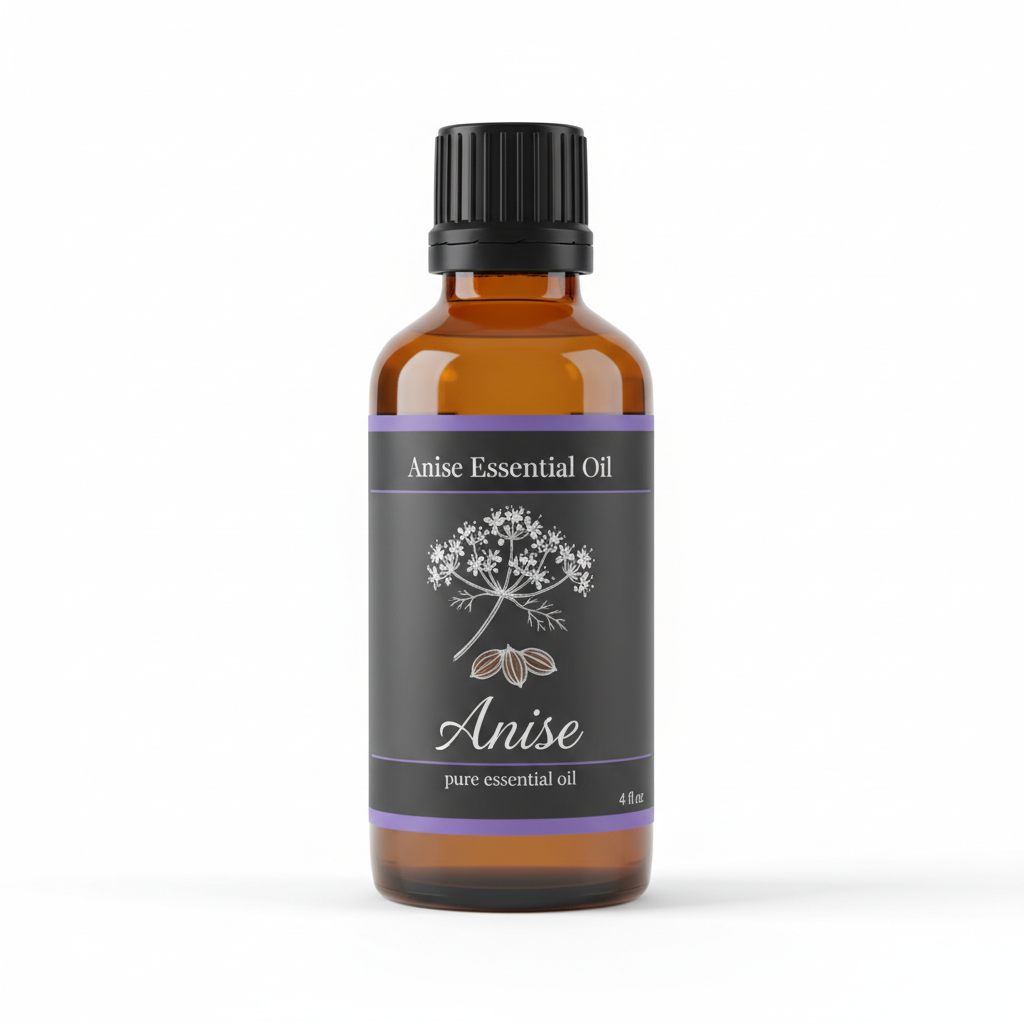
Anise Essential Oil
Our own Anise Essential Oil, in sizes from 0.5 oz to bulk.
From $8.99
Shop Now →What you are seeing
Anise oil is mostly one molecule, trans-anethole. The international standard for aniseed oil gives a range of 87 to 94 percent (ISO 3475:2020), and the GC-MS report we publish for our oil lists 85.79%. With that much of one compound, the oil behaves like the compound itself, and anethole melts at about 21 C (70 F) (PubChem). Below that, it forms crystals. A cool room, a winter windowsill, a garage shelf, a shipping box left on a porch or a refrigerator will all do it.
The change is physical, not chemical. The molecules have not turned into anything new; they have just packed into an orderly lattice, the way water turns to ice. Warm them up and they let go again, with the same aroma as before. It is, if anything, a reminder of how much anethole is in the bottle.
The first time it happens it can be a little startling. You go to the shelf expecting a pale, runny liquid and find a bottle that looks half frozen, with little white needles gathered at the bottom. It is one of the more charming quirks of this oil, and once you have seen it you will know what you are looking at every time.
How to warm it back to clear
- Tighten the cap fully so no water gets in.
- Fill a bowl with warm tap water, comfortably warm to the hand. You only need to get the oil a little above 21 C, so there is no need for hot water.
- Stand the bottle in the water with the oil below the waterline and the cap out of the water.
- Check every few minutes, swirling gently, until the oil is completely clear.
- Dry the bottle before you open it.
Melt all of it, not just most. Leftover crystals act as seeds that help the oil set again quickly. Work with a bulk pail or drum the same way, only slower: move the whole container to a warm room for a day or more before you dispense.
Skip the microwave, the stove, a radiator, a heating pad or a hair dryer, and keep the bottle away from flames. Essential oils are flammable, and warm water is both gentler and entirely sufficient.
Why it is worth melting before you measure
When a bottle is part solid, the crystals are mostly anethole, so the liquid left behind has a different balance from the oil as a whole. Pouring from a half-set bottle gives you a lopsided sample. If you scale a candle, soap or perfume by weight, melt the bottle fully and swirl before measuring, and your scent will come out the same from batch to batch. This is our reasoning from how crystallization works, and it takes about five minutes.
Making it part of your routine
If your workroom runs cool in winter, it helps to plan ahead. Put the bottle in its warm-water bath while you set out your scale, jars and labels, and by the time you are ready to measure it will be clear. Keep a small towel nearby for drying the bottle, and a pencil and paper to jot down the amount you used. If you often work in a cold space, you might decant a small working amount into a little bottle and keeping the main bottle somewhere steadier.
Does it affect the oil?
Crystallizing and thawing does no harm. What does age an oil is oxygen, heat and light, which is why we recommend keeping the cap tight and the bottle in a cool, dark place. Our post on shelf life covers the signs. Cool storage will make crystals more likely, and we think that is a fair trade for slower aging; you simply warm the bottle when you are ready to use it.
If you ship or carry a bottle in winter, a simple trick is to wrap it in a small towel or tuck it inside a bag in your coat. It will stay clear a little longer, and you will have one less thing to fuss with when you arrive.
A quick note on what crystals can and cannot tell you
You may read that setting solid in the cold proves an oil is genuine. It is a nice sign that the oil is rich in anethole, but not proof of anything more. Anethole made in a factory is the same molecule and sets at the same temperature. In a 2024 study of 30 commercial fennel, star anise and anise oils, researchers flagged 8 as adulterated using GC-MS and carbon isotope analysis (Murphy et al., Plants, 2024). For real reassurance, look at paperwork: the Certificate of Analysis we publish for one batch, the GC-MS report, and the lot-specific figures we are happy to send when you ask in writing through our contact page.
So next time you find a bottle full of crystals, there is nothing to worry about. Run a warm bath, wait a few minutes and enjoy the scent coming back to life.
Anise Essential Oil
Anise Essential Oil from our own shop, in sizes from 0.5 oz to bulk.
From $8.99
Shop Now →