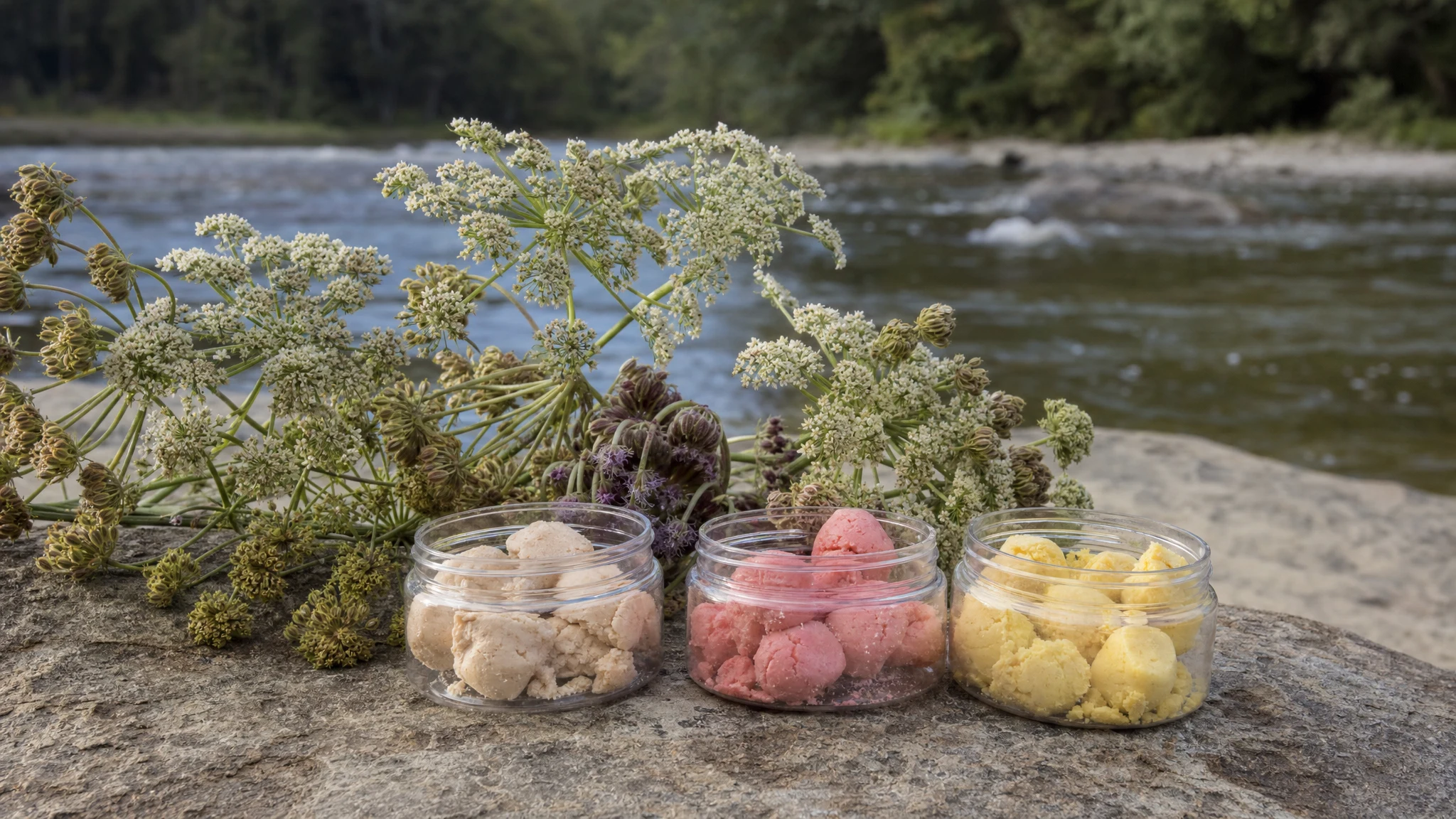
Anise vs Garlic vs Krill: Choosing a Fish Attractant Scent
On evidence, natural amino acid and nucleotide sources such as krill and fresh fish solubles beat both anise and garlic, and neither anise nor garlic has an angling trial we could find. Anise's real advantage is practical: a cheap, strongly aromatic, oil-based accent that clings to bait at tiny doses. Choose by species, water and rules, not by tradition.
Anise Essential Oil
Our own Anise Essential Oil, in sizes from 0.5 oz to bulk.
From $7.99
Shop Now →Here is the comparison in one place, with the research kept apart from the folklore. Details and sources follow the table.
| Situation | Scent | Research or folklore? | Trade-offs |
|---|---|---|---|
| Most freshwater fish, bait or dough | Krill (meal, extract, fresh) | Research on mechanism: soluble amino acids and nucleotides are core feeding stimulants. Krill meal raised shrimp feed intake at 5% inclusion but lowered it at 1% and 3% in one trial. No angling trial found. | Persistence is probably short because the active parts dissolve and leach (reasoned). Messy, can spoil, handled like raw food. Dosed at percent levels in the shrimp trial, not drops. |
| Largemouth bass (feed studies) | Garlic (allicin) | Allicin as a feed additive was more attractive than control in a bass study, peaking at 0.2%. Aquaculture feed, not lures. For anglers, folklore. | Strong smell on hands and tackle, which anglers may or may not want. Dose curve bends down. |
| Catfish, dough and cut bait | Anise | Folklore. No catfish or other fish study of anethole found. Catfish chemistry points to amino acids. | Oil clings to bait and tackle, tiny dose, easy to smell for the angler. Not water-soluble in any large amount, so its reach underwater is unproven. |
| Carp, boilies and method mix | Anise, garlic or other oils | Expert opinion only: use the lowest level of essential oil; garlic and black pepper oils often overdosed. Field data show flavors rise and fall within a season. | Overdosing may repel and shorten bait life. Dose matters more than which oil. |
| Trout, especially stocked | Any scent | No scent trial found. Trout detect amino acids, but vision alone can release feeding. | Many waters classify scented lures as bait or ban bait outright. Regulation is the main constraint. |
| Anywhere, as a cover for handling odors | Anise or garlic | Folklore. We found no measurement of whether strong scents mask human odors for fish. | Low cost, but unproven. Wash hands and keep sunscreen and fuel off bait instead. |
What the research can actually support
Fish find food through smell and taste, and the compounds that work are specific. John Caprio of Louisiana State University lists the main feeding stimuli as amino acids, small peptides, amines, nucleotides and quaternary ammonium bases. All are small and water-soluble. He also makes two points that cut against much tackle-shop marketing: for aquatic animals volatility is irrelevant, and a bait that smells strong to a person may be ineffective unless it releases water-soluble components (Caprio, 2001).
The University of Florida's extension review agrees on the compounds: amino acids are highly efficient stimulants across freshwater and marine fish, nucleotides are powerful, and in one largemouth bass study nucleotides outperformed amino acids and betaine. It also stresses that attractants can be species-specific (Roda et al., UF/IFAS). The practical reading: attractants that dissolve into the water as food-like chemistry have the strongest basis. That favors krill, fish extract and fresh cut bait over any added aromatic oil.
Krill has more than marketing behind it, though less than you might expect for fish. In a shrimp feed trial reported by researchers with Aker BioMarine, a krill supplier, diets with 1% and 3% krill meal were eaten less than the control and 5% increased intake, and the authors tie improved growth partly to feed attractiveness (Nunes et al., 2017). That is shrimp, farmed, with an industry author. It supports "dose matters and krill can raise intake," not "krill catches more fish on a hook."
Garlic: one compound studied, in a feed trial
Garlic gets credit from angling lore, and we could not find an angling trial of it. The closest we could open is a 2022 largemouth bass study that tested limonene, allicin (the garlic compound) and betaine in feed. Attraction rose, peaked at 0.2% and fell at higher levels, even below the control at the highest dose tested, and allicin was among the additives more attractive than control at 0.2% (Yue et al., 2022). It is a useful hint that garlic's active compound can interest a predatory fish. It is also a different species, delivered in feed, so it cannot say how a garlic-scented lure performs in the field.
The dose shape matters more than the ranking. If more of a good additive can turn into less attraction, then "how much" is as important as "which scent." That is the argument for starting low with any of the three.
Anise: what it has going for it, and what it lacks
For anise we found nothing: no study of anethole on a fish's olfaction or feeding. Anglers have used it for generations, and our fishing overview says so while making clear the support is anecdotal. We would put its case this way.
- It is not a food signal. Anethole is a plant aromatic, not an amino acid or nucleotide, so there is no mechanism in the catfish, carp or trout literature that predicts attraction.
- It is slightly water-soluble. PubChem lists 0.111 g per liter at 25 C (PubChem), so some will reach the water, but Caprio's primer describes oils as poor feeding activators.
- It is practical. The oil clings to plastics, dough and tackle, and doses are tiny: at 0.05% of bait weight a single ounce covers more than 120 one-pound batches, if you assume about 20 drops per mL and 1 mL near 1 g. Krill is dosed by the percent; this is dosed by the drop.
- The angler can tell it is there. The scent is strong to people, so you can verify it is on the bait, which you cannot do with a faint amino acid solution.
So the fair position is that anise is a low-cost, low-dose accent with no proof of benefit, not a competitor to the natural attractants on evidence. It may make most sense where it adds to a bait that already carries the soluble signal: a cut bait, a fish-protein dough, a boilie. Our articles on catfish bait recipes and carp bait dosing give weight-based starting points and say plainly they are untested.
Persistence, handling and cost, side by side
These are reasoned from chemistry and handling, not from fish trials, so weigh them accordingly.
- Persistence. Water-soluble stimulants such as amino acids from krill or cut bait leach out of a bait into the water, which is the point, but also means the signal fades. An oil clings, so it may last on the bait longer, though how much of it fish actually detect is unknown.
- Handling. Fresh krill, fish and liver spoil and need cold storage and clean-up; the CDC has documented Campylobacter outbreaks from undercooked chicken livers, a reminder that animal-based bait is raw food (CDC MMWR). Essential oil keeps well in a closed bottle but needs care around skin, eyes and pets; see our anise oil safety guide.
- Cost. We do not quote prices here. The useful comparison is dose: anise in the tenths of a percent, krill in single-digit percent of the bait by weight in the shrimp trial above.
Regulations do not distinguish between the three
A rule does not care which scent you use. North Carolina's 2026-27 regulations digest defines an artificial lure as one with no substance added to it or applied to it that attracts fish by taste or smell, and counts prepared substances designed to attract fish by taste or smell as natural bait (NCWRC digest, p. 35). South Carolina's code says lures or fish eggs enhanced with scents or salts are not artificial lures (S.C. Code, Title 50, Chapter 13). Anise, garlic and krill all fall under those words.
Minnesota draws a different line: its DNR says scent is acceptable when applied to a lure or used in scented bait, but a loose attractant released in the water is chumming or littering and not an authorized method (Minnesota DNR). The takeaway is the same for all three scents: check the current digest and the special rules for your exact water before you bring any attractant. Our trout article tabulates more states.
How to choose
- Catfish: start with a fresh, amino-acid-rich bait. Add anise or garlic only as a minor extra and keep it low.
- Carp: choose a base you trust, use the lowest level of any oil, and remember flavors that work in one month may not in the next.
- Trout: check your water's rules first. If scent is banned, the choice is made for you.
- Anywhere: change one variable at a time and fish a matched, unscented control.
If you want to run the anise side of that test, our Anise Essential Oil is sold in sizes from 0.5 oz. If you want the strongest evidence for an attractant, buy fresh bait or a krill-based product instead. Before bringing any scent to a stream, check the rules for your water.
Anise Essential Oil
Anise Essential Oil from our own shop, in sizes from 0.5 oz to bulk.
From $7.99
Shop Now →Sources & Further Reading
- Caprio J. Chemoreception in the aquatic environment: a primer. Global Aquaculture Advocate, 2001
- Roda T.N., Farzad R., Allen M.S. A review of feed attractants as a guide for aquaculture operations. UF/IFAS Extension FS462
- Nunes A.J.P. et al. Krill meal in shrimp feed experiments. Global Aquaculture Advocate, 2017
- Yue Y. et al. Effects of three feed attractants on the growth performance and meat quality of the largemouth bass. Frontiers in Marine Science, 2022
- PubChem: anethole
- Baker J. Flavours: Myth or Magic? CARPology, 2022
- Kasumyan A.O. et al. Evaluation of the effectiveness of food chemical attractants for wild common carp. Journal of Ichthyology, 2024
- Valentinčič T., Caprio J. Visual and chemical release of feeding behavior in adult rainbow trout. Chemical Senses, 1997
- CDC. Multistate outbreak of Campylobacter jejuni infections associated with undercooked chicken livers, 2012
- North Carolina Wildlife Resources Commission. 2026-27 Inland Fishing, Hunting and Trapping regulations digest
- South Carolina Code of Laws, Title 50, Chapter 13
- Minnesota DNR. BaitCloud cannot be used in Minnesota