Anise Lip Balm Recipe: Beeswax, Carrier Oils and Safe Dilution
Our anise essential oil is not suited to lip balm at any rate a home scale can measure. Using the methyl chavicol figure on our published GC-MS report and IFRA's lip-product limit for estragole, the ceiling is about 0.0076 percent oil, a fraction of a drop per tube. Below: a sourced base balm and the math.
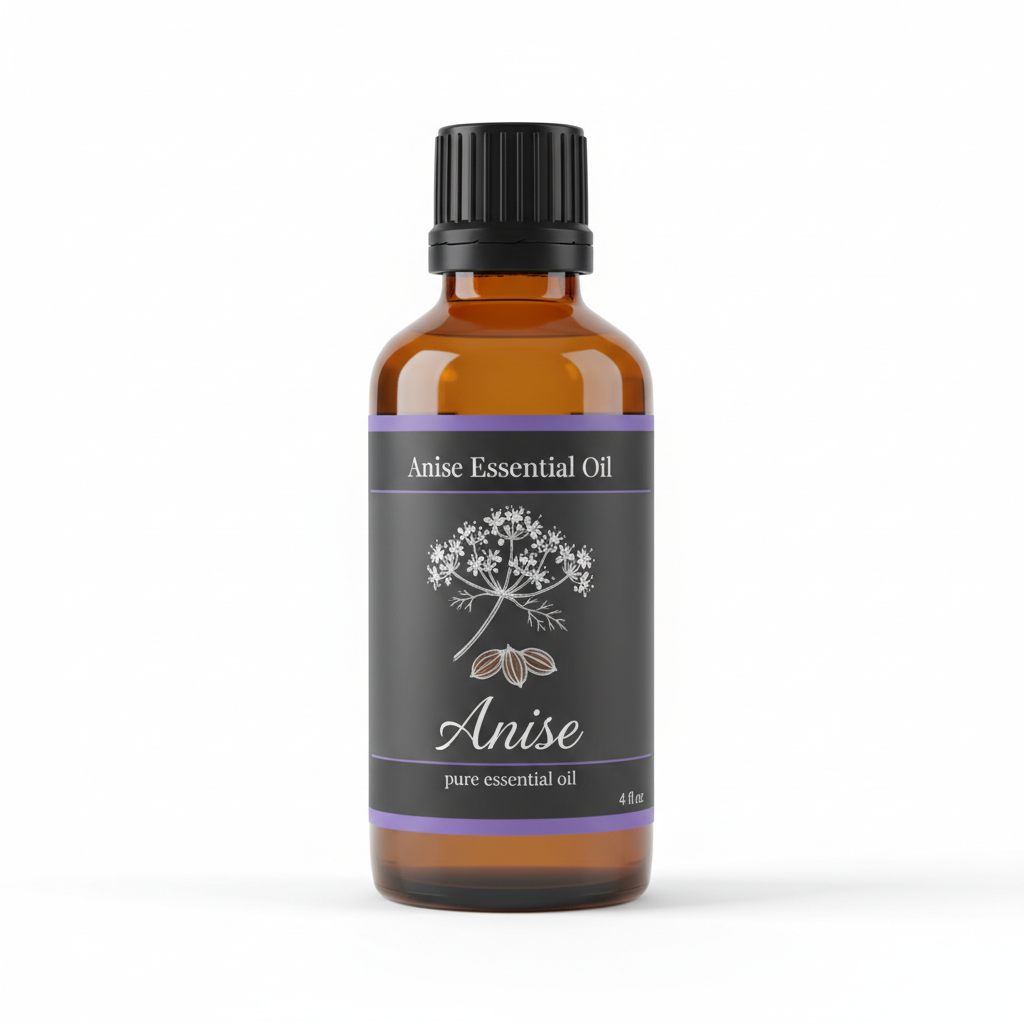
Anise Essential Oil
Our own Anise Essential Oil, in sizes from 0.5 oz to bulk.
From $7.99
Shop Now →A lot of "anise lip balm" and "licorice lip balm DIY" pages hand you a drop count and move on. That skips the one question that matters for anything that goes on the mouth: lip products get swallowed in small amounts, and anise oil carries a constituent that safety standards limit very tightly. If you are new to this oil, our anise oil safety basics covers skin dilution and patch testing, and can you eat anise essential oil explains why we do not sell this oil as a food or lip product.
Why lip balm is a different problem from body balm
The skin-dilution range on our safety page, 0.5 to 1 percent, was written for skin. It is not a lip-product range, and the two should not be swapped. The International Fragrance Association (IFRA) sorts finished products into categories by how they contact the body. Category 1 is "Products applied to the lips," and the supplier certificate that reproduces IFRA's category annex lists "Lip Products of all types (solid and liquid lipsticks, balms, clear or colored, etc.)" there, alongside children's toys. IFRA's estragole standard explains the extra layer: because small amounts of fragrance ingredients may be ingested from products in Categories 1 and 6, materials must also be recognized as safe flavoring ingredients under the IOFI Code of Practice.
Two points follow. First, "essential oil" and "lip-safe" are not the same claim. Second, a hobbyist is not audited by IFRA, but its numbers are the best published yardstick for what a fragrance ingredient should add up to in a finished product, and we would rather measure against it than guess.
The numbers: what IFRA's estragole limit does to an anise oil
IFRA's 51st Amendment (2023) restricts estragole, also called methyl chavicol. Estragole is a minor constituent of anise-type oils (the main one is anethole; see the chemistry of anise oil). The standard sets a maximum in the finished product of 0.00031 percent for Category 1. Our published GC-MS report lists methyl chavicol at 4.08 percent for the reported lot. If you divide the limit by that fraction, the most oil a lip product could hold before its estragole alone reached the limit is:
0.00031 percent divided by 0.0408 = 0.0076 percent anise oil
| Finished product | IFRA category | Estragole limit (finished product) | Maximum anise oil at 4.08% estragole |
|---|---|---|---|
| Lip balm | 1 | 0.00031% | 0.0076% |
| Solid perfume | 4 | 0.014% | 0.34% |
| Body lotion, leave-on | 5A | 0.0022% | 0.054% |
In practical terms, a 5 g lip balm tube at 0.0076 percent holds 0.38 mg of oil. A kitchen scale that reads to 0.01 g cannot see 0.38 mg, and a drop of essential oil is a far larger amount than that. A full 1 kg batch would take about 76 mg. The 0.5 to 1 percent skin range would put 66 to 132 times the estragole limit into the same tube (0.5 percent oil carries 0.0204 percent estragole, which is 66 times 0.00031).
How firm is that number?
Not as firm as it looks, in both directions, so read it as an order of magnitude and not as a dosing instruction.
- Our GC-MS report is labelled qualitative and gives area percent, which is not the same as weight percent. A quantitative estragole assay for your lot is the proper basis for compliance work.
- Estragole varies between lots. The European Medicines Agency's assessment of aniseed oil tabulated 0.5 to 6.1 percent from the literature, and the European Food Safety Authority measured 0.52 to 1.08 percent in five batches of anise oil. At those two measured values the same arithmetic gives a ceiling of 0.0596 to 0.0287 percent, still only 1.4 to 3.0 mg of oil in a 5 g tube.
- IFRA is revising its standards. The 52nd Amendment completed consultation in 2026, with a formal notification expected in January 2027, and the end-of-consultation letter does not mention estragole or anethole. Check the current amendment when you read this.
- We searched the full text of the 51st Amendment compilation and found no separate trans-anethole standard, only the estragole standard. A different regulator or a supplier's own certificate may treat anethole differently, so ask for the certificate that applies to your lot.
EFSA's 2023 opinion on anise oil as an animal feed additive notes that because estragole is at or above 1 percent the oil is classified as suspected of causing genetic defects and cancer. That opinion concerns feed, not lip products, but it shows why regulators watch this one constituent.
Our position: do not make anise lip balm with this oil
We recommend you do not add our anise oil to lip balm, at 0.5 percent, 1 percent or any other rate you can weigh out, and we do not describe this oil as lip-safe or food-safe. If you want a licorice note on the lips, the verifiable route is a flavor sold for lip products whose supplier states Category 1 compliance on an IFRA certificate and which is listed for food use. We have not evaluated any such flavor and name none. If you only want the balm, make the plain base below, which does not need a scent to work.
Where our oil does fit is in products with a higher ceiling, such as the wrist-and-pulse balm in our solid perfume recipe. That recipe uses 10 to 12 drops in about an ounce of balm. Weigh a drop on your own scale and compare it with the 0.34 percent Category 4 figure above before you gift it. The oil is on our shop page for aromatic and cosmetic projects.
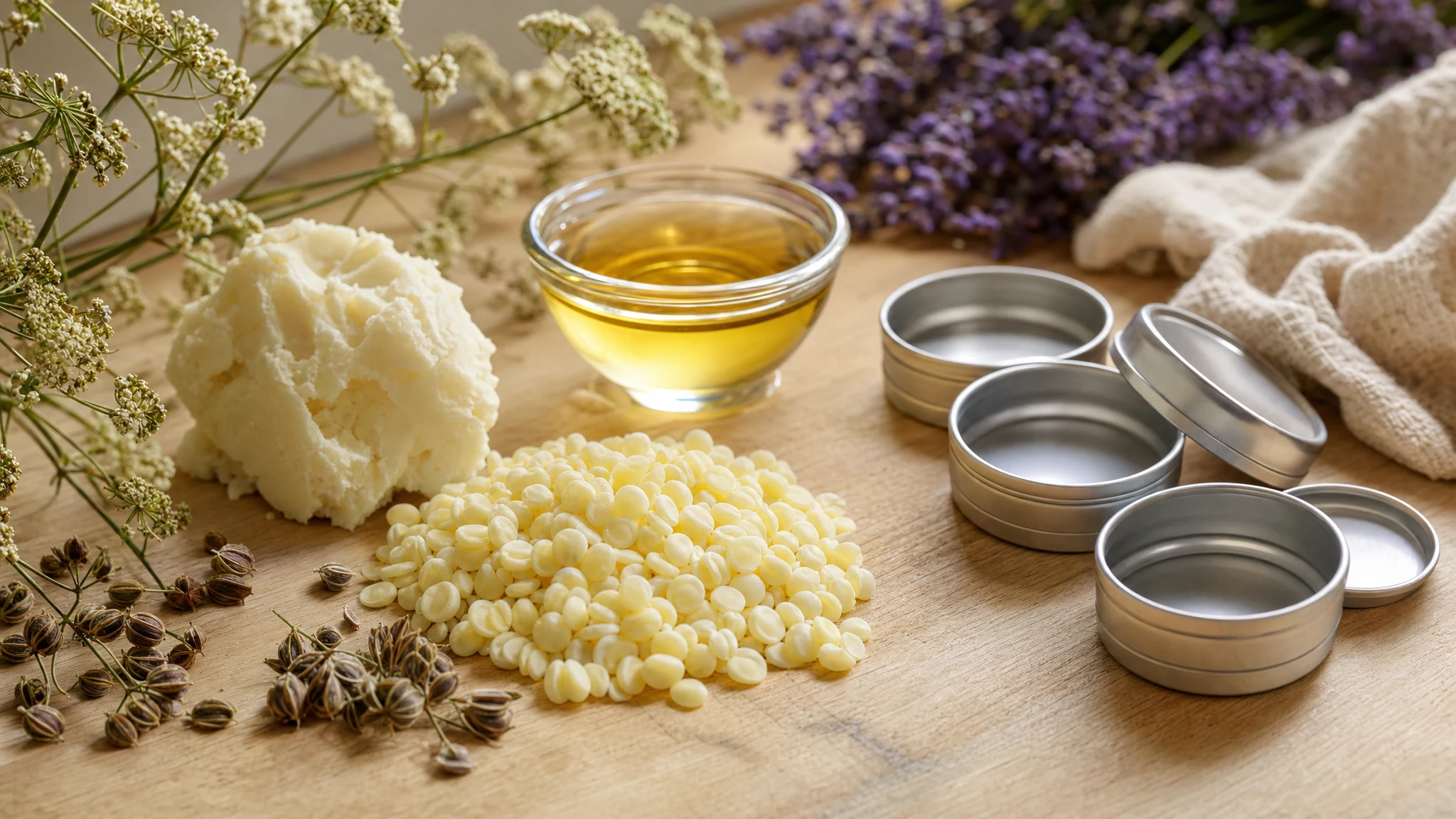
A sourced base balm (percentages by weight)
The only formula we found that is published with weights, percentages and a method is the "Shea Lip Care Balm" sample recipe from MakingCosmetics.com. We reproduce its structure, minus the flavor line. Quantities for a 50 g batch are in the source; percentages scale to any batch.
| Ingredient | Role | Weight % | For 50 g |
|---|---|---|---|
| Jojoba oil | liquid emollient | 35 | 17.5 g |
| Castor oil | liquid emollient | 10 | 5 g |
| Triglyceride (caprylic/capric) | liquid emollient | 23 | 11.5 g |
| Shea butter | butter | 12 | 6 g |
| Beeswax | structure | 17 | 8.5 g |
| Lecithin | emulsifier | 0.5 | 0.25 g |
| Provitamin B5 | additive | 1 | 0.5 g |
| Tocopherol | antioxidant | 0.2 | 0.1 g |
| Allantoin | additive | 0.2 | 0.1 g |
| Phenoxyethanol-based preservative | preservative | 1 | 0.5 g |
| Food flavoring | flavor | 0.3 | 0.15 g |
The ratio that matters is beeswax to butter to liquid oils, 17 to 12 to 68, or roughly 1 to 0.7 to 4 by weight. That is a soft, spreadable balm. In the source, the oil, butter and wax (Phase A) are heated to 154 F (68 C) until melted, the heat is removed, the remaining ingredients are stirred in, and the mixture is poured while still liquid into sticks or jars. The recipe is from a 2012 cosmetic-ingredient supplier sample, so treat it as a starting formula and not a tested product of ours. We have no first-hand batch results to report.
Leave the flavor line empty. The source's 0.3 percent is a food flavoring, not an essential oil, and it is not interchangeable with ours. Whether you keep the preservative is your call: the formula has no water, but the source includes one, and anything you sell or give to others is a question for a cosmetic formulator.
Process steps
- Weigh everything into a heat-safe glass beaker. Use a scale for the beeswax and butter, because volume measures vary with how finely they are packed.
- Melt the oils, butter and wax together in a water bath until no lumps remain. Heat to 154 F (68 C) as in the source, then remove from heat.
- Stir in the remaining ingredients until uniform.
- Pour into tubes or tins while liquid.
- Chill promptly, for example in the refrigerator, so the butter sets quickly (see graininess below).
- Label with the date and the full ingredient list.
Troubleshooting
| Problem | Likely cause | What to do |
|---|---|---|
| Gritty or grainy balm | Shea butter fats crystallize at different temperatures when cooling is slow. | Melt fully, then cool fast in a refrigerator or freezer. Wholesale Supplies Plus says rapid cooling makes the fatty acids set together and avoids clumping. The same source notes shea products may turn grainy if stored at 80 F or warmer. |
| Beads of oil on the surface ("sweating") | Oils separating out of the formula after temperature swings or heat and humidity. The best source we found describes lipstick, not balm, so this is by analogy. | Store cool and steady. If the balm is also soft, a higher beeswax share is the usual lever, reasoning from the wax's structural role. |
| Too soft or too hard | The wax-to-oil ratio. | Make a 10 g test batch and adjust the beeswax share in small steps. |
| Odd smell, fuzz or visible growth | Spoilage or contamination. | Discard. Red Apple Lipstick lists mold, odd smell or fuzz as signs to toss a lip product. |
Who should not use anise-scented products on or near the mouth
- Pregnant or breastfeeding people. The European Medicines Agency's 2008 assessment notes estrogenic activity and antifertility and fetal cell toxicity effects for trans-anethole in rats, and says that as a precaution aniseed oil should not be used during pregnancy and lactation. Ask your OB-GYN or midwife, and see anise oil during pregnancy and breastfeeding.
- Children. The EMA's public summary for anise oil medicines says they must not be used in children and adolescents under 18. Those are oral medicines, not cosmetics, but it is the best published signal for a product that ends up on the mouth. Ask a pediatrician first, and see is anise oil safe around children.
- People with allergies to the carrot family or to anethole. The same EMA summary excludes patients allergic to aniseed, to plants of the Apiaceae family such as caraway, celery, coriander, dill and fennel, or to anethole.
- Sensitive or reactive skin. EFSA describes anise oil as irritant to skin and eyes and as a skin and respiratory sensitizer. Lip skin is thin, which is a reason for caution and not a measured finding.
If a product causes a reaction, stop using it and contact your physician or pharmacist. For a suspected swallowing exposure, call US Poison Control at 1-800-222-1222.
Frequently asked questions
Can I use anise oil in lip balm at 0.1 percent?
By the math above, 0.1 percent is about 13 times our estimated ceiling for the reported lot. We do not recommend it. For the broader question of dilution on skin, see the safety basics page.
Is a "licorice lip balm DIY" possible without anise oil?
Yes. Make the plain base and, if you want flavor, use an ingredient whose supplier documents lip-product use. We cannot vouch for one, so check its certificate against the IFRA Category 1 row.
What if the balm is only for me?
The ceiling does not depend on who makes the balm. It reflects what a person swallows over time from a product used on the lips, so a private batch carries the same exposure as a gifted one.
Should I patch test first?
For any skin product, yes. The FAQ and the safety page explain how. A patch test on forearm skin does not test lip tissue or swallowing, which is why we do not offer a lip-balm rate.
Anise Essential Oil
Anise Essential Oil from our own shop, in sizes from 0.5 oz to bulk.
From $7.99
Shop Now →Sources & Further Reading
- IFRA Standards, 51st Amendment (compiled, January 2024): Estragole standard and Category 1 and 6 flavor requirement
- Supplier IFRA 51 certificate (4 Oct 2024) reproducing IFRA category definitions
- IFRA: End of consultation letter for the 52nd Amendment (31 August 2026)
- MakingCosmetics: Shea Lip Care Balm sample recipe (2012)
- Wholesale Supplies Plus: Tips for dealing with grainy shea butter
- Red Apple Lipstick: Why lipstick sweats and when to toss it
- EMA HMPC assessment report on aniseed (12 June 2008, superseded)
- EMA: Anise oil, summary for the public (EMA/412178/2016)
- EFSA FEEDAP Panel (2023): Safety and efficacy of anise oil as a feed additive
- Our published GC-MS report (qualitative, area percent)