The History of Anise in Medicine and Culture
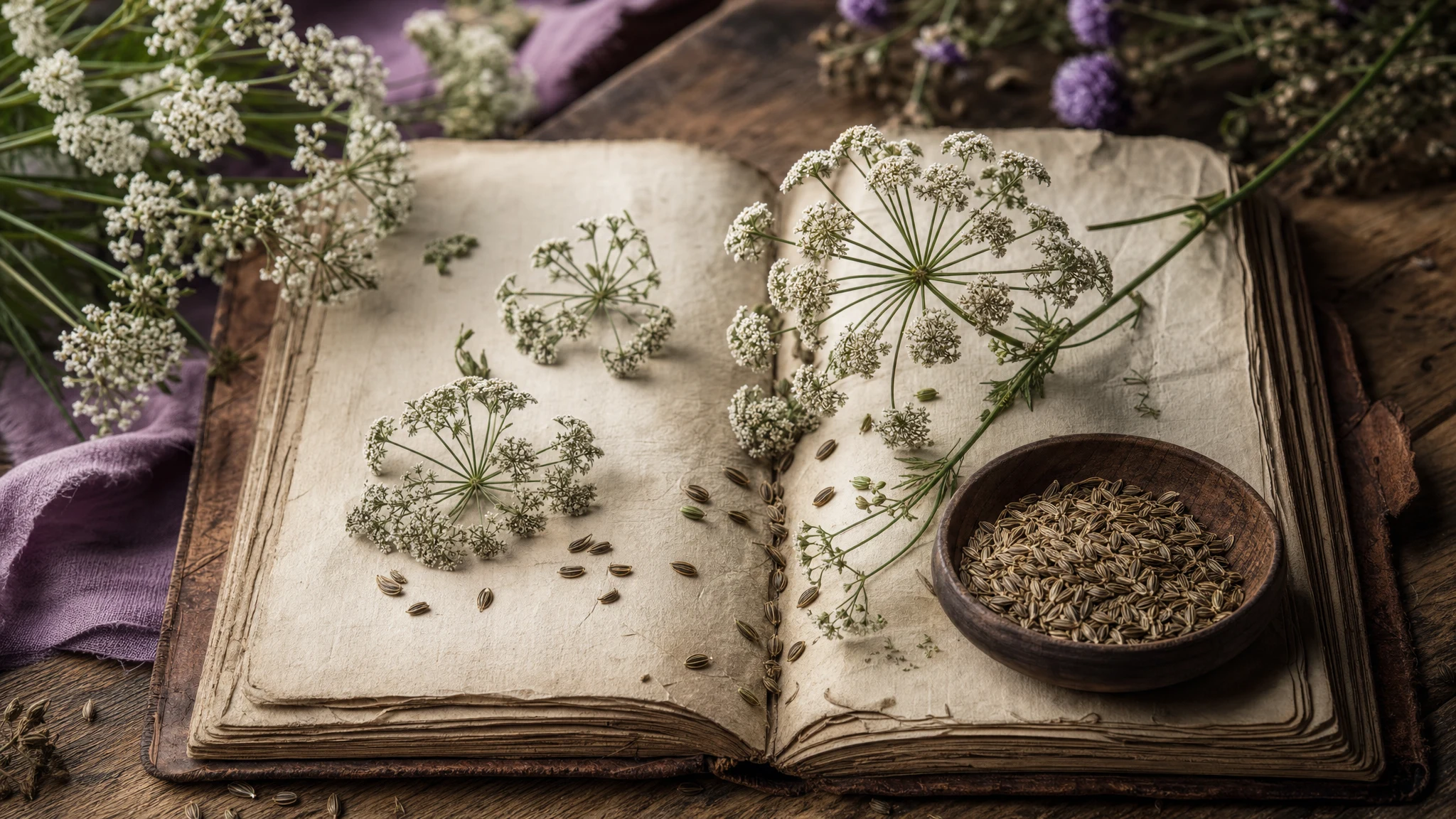
Anise, the seed of Pimpinella anisum, is documented in Roman agriculture and medicine by about 160 BCE and 77 CE, in Charlemagne-era estate lists around 800 CE, and in Spanish, French and American spirits and baking from the 1600s on. Egypt is an older but less certain record. We separate documentation from folklore.
Anise Essential Oil
Our own Anise Essential Oil, in sizes from 0.5 oz to bulk.
From $7.99
Shop Now →Two ground rules. First, this is history only. When Pliny or Dioscorides recorded a medical use, we report that they recorded it. We are not telling you it works, and nothing here is a recommendation to use anise or any oil for a health purpose. Second, we name the shaky stories as shaky. If you want the botany first, start with what anise oil is and Pimpinella anisum: the Mediterranean seed.
Egypt: the claim that is older than the evidence we can check
Popular pages say anise was grown in Egypt around 4,000 years ago and appears in the Ebers Papyrus of about 1550 BCE. We found those statements only on general web pages with no citation trail, so we do not repeat them as fact. The best scholarly source we found is a 2020 conference chapter by Hedvig Győry and Éva Héthelyi, "Anise and Ancient Egyptian Pharmacopoeia," published in Aegyptus et Pannonia VI. Its abstract states that anise has been cultivated since pharaonic Egypt, and it asks two open questions: when did Egyptians start to eat it, and can it be identified with the ancient Egyptian plant name ineset? The authors compare Egyptian written sources with classical medical literature and with modern analyses of anise oil. We read the abstract only, so we cannot tell you how firm their identification is. Treat "anise in pharaonic Egypt" as a serious scholarly question, not a settled fact.
What is firmly documented about Egypt comes later. Both Pliny and Dioscorides, writing in the first century CE, rank Egyptian anise second in quality, after Cretan. That tells us Egyptian anise was an established trade product by Roman times, which is a narrower claim than "pharaohs used it."
Rome: Cato's cakes, Pliny's catalogue and Dioscorides
Cato and the mustaceum, around 160 BCE
The oldest surviving Latin prose work, Cato the Elder's De agri cultura, is dated to about the 160s BCE. Section 121 gives a recipe for mustacei: a measure of fine wheat flour moistened with grape must, with anise (spelled anesum), cumin, two pounds of fat and a pound of cheese, plus bay bark, baked on bay leaves. We read the Latin on The Latin Library. A modern food-history reference describes mustaceum as a dessert served at the end of rich meals. That is the earliest dated recipe we found that puts anise in a baked sweet, and it explains why a modern anise cookie is old in spirit. The step from Cato's farm cake to a modern holiday cookie is our observation, and we have not found a source tracing a direct line. For the cookie traditions that survive, see anise in holiday baking traditions around the world.
Pliny, Natural History Book 20, chapters 72 and 73
Pliny the Elder published the first ten books of the Natural History in 77 CE, and the later books, including the medical plant books, after his death in 79 CE. In the Bostock and Riley translation (1856), Book 20 chapter 72 is devoted to anise and chapter 73 covers where the best anise is found. Our reading of what Pliny records:
- Food and drink. He says anise, green or dried, is esteemed as an ingredient in seasonings and sauces, that it was placed under the bottom crust of bread, and that with bitter almonds in the cloth used to strain wine it gave the wine a pleasant flavor.
- Breath and appearance. He says chewing it in the morning sweetens the breath, and that it gives the face a youthful look.
- The nightmare pillow. He says hung at the pillow it prevents bad dreams. This is folklore as reported, with no mechanism.
- Medical uses. He lists many, from scorpion stings taken in wine to uses for the stomach, cough and sleep, and he credits particular physicians by name, such as Evenor and Iollas. These are reports of ancient practice. They are not evidence that anise works, and we make no claim about them.
- Origin. "The most esteemed anise is that of Crete, and, next to it, that of Egypt."
- Pythagoras. Pliny says anise was among the few plants commended by Pythagoras. That is Pliny's report centuries later, not an independent source.
Pliny also says that, for the various reasons he lists, some people gave the plant the name "anicetum". We cannot evaluate that naming and note only that he reports it.
Dioscorides, De materia medica 3.65, about 50 to 70 CE
Pedanius Dioscorides, a Greek physician serving with the Roman army, wrote De materia medica in five books between about 50 and 70 CE, and it remained a core pharmacology reference in Europe for well over a thousand years. In the Osbaldeston and Wood English version, entry 3.65 describes anise as warming, drying and sweetening to the breath, and, like Pliny, ranks the Cretan seed first and the Egyptian second. He also notes that the Romans call it anisum. The two authors agree on where the best seed came from, which is useful corroboration of a trade ranking and of a Mediterranean source. We were not able to verify Theophrastus on anise, so he is not cited here.
Timeline of dated records
| Date | Record | Type | Confidence |
|---|---|---|---|
| Pharaonic period (undated) | Anise cultivated in Egypt, possible link to ineset | Scholarly question | Open; abstract only |
| c. 160s BCE | Cato, De agri cultura 121: anesum in mustacei | Primary text | High |
| c. 50 to 70 CE | Dioscorides 3.65 describes anise; Cretan best, Egyptian second | Primary text | High |
| 77 to 79 CE | Pliny, Natural History 20.72 and 20.73 | Primary text | High |
| 771 to 800 | Capitulare de villis lists anesum among plants for royal estates | Primary text, modern plant identification | Medium |
| 14th century | Oldest known springerle mold, Zürich; the cookie is called Anisbrötli in Switzerland | Museum object, secondary summary | Medium |
| 16th century | Spanish colonists bring the anise cookie to New Mexico (the biscochito) | State government account | Medium |
| 1630s | Anís production in Rute, Córdoba | Trade article | Medium |
| 1755 | Marie Brizard anisette in France | Secondary summary | Medium |
| 1805 | Maison Pernod Fils at Pontarlier, France | Secondary summary | Medium |
| 1870 or 1880 | Anís del Mono, Badalona (sources differ) | Museum and encyclopedia | Low on exact year |
| 1897 | American edition of Davidis renders Anisplätzchen as "anise wafers" | Cookbook citation | Medium |
| 1912 | United States bans absinthe | Secondary summary | Medium |
| 1989 | New Mexico names the biscochito its state cookie | State government | High |
| 2007 | TTB effectively lifts the absinthe ban, with a thujone limit | Secondary summary | Medium |
The Middle Ages: anise on Charlemagne's list
The Capitulare de villis is a set of regulations for the royal estates of the Frankish kingdom. The general consensus, per Wikipedia's article, dates it between 771 and 800, though the single surviving copy is in a later manuscript at Wolfenbüttel. Its horticultural chapter, number 70, lists dozens of plants to be grown. A modern tabulation of that list, on German Wikipedia, gives entry 19 as anesum and identifies it with Pimpinella anisum. A caution applies: scholars note that some plant names in the list cannot be matched with certainty, so the identification of anesum with anise is a modern reading, though it matches the classical spelling Cato used. What we can responsibly say is that anise was among the plants a Frankish king wanted cultivated on his estates, not what they used it for.
Spirits: from the alembic to the louche
Spanish anís has a documented commercial trail. Foods and Wines from Spain credits Moorish-era alembic distillation for the origins of anís, says production in Rute goes back to the 1630s, and reports that phylloxera in the 19th century devastated vineyards, after which anís filled the gap and became the most popular drink in Spain by the 1950s. In France, Marie Brizard anisette dates from 1755, and Pernod Fils opened a distillery at Pontarlier in 1805. Absinthe, built on wormwood, green anise and fennel, was banned in the United States in 1912; the TTB effectively lifted the ban in 2007, under a rule requiring that finished products be thujone-free, defined as under 10 ppm. These dates come from secondary summaries, and we flag that the French ban is given as 1914 in one place and 1915 in another in the same source.
The scientific side of why these drinks go cloudy is a separate story, told in our guide to the ouzo effect. If you want to know what the myths about licorice and absinthe get wrong, read anise oil myths.
Documented history versus folklore
| Claim you will see online | What the sources support |
|---|---|
| "Anise was prized by pharaohs and in the Ebers Papyrus" | Scholars are examining whether the Egyptian plant ineset is anise. We could not verify the Ebers claim. |
| "Pythagoras recommended anise" | Pliny reports it, centuries later. Not independently confirmed. |
| "Anise under the pillow prevents nightmares" | Pliny reports it. It is folklore. |
| "Pizzelle began as a snake festival cookie" | We found no historical evidence for the link. |
| "Roman cakes were the first anise cookies" | Cato's recipe is real and dated; a direct line to modern cookies is not documented. |
| "Anise is the same as licorice" | False. Different plants; see our myths article. |
Why this matters if you buy anise today
Two practical points come out of the record. First, the historical medical uses named in Pliny and Dioscorides, from the stomach to the cough, are statements about ancient practice, and you should take any modern health question to a physician or pharmacist. Second, anise is a seed with a very long, well-documented kitchen and trade history, so the strong claims you read online about its ancient health uses are the ones to be most skeptical about. Botany matters too: star anise (Illicium verum) is a different plant with a similar-smelling oil, and the two are easy to confuse, as we explain in anise vs star anise. The oil we sell is on the shop page, for aromatic and cosmetic use.
Anise Essential Oil
Anise Essential Oil from our own shop, in sizes from 0.5 oz to bulk.
From $7.99
Shop Now →Sources & Further Reading
- Pliny the Elder, The Natural History, Volume 4, trans. John Bostock and H. T. Riley (1856), Book 20 chapters 72 and 73, Project Gutenberg #61113
- Natural History (Pliny), Wikipedia, for publication dates
- Dioscorides, De materia medica, a new indexed version in modern English by T. A. Osbaldeston and R. P. A. Wood (entry 3.65, Anison)
- De materia medica, Wikipedia, for date and later use
- Cato, De agri cultura, Latin text, section 121 (The Latin Library)
- De agri cultura, Wikipedia, for date
- CooksInfo, Mustacae
- Győry and Héthelyi, Anise and Ancient Egyptian Pharmacopoeia (2020), abstract
- Capitulare de villis, German Wikipedia (plant list, entry 19 anesum)
- Capitulare de villis, English Wikipedia (date range)
- Foods and Wines from Spain, Anís (2023)
- Anisette, Wikipedia
- Absinthe, Wikipedia (Pernod Fils, 1912 US ban, 2007 TTB)
- State Symbols USA, New Mexico biscochito
- Anisplätzchen, German Wikipedia (Davidis, 1897 American edition)
- Springerle, Wikipedia