Why Anise Fades in Perfume: 3 Suspects to Check
You mix a blend, love the licorice sweetness at first sniff, and ten minutes later it seems to have slipped away. The common explanation is that anise is a light, quick top note that evaporates early. The numbers say something more interesting: anise's main molecule is actually one of the slower ones in the room.
Anise Essential Oil
Our own Anise Essential Oil, in sizes from 0.5 oz to bulk.
From $8.99
Shop Now →Anise holds on longer than you would think
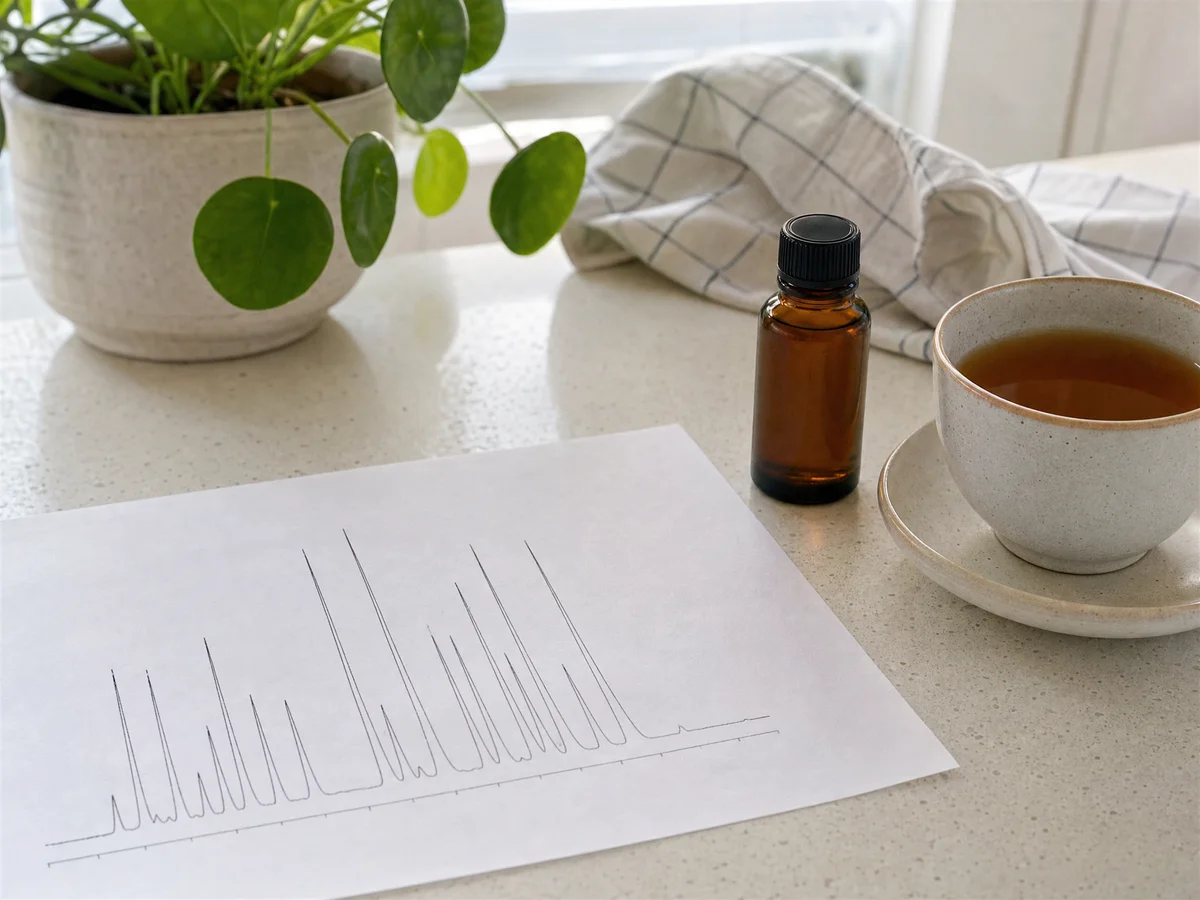
The GC-MS report we publish for our oil lists (E)-anethole as the main component at 85.79%, with linalool and limonene in the low single digits. It has no batch number, so treat the figures as a guide. PubChem's records give boiling points and vapor pressures for each, and the ordering is clear: limonene, the citrus molecule, is the quickest to leave, linalool comes next, and anethole is the slowest of the three. Anethole's vapor pressure is about thirty times below limonene's (anethole, linalool, limonene; the entries were measured under different conditions, so read it as an order, not an exact ratio).
In practice, that suggests an orange or bergamot top will leave the skin before the anise does. So if anise seems to disappear, it is worth looking at three other suspects.
Before you reach for the bottle again, it helps to treat this as detective work and not as a problem. Each suspect below has its own tell, and you can usually rule them out one at a time.
Suspect one: your nose
Noses tire quickly. In one study, 26 volunteers sniffed an anise odorant 20 times, and those who liked it at the start rated it less pleasant as the sniffs piled up (Ferdenzi et al., 2014). If you keep sniffing your own blend to check on it, you may be wearing out your response, not losing the note. Step outside, breathe fresh air, or hand the blotter to a friend who has not been smelling it. If they find anise where you cannot, the oil is still there.
Suspect two: how much anise went in
Anise has a small allowance in fine fragrance, because of a constituent called estragole. Under the IFRA estragole standard for fine fragrance (Category 4, 51st Amendment), the arithmetic with our published report works out to roughly 0.34% anise oil in the finished perfume, about two drops per 30 ml. Anise at that level is a whisper, a sweet thread through the blend and not a headline. That is exactly how perfumers use it. If a recipe borrowed from a candle or room spray, where the limit is looser, feels loud in the bottle and faint on skin, the answer is a better supporting cast, not more anise. Our post on anise pairings in perfume shows partners that make a small amount go further.
Suspect three: the rest of the blend moved on
As the quick citrus top leaves, what remains is a different blend from the one you started with. Anise can feel stronger or weaker against a heavy base than it did at minute one. That is simply how a perfume develops, and it is why we suggest judging a blend across hours, not minutes.
It is a funny feeling to build a blend you love and then lose it, and most of us react by adding more. Resist that urge for a day. A blend often looks very different when you come back to it with a rested nose and a clear head, and the answer is usually quieter than you expect.
A blotter routine that sorts it out
- Dip three paper blotters in the blend. Smell one at 10 minutes, one at an hour and one at four hours, each only once.
- Have a friend, in a different room, rate a second set for anise, without telling them what you expect.
- Compare notes. Anise present on the four-hour blotter but missing on your skin points to skin chemistry or the carrier. Present for your friend but not for you points to nose fatigue. Gone from the blotters too points to the dose or to the balance of the blend.
Blotters do not behave exactly like skin, so take the comparison as a strong clue and not a verdict.
Keep the notes simple. A small notebook with the date, the drops of each oil and a sentence about how it smelled at the start and at the end is all you need. After a few experiments, patterns appear, and you will start to hear what your blend is telling you.
Fixing it without overshooting
If nose fatigue is the cause, rest your nose for a day and smell the blend fresh. If dose is the cause, leave the anise where it is and build around it with partners we like: sweet orange, clove bud, cinnamon leaf, cardamom and ginger. If the blend's balance is the cause, nudge the base up a little so it carries the sweetness longer. Keep a note of each change, and alter one thing at a time. Anise oil can set solid in a cool room, so warm the closed bottle until clear before you measure; this guide shows how.
Ready to experiment? A note through our contact page is the way to ask about your lot.
Anise Essential Oil
Anise Essential Oil from our own shop, in sizes from 0.5 oz to bulk.
From $8.99
Shop Now →