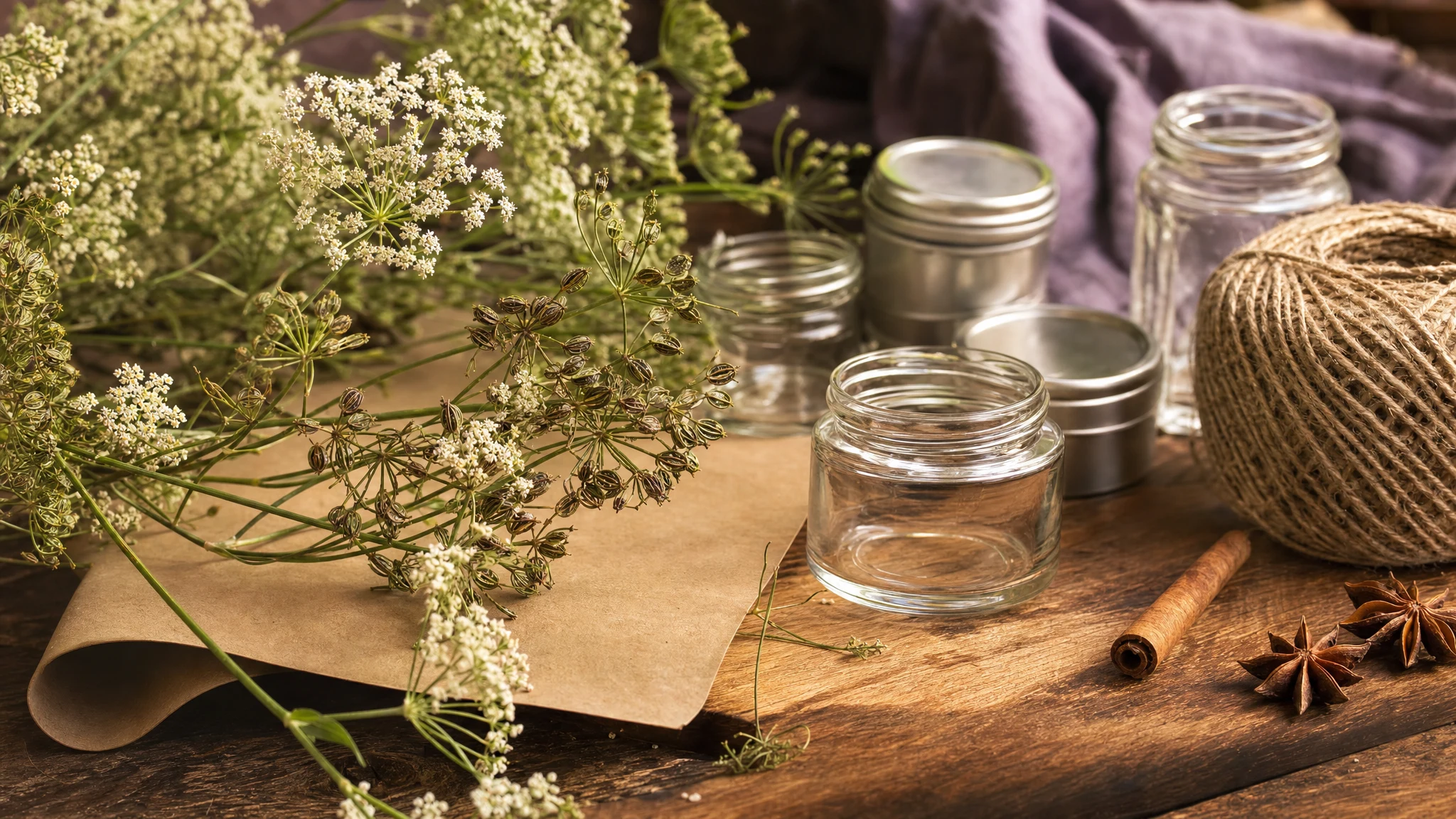
Holiday DIY Gifts Made With Anise Oil
Five gifts work with anise oil: a container candle, a solid perfume, cold process soap, a room and linen spray, and the oil itself for a maker friend. The catch is dose. Estragole limits cap our oil far lower in soap and sprays than in candles, and soap needs about six weeks to cure, so start there.
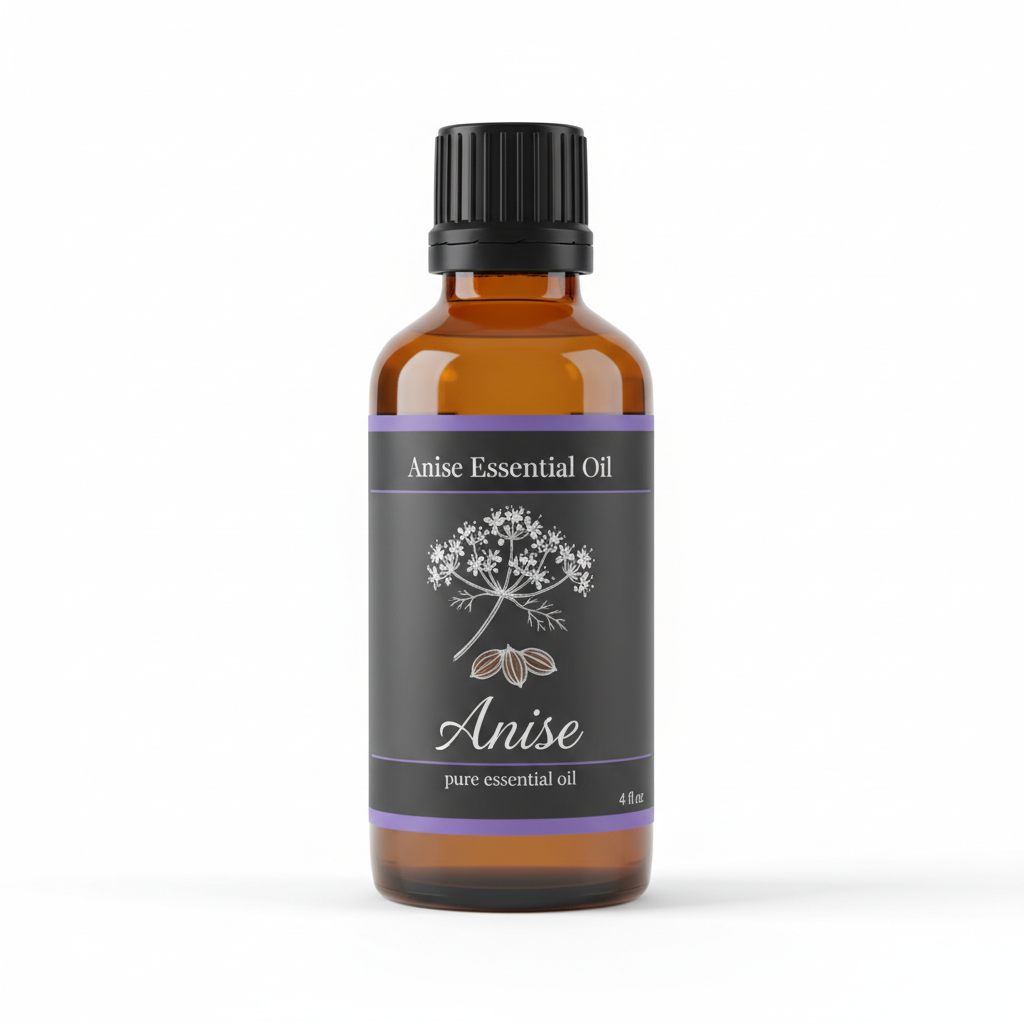
Anise Essential Oil
Our own Anise Essential Oil, in sizes from 0.5 oz to bulk.
From $7.99
Shop Now →Gift guides for essential oils usually stop at "add 10 drops." A gift leaves your kitchen, goes into a household you do not control, and may be used by someone who is pregnant, allergic, or owns a cat. This page plans each project backward from the date you want to hand it over, then sets a dose ceiling and a label. It leans on our existing recipes, so read anise oil safety basics first, and see our holiday diffuser blends guide if you are scenting your own home instead.
First, the dose ceiling that applies to every gift
The International Fragrance Association (IFRA) caps estragole, also called methyl chavicol, in its 51st Amendment (2023) by product category. Our published GC-MS report lists methyl chavicol at 4.08 percent for the reported lot. Dividing each limit by that fraction gives the most anise oil a finished product could hold before its estragole alone reached the limit. A supplier's IFRA certificate reproducing the category annex supplies the product-to-category mapping.
| Gift | IFRA category | Estragole limit | Maximum anise oil at 4.08% estragole |
|---|---|---|---|
| Container candle | 12 (candles of all types) | 0.11% | 2.7% |
| Solid perfume | 4 (fine fragrance, solid perfume) | 0.014% | 0.34% |
| Bar soap | 9 | 0.0041% | 0.10% |
| Room spray (manual) | 10B | 0.0022% | 0.054% |
| Linen or fabric spray | 10A | 0.00094% | 0.023% |
Read these as an order of magnitude. Our report is qualitative and gives area percent, not weight percent, and estragole differs by lot: the European Medicines Agency's 2008 assessment lists 0.5 to 6.1 percent for aniseed oil. IFRA's 52nd Amendment finished consultation in 2026, with the formal notification expected in January 2027, and may change limits. The existing candle, solid perfume and soap guides on this site were written for scent performance, and their rates (an 8 percent candle starting load, 10 to 12 drops of oil in about an ounce of perfume balm, and 3 to 7 percent in soap) sit above these ceilings. For gifts, use the lower number. Where the ceiling leaves too little scent, choose a different fragrance instead of exceeding it.
Project 1: Container candle (about 2 weeks ahead)
Follow the wax, wick and pour steps in how to scent container candles with anise oil, but cap the fragrance load at about 2.5 percent by weight instead of its 8 percent starting point. For a 250 g candle that is about 6 g of oil. That article says to let a finished candle rest at least 48 hours before the first burn and up to two weeks for the fullest scent throw, so pour at least two weeks before the gift date. Add a wick-trim and burn-time note to the label, and warn that a burning candle is a flame hazard around curtains and pets. The 2.5 percent figure is our reasoning from IFRA's limit; we have no burn-test results to report.
Project 2: Solid perfume (a week ahead)
The beeswax and jojoba solid perfume sets in 1 to 2 hours, so it is the last-minute gift. The ceiling is 0.34 percent of the balm. For a 28 g tin that is about 0.1 g of oil, which needs a scale that reads to 0.001 g, so weigh your own drops and check them against that number. Because the balm is used on skin, it is subject to the usual dilution advice, and a patch test should come before gifting. It is not for the mouth; see our lip balm page for why we do not recommend anise in lip products.
Project 3: Cold process soap (start six weeks ahead)
Cold process soap is the longest lead time. Making Soap Naturally states that most cold process soap should cure for 4 to 6 weeks while water evaporates and the bar hardens, with longer times for some recipes: 8 to 12 weeks for high-olive-oil, rice bran or avocado recipes, and 6 to 12 months for 100 percent olive oil castile. Our soap scent-fade guide uses the same four to six week window. Add a day or two to cut and wrap.
The honest limit is scent. At 0.10 percent oil, a bar will smell far fainter than the 3 to 7 percent loads discussed in the soap guide. Soap-making also involves lye, so follow a tested recipe and your lye supplier's safety instructions. If a faint anise note is not worth the six weeks, make soap with a different scent and gift the anise in a candle.
Project 4: Room and linen spray (a few days ahead)
Our DIY anise room and linen spray recipe sets the dose at about 0.02 percent oil with polysorbate 20, distilled water and a preservative. Because a water-based spray can grow mold, make it close to the gift date and write the make date on the bottle. Gift it only to households without cats or infants, and tell the person to test a hidden spot of fabric first.
Project 5: A bottle of oil for a maker friend
For someone who already makes candles or soap, the useful gift may be the ingredient. Our smaller sizes, from 0.5 oz up, are on the shop page. Include a printed card with the safety basics, the dose ceilings above, the COA and a note to keep it in a cool, dark place out of reach of children and pets. The bottle size guide helps pick one. Do not give it to anyone who might use it undiluted on skin or swallow it.
Seasonal planning table
This table assumes a gift date of December 20. Shift every row by the same number of days for another date.
| Task | Lead time | Start by (Dec 20 gift) | Why |
|---|---|---|---|
| Order oil and supplies | 1 week before the first pour, plus carrier time | Oct 25 | Allows delivery before the soap pour |
| Pour soap | 6 weeks cure plus 1 to 2 days to cut and wrap | Nov 1 | 4 to 6 weeks cure per Making Soap Naturally |
| Pour candles | 2 weeks | Dec 1 | Up to two weeks for scent throw per our candle guide |
| Make solid perfume | 1 week | Dec 10 | Sets in 1 to 2 hours |
| Mix room spray | 2 to 5 days | Dec 15 | Water-based, so make last and date it |
| Wrap and label | 1 day | Dec 19 | Final check of every label |
Gift safety labeling
Whatever the project, put a label on it. A label is not a legal substitute for a formulator's review, but it is the minimum.
- Ingredients, in full. List the oil by common name and the botanical name that matches your lot's documentation, plus every other ingredient.
- "For external use only. Not for children. Keep away from pets." Add "Do not ingest."
- Allergy line. The European Medicines Agency's summary for anise oil medicines excludes people allergic to aniseed, to Apiaceae plants such as caraway, celery, coriander, dill and fennel, or to anethole. Name anise on the label so a recipient can check.
- Date and your name. A make date matters most for sprays.
- Patch test note for leave-on skin products.
What not to gift
- Anything ingestible from this oil. We do not sell our oil as a food or lip product. See can you eat anise essential oil.
- Lip balm. The IFRA ceiling is about 0.0076 percent, below what a home scale can weigh.
- Anything for a household with cats. Pet Poison Helpline's veterinary handout says cats lack a liver enzyme needed to metabolize essential oils and that higher concentration means greater risk. Candles, sprays and diffusers all put oil into the air or onto surfaces. Texas A&M's veterinary school adds that fine droplets can land on fur and be swallowed when a cat grooms. Dogs and birds also need caution; see the safety page.
- Anything for a home with an infant or toddler. Our safety page does not recommend use around children under 12.
- Anything for someone who is pregnant or breastfeeding. The EMA's 2008 assessment advises avoiding aniseed oil in pregnancy and lactation as a precaution. If you are unsure, ask the recipient and suggest they check with their OB-GYN or midwife.
- Liquid potpourri and simmer pots. Pet Poison Helpline says ingestion of liquid potpourri can cause chemical burns to the lips, tongue, gums and throat, and that cats are particularly sensitive to its corrosive chemicals. IFRA also lists pot-pourri oil under Category 10A, a ceiling of about 0.023 percent for our lot.
- Reed diffusers. IFRA lists reed diffuser oil in Category 10A, so the ceiling is also about 0.023 percent, far below the 20 to 25 percent ratio in our holiday scenting guide. We do not recommend gifting that ratio.
We also left out salt dough ornaments. We found no source on essential oil in baked dough, and the finished object sits within reach of children and pets.
If something goes wrong, call your physician or pharmacist. For a suspected swallowing, call US Poison Control at 1-800-222-1222. For a pet, call your veterinarian, Pet Poison Helpline at (855) 764-7661 or the ASPCA Animal Poison Control Center at (888) 426-4435.
Frequently asked questions
Can I give anise soap if it has not cured?
We recommend against it. Making Soap Naturally gives 4 to 6 weeks as the standard cure and says curing makes the bar harder and milder. A gift is not the place to rush it.
How much oil do I need for all five projects?
Very little by weight, because the ceilings are low. The big cost is packaging, not oil. For a first try, a 0.5 oz bottle is more than the four recipes together use.
Can I give the spray in the mail?
Sprays are water-based and may be exposed to heat in transit. If you ship, keep it small, sealed and dated, and tell the recipient how to test it. We do not give shipping rules.
Where does anise fit best for gifts?
In a candle, which has the highest ceiling by a wide margin: about 2.7 percent against 0.34 percent for solid perfume and 0.10 percent for soap.
Anise Essential Oil
Anise Essential Oil from our own shop, in sizes from 0.5 oz to bulk.
From $7.99
Shop Now →Sources & Further Reading
- IFRA Standards, 51st Amendment (compiled, January 2024): Estragole standard
- Supplier IFRA 51 certificate (4 Oct 2024) with category definitions
- IFRA: End of consultation letter for the 52nd Amendment
- Making Soap Naturally: How long should handmade soap cure?
- Pet Poison Helpline: Essential Oils and Cats
- Pet Poison Helpline: Liquid potpourri is toxic to cats
- Texas A&M Veterinary Medicine: Essential oil diffusers and your cat (2019)
- EMA HMPC assessment report on aniseed (2008, superseded)
- EMA: Anise oil, summary for the public (2016)
- Our published GC-MS report (qualitative, area percent)